

Tesla's stock price fell 3.32% in after-hours trading, following the company's announcement of flat revenue and a significant 43% decline in net profit, while the issue of backlogs in electric vehicle production continues to persist.
Investors are highly cautious about their merger with SpaceX, due to reasons including capital intensity, regulatory barriers, past failure cases of similar mergers and acquisitions, as well as concerns regarding national security.
Nevertheless, analysts still maintain a "buy" rating on TSLA with a target price of $402.
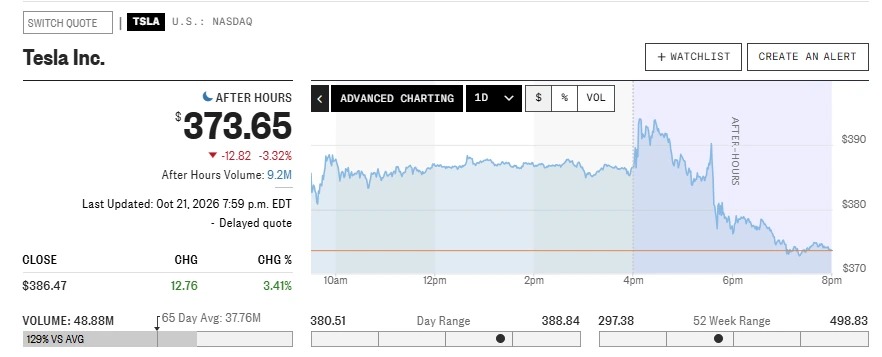
Tesla (Nasdaq ticker: TSLA) fell 3.32% in after-hours trading, closing at $373.65. Previously, the company released a mixed report from its third-quarter 2026 earnings call, and the market is skeptical about its merger negotiations with aerospace company SpaceX.
Tesla's Third Quarter 2026 Financial Report: Financial Data
This electric vehicle manufacturer reported that its revenue remained flat year-on-year at $28.05 billion, which is lower than the Wall Street forecast of $28.3 billion to $28.13 billion.
Due to the loss of a $7,500 federal electric vehicle tax credit, the company's profits were also affected, resulting in a nearly 20% decline in sales year-on-year. Tesla usually sells these carbon credits, and since they don't need that many, the profit margin on these credits can reach at least 100%.
In addition, free cash flow reached $1.53 billion, far exceeding Wall Street's previous forecast of a negative value between $4.5 billion and $4.9 billion. The gross profit margin for automobiles also rebounded to 18.1% from 16.3% in the previous quarter.
Operational and Strategic Highlights
Tesla delivered 486,532 electric vehicles in the third quarter, exceeding Bloomberg's estimate of 463,000, but still showing a 2% decline year-over-year. The reduction in production also means that the company has experienced its highest level of production backlogs in four years, mainly due to limited battery supply.
Full autonomous driving (FSD) subscriptions increased by 20% this quarter, and it covers 75% of new Tesla electric vehicles in North America.
Capital expenditure was reduced to $4.73 billion, lower than the $5.8 billion of the previous quarter. These funds were used for artificial intelligence, robotics, Cybercab driverless taxis, as well as the Terafab chip factory jointly built with SpaceX. The strategy of cutting expenditures is also reflected in the annual capital expenditure guidance, with Tesla lowering its estimate from $25 billion to $20 billion.
Tesla's merger negotiations with SpaceX
On Tuesday, Tesla's CEO Elon Musk confirmed that a special committee is studying a potential merger transaction between Tesla and SpaceX. If it comes to fruition, this would become the largest corporate acquisition in history, but it will require the voting support of 50% of all Tesla shareholders.
Supporters believe that this merger will contribute to the development of artificial intelligence, as both companies can integrate resources for common products.
TSLA Stock Price
Another concern is that Tesla may hold back SpaceX, as the latter has better growth indicators. Critics also argue that this could distract attention away from Tesla, which currently urgently needs to improve its revenue.
More importantly, investors are looking back at history and pointing out that 70% to 75% of large mergers and acquisitions typically erode the combined market value after three years.
In addition, Tesla has extensive collaborations with Chinese manufacturers, which may pose national security issues or regulatory obstacles when merging with this American aerospace company.
Although there is divergence in the performance during financial report conference calls, analysts unanimously maintain a 'buy' rating at present, with an average target price of $402.47, which is 7.70% higher than today's closing price of $386.47.