Key Points
- Ripple Prime participated in the institutional tokenization working group of DTCC.
- BlackRock and JPMorgan Chase participated in completed tests of securities tokenization production environment transactions.
- DTCC has not yet confirmed the connection with XRP Ledger for settlement.
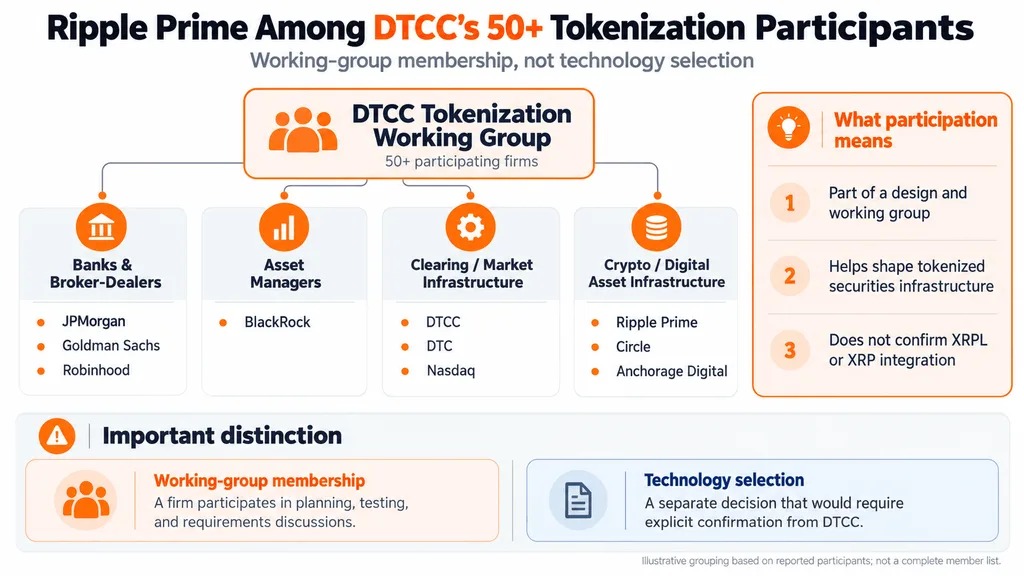
Ripple Prime is one of more than 50 financial companies that have collaborated with the U.S. Depository Trust and Clearing Corporation (DTCC) to build infrastructure for tokenized securities, which puts Ripple's institutional brokerage business on par with that of BlackRock, JPMorgan Chase, and Goldman Sachs.
The aim of this plan is to introduce traditional financial assets into the blockchain network while retaining existing ownership and investor protection mechanisms. However, the participation of Ripple Prime does not imply that DTCC will use XRP or XRP Ledger for settlement.
According to the official announcement of DTCC, the working group disclosed in May that production and trading would be completed in July, with a broader service availability goal set for the fourth quarter.
Ripple Prime Joins Wall Street in Tokenization Infrastructure Construction
Members of the working group for DTCC include banks, asset management companies, custodian institutions, exchanges, and blockchain technology providers. The participants consist of BlackRock, JPMorgan Chase, Goldman Sachs, Circle, Robinhood, and Ripple Prime.
The focus of cooperation among these institutions is on the operational needs of tokenized stocks, exchange-traded funds (ETF), and U.S. Treasury bonds.
The plan is based on the existing clearing relationships established under Ripple Prime; these relationships developed after Ripple acquired the institutional broker Hidden Road for $1.25 billion.
DTCC's subsidiary, Depository Trust Company, provides custody and asset management services for over $114 trillion in securities.
This figure represents the assets held within the existing financial infrastructure, rather than securities that have already been transferred to the blockchain.
A broader tokenization plan aims to enable these traditional assets to be used in the digital market, while not removing the existing legal protections.
DTCC Testing real securities on the blockchain network
On July 15th, DTCC announced that it has successfully completed the production and trading of tokenized U.S. Treasury bonds, stocks, and other financial instruments.
More than 30 institutions participated in these transactions, covering securities lending, collateral transfer, repurchase agreements, and stock settlement.
According to the production and trading announcement of DTCC, these transactions utilized the Besu infrastructure of Canton Network and LFDT.
This creates an important distinction for Ripple investors: participating in institutional-level promotion does not mean that Ripple Prime executed the trades in July, nor does it imply the use of XRP.
DTCC also lists Stellar as a potential public chain connection solution, with tokenized assets expected to be available in the first half of 2027.
Stellar Access Instructions: DTCC adopts a multi-chain strategy, rather than relying on a single blockchain alone.
Marcus Hale
Marcus Hale is an author who focuses on cryptocurrency and financial markets, covering topics such as Bitcoin, Ethereum, digital assets, regulation, ETF, and the adoption by institutions. His work focuses on developments that may drive market changes, investor trends, and the broader forces that shape the crypto economy.