Key Points
- HSBC warns that thin liquidity may limit the expansion of Ripple Prime.
- The newly launched swap products can access over 100 markets.
- Weekend derivatives clearing exposes risks during Wall Street's market closure
Ripple Prime is expanding into 24/7 stock and commodity derivatives trading, and is attracting the attention of HSBC. HSBC warns that limited liquidity may prevent large financial institutions from fully embracing this new service.
This warning appeared after Ripple launched perpetual swaps linked to over 100 traditional markets on October 15th, including stocks, exchange-traded funds, metals, energy, and foreign exchange.
According to a report on October 21st, Daragh Maher, the head of HSBC's digital assets research, described this progress as "evolution, not revolution," and questioned whether there is sufficient trading activity to accommodate large institutional positions.
Ripple Prime Offers 24/7 trading on over 100 markets
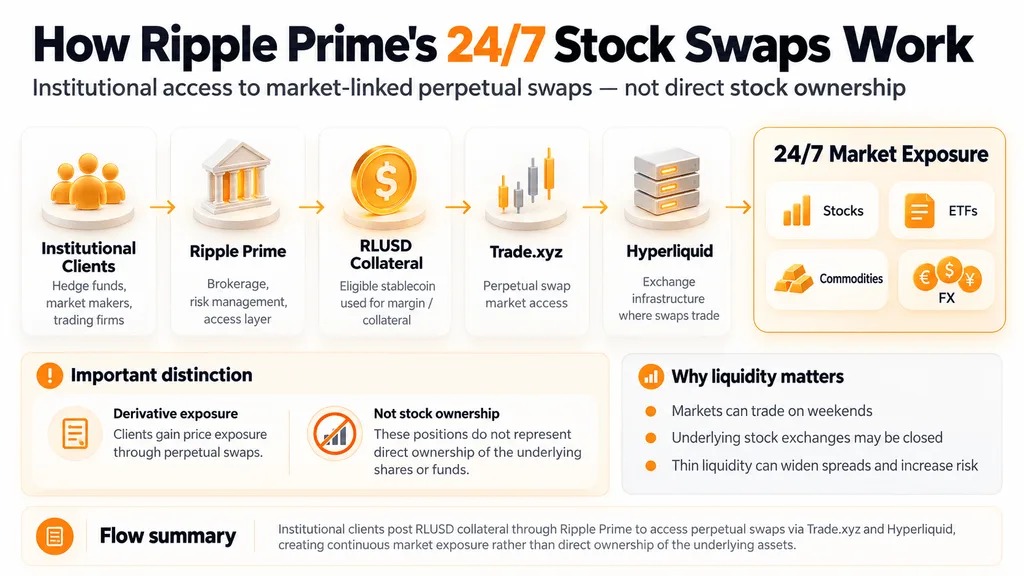
Ripple Prime Institutional clients are allowed to trade swap products of perpetual futures listed on Hyperliquid under Trade.xyz. Hyperliquid is a decentralized derivatives platform.
Unlike traditional stock trading, these contracts can also be traded on weekends and holidays. However, what they provide is an exposure to price changes, rather than direct ownership of the underlying stocks.
Ripple The initial announcement confirmed that trading company Virtu has already been using this service.
This launch is based on the expansion of Ripple Prime to 100 markets. Eligible institutional clients can also use Ripple USD ( RLUSD ) as collateral.
Ripple Prime A broader range of institutional brokerage services cover the clearing, financing, and risk management of traditional and digital assets.
However, providing 24/7 market access and ensuring sufficient liquidity to execute large transactions are not the same thing.
HSBC warns that weak markets may limit institutional trading
Maher believes that the sustainable market for tracking traditional assets is still relatively small in scale compared to the mature exchanges that track those prices.
Hedge funds need sufficient counterparties in order to establish or liquidate positions worth millions of dollars. In the absence of counterparties, large orders can lead to significant price fluctuations, wider bid-ask spreads, and unexpected trading losses.
HSBC expects that early demand will mainly come from market makers, proprietary trading firms, and hedge funds engaged in arbitrage or basis trading, rather than institutions seeking large-scale, long-term hedging strategies.
The risk became apparent on October 17: Approximately $51.6 million in leveraged positions linked to semiconductor stocks and funds were liquidated within ten minutes.
According to market data cited by CoinDesk, approximately $38 million was involved in long positions. Since the U.S. stock market was closed at that time, derivatives traders were unable to obtain the latest prices of the underlying stocks continuously.
This incident demonstrates that extending market opening hours requires not only faster trading infrastructure but also reliable price discovery and risk control.
What does HSBC's warning mean for XRP and RLUSD?
The product of Ripple Prime provides another potential institutional use for RLUSD; customers can utilize it to meet the margin requirements for eligible positions.
This continues the collaboration between Ripple and LMAX, as well as another collaboration with DriveWealth. Both aim to expand the scope of services provided by stablecoins in traditional finance.
However, these perpetual swaps refer to instruments traded through Hyperliquid, rather than securities issued directly on XRP Ledger. Ripple does not designate XRP as a required settlement or collateral asset.
This distinction is also important for the existing institutional liquidity cooperation of Ripple. Since an increase in brokerage business activities does not automatically mean an increase in the purchase volume of XRP.
Marcus Hale
Marcus Hale is a cryptocurrency and financial markets contributor who reports on Bitcoin, Ethereum, digital assets, regulation, ETF, and institutional adoption. His work focuses on developments that drive market changes, investor trends, and the broader forces that shape the crypto economy.