

Advanced Micro Devices ( NASDAQ : AMD ), Archer Aviation ( NYSE : ACHR ) and Joby Aviation ( NYSE : JOBY ) seem to be a group of companies that are not likely to be associated together. After all, one is a semiconductor giant that is driving the artificial intelligence boom, while the other two are striving to bring "flying taxis" into the sky. However, they have one thing in common: all three companies are making significant bets on technologies that could transform their respective industries.
However, the stock market has been much more favorable towards AMD than towards the two flying taxi companies. Although AMD fell by about 14% in October, this chip manufacturer still saw a 148% increase throughout the year. This surge reflects investors' enthusiasm for artificial intelligence. Nevertheless, recent concerns regarding the industry's capital expenditure commitments have put pressure on its stock price.
Meanwhile, this year has been much colder for investors in the flying taxi industry. The stock price of Archer Aviation fell by about 48% in 2026, while its competitor Joby Aviation saw an even steeper decline of around 64%. Both companies are working to commercialize electric aircraft, but such sharp drops also indicate that the market has lost patience with projects that still require a great deal of proofing.
The upward trend of artificial intelligence represented by AMD faces a test of reality.
AMD has performed strongly this year, and investors are betting that it has the capability to challenge NVIDIA in the advanced AI processor market. The demand for data center chips remains at the core of its growth prospects, and its expanding cooperation with large technology companies has also strengthened market expectations for future revenue.
However, in October, investors were reminded that even the biggest winners are not immune to selling off. There are concerns about how tech companies will finance their investments in infrastructure (represented by AI), which has put pressure on semiconductor stocks. The overly high valuations of AMD have also exacerbated this unease, especially as investors await their financial reports on November 3rd.
It is worth noting that AMD is launching the next generation of MI450 AI chips, which is expected to become the core of the company's expansion. This processor is part of the large-scale deployments planned with customers such as OpenAI and Oracle, and shipments are expected to accelerate by 2027. However, AMD has warned that increasing production may lower gross margins, which means that higher sales volumes may not immediately translate into higher profitability.
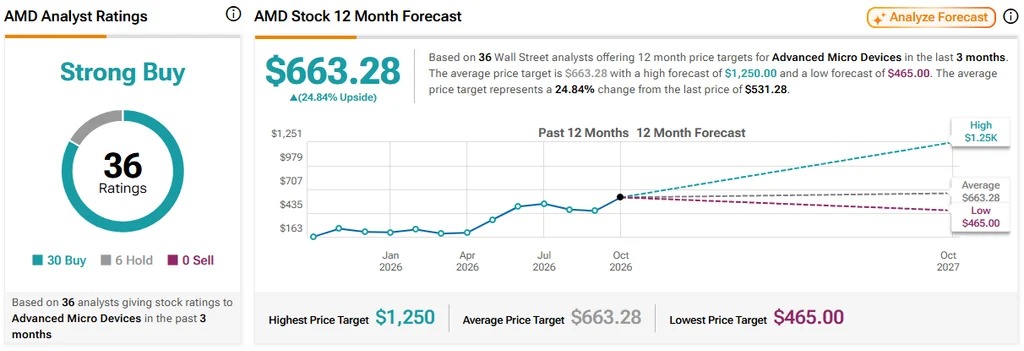
Despite Cathie Wood continuously reducing its holdings in AMD, Wall Street analysts still believe there is room for the stock to rise. With 30 buy ratings and 6 hold ratings, AMD currently has a consensus rating of "strong buy"; its 12-month average target price is $663.28, which represents a potential increase of about 25% from the current level. (See AMD stock price forecast)
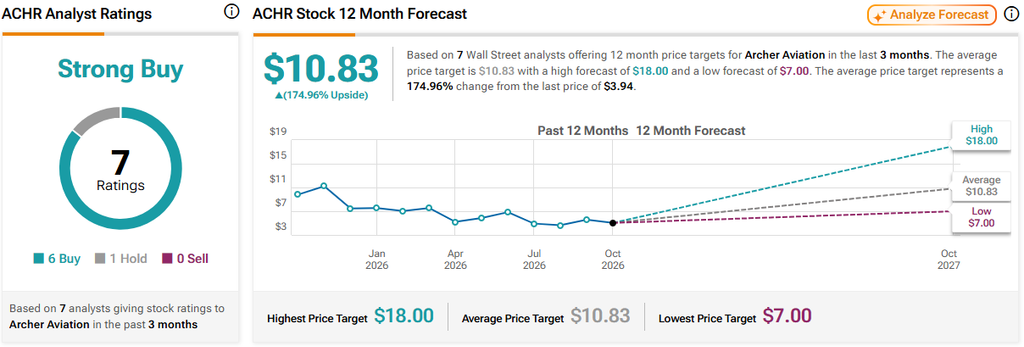
The grand plan of Archer Aviation did not save the stock price.
Despite progress in the development of electric aircraft, Archer has still seen a cumulative decline of 48% this year. Earlier this month, the company completed flights with an air taxi over the San Francisco Bay, demonstrating the capabilities of its Midnight model, while continuing to advance commercial passenger operations.
The company is also expanding into areas beyond passenger transportation through a proposed acquisition involving Boeing's aviation business. In August, Archer announced plans to acquire Wisk Aero, Insitu, and SkyGrid; among them, Insitu is expected to contribute over $200 million in annual revenue. The transaction overcame an important antitrust review hurdle in September and is expected to be completed by the end of the year.
However, investors still have several reasons to remain cautious about the financial prospects of Archer. Both business certification and manufacturing expansion require substantial capital, and Boeing-related transactions have also raised concerns about potential dilution of equity. Legal disputes add another layer of complexity, including a patent infringement counterclaim filed by Vertical Aerospace in October against Archer regarding the Midnight aircraft.
The next financial report under Archer is expected to be released on November 9th, which may provide investors with a clearer view of its commercialization progress. In addition to the latest financial results, investors will also be interested in the certification progress of FAA, the timeline for launching passenger services, and how much cash the company expects to consume when expanding aircraft production.
Joby The road to commercial aviation is still long.
The situation of Joby is equally challenging, yet the company continues to advance towards commercial aircraft certification. In the second quarter, the company reported that it had entered the fifth and final stage of the FAA approval process. Joby also stated that at that time, there were 5 aircraft in operation, with another 12 in production, preparing for increased manufacturing.
However, these advancements have not yet convinced investors that commercial operations will soon generate profits. Joby continues to make substantial expenditures in areas such as certification, aircraft production, and infrastructure, with cash usage in the second quarter amounting to approximately $202 million. Despite holding $2.3 billion in cash and investments as of the end of June, the company's funding needs remain considerable.
Legal issues have also added to the burdens on Joby's already challenging market performance. Earlier in October, the company faced the subsequent impact of a $116.9 million jury award due to a trade secret dispute with its aviation supplier Aerosonic. In addition to concerns regarding financing and commercialization timelines, this setback has also dampened investor sentiment.
Joby is expected to release its third-quarter financial report on November 9th, which will provide investors with another opportunity to assess its path towards commercial operation. In addition to the financial results, investors will also be watching the progress of FAA certification, the advancement of passenger service launches, and the company's cash reserves.
Unlike Archer, Joby has not yet received widespread support from Wall Street analysts. With 2 buy ratings, 3 hold ratings, and 3 sell ratings, the current consensus rating for this stock is 'Hold' (i.e., neutral). However, its average target price of $10.06 indicates that there is still about 115% room for growth in the coming year. (See JOBY stock price forecast)
Disclaimer and Disclosure Report an issue