Anthropic was established in 2021 with the goal of ensuring that humanity can control AI and benefit from it in the long term. However, as this cutting-edge laboratory approaches its initial public offering (IPO), there is one group of people who are excluded from this control: anyone who buys its shares on the public market.
In Silicon Valley, it is not uncommon for founders to control a listed company with a complex structure without holding a majority stake in the company, as seen in cases like Elon Musk or Mark Zuckerberg. However, Anthropic's obsession with AI's security has led to a truly intricate corporate governance structure, which leaves ordinary shareholders with almost no say in major decisions of this AI company, including the allocation of board seats.
Currently, the board of directors of Anthropic is chaired by the company's president, Daniela Amodei. The members include the CEO, Dario Amodei (her brother), co-founder Reed Hastings, former CFOs of Microsoft and General Motors, Christopher Liddell, CEO of Novartis, Vas Narasimhan, and partner Spark Capital Yasmin Razavi. There is currently one vacant position on the board of directors.
Secondly, Anthropic allocated significant control rights of the board of directors to a long-term benefit trust (Long Term Benefit Trust, LTBT). This is an independent group designed to ensure that the company always focuses on its mission of "benefiting humanity." The trust holds a class of shares that grant it the ability to elect and remove the majority of the company's board members, who are referred to as Class T directors. LTBT is led by the global health expert Neil Shah. Shah was formerly the managing director of GiveWell; GiveWell is a non-profit organization that ranks charitable institutions. LTBT also includes former Federal Reserve Chairman Ben Bernanke, national security expert Richard Fontaine, and Harvard physicist Christopher Stubbs. There is currently an empty seat in LTBT, and the existing members will decide who will fill it.
Finally, the board of directors can also serve as a check and balance against LTBT. When LTBT nominates one of its four directors as a "designated" director, or dismisses that director without cause (that is, without accusing them of any misconduct), the board's nomination committee may refuse to approve such a decision and refer the matter to the company's employees for a vote.
It is difficult to predict how such a complex structure will operate. We have seen a famous case where a similar structure was substantially overturned: the so-called “blip” incident. At that time, the board of directors of OpenAI temporarily dismissed the CEO Sam Altman due to concerns that he was not candid enough with the board. However, due to the loyalty of the company's employees to Altman, the board eventually conceded, reinstated him in his position, and established a new governance structure. The structure of Anthropic seems to have formalized this type of employee power.
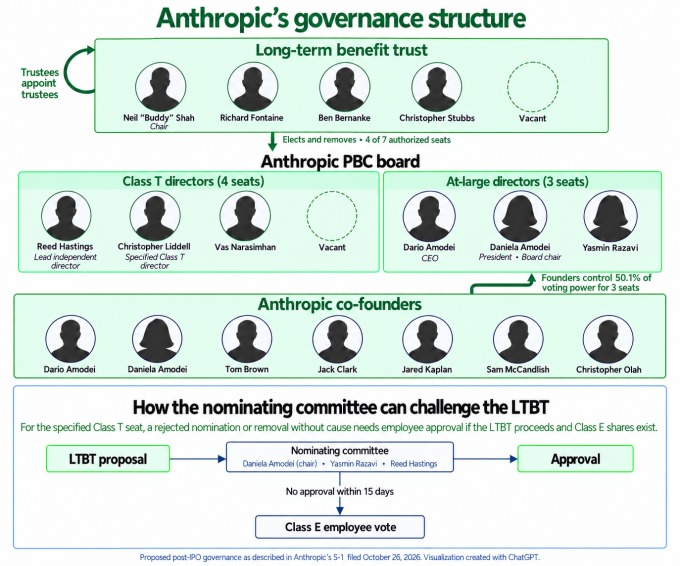
The founder's control will not last forever: After IPO, the founder can choose to end their control over the company; if there are fewer than three founders by that time, their control will also automatically terminate. At that point, LTBT will continue to exist until 85% of the common shareholders vote to terminate it, or it may withdraw on its own with the approval of the board of directors.