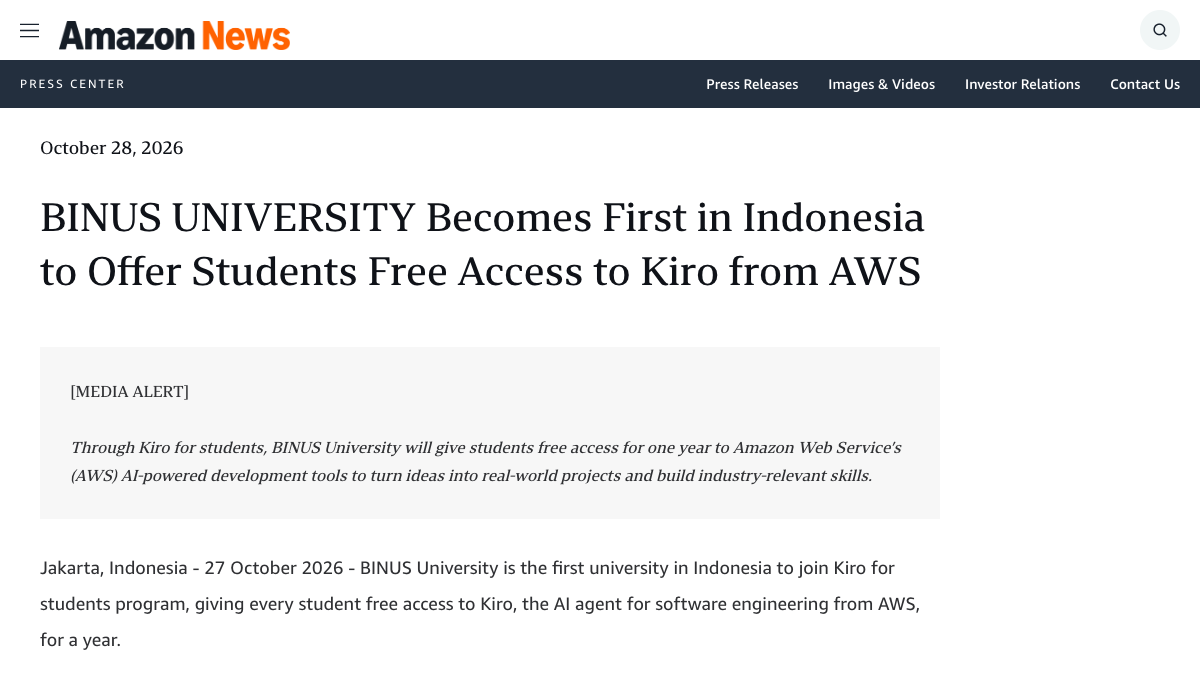


Students write down the applications they want to create in natural language, and Kiro first extracts the requirements, design, and tasks before assisting with coding. BINUS University announces its participation in the Kiro for students plan, allowing students to use this AWS software engineering agent for free for one year. The news page indicates October 28th, but the Jakarta release header in the main text is dated October 27th; for details on this arrangement and the specific quota, please refer to the [official announcement](https://press.aboutamazon.com/2026/10/binus-university-becomes-first-in-indonesia-to-offer-students-free-access-to-kiro-from-aws).
Free service with a clear unit: 1,000 credits per month, for a duration of one year. Design generation, task lists, code explanations, and other AI auxiliary operations are all within the scope of the allocated quota. Therefore, this benefit should not be interpreted as unlimited usage, nor can it be simply converted into the number of applications that can be delivered each month. The complexity of tasks and the way they are used will still affect how the quota is consumed.
The announcement describes the program as a development environment based on specifications. For students, this makes “writing requirements” a part of the tool operation for the first time: what problem needs to be solved, how the system should function, and how the tasks should be broken down are all topics that can be discussed before the code is generated.
What the teacher wants to see is where the students make their decisions.
Looking solely at the free tools, it seems like a campus promotion; however, by incorporating the school's stance, there is an additional layer to the arrangement. The person in charge of the School of Computer Science emphasizes that students should understand and be responsible for the plans they develop themselves, with academic foundation, teacher guidance, and project evaluation still being part of it. The school does not describe intelligent agents as a substitute for course evaluation.
This will affect how tools are used in the classroom. If only a functional program is accepted, the speed of generation may overshadow the students' understanding of the design. However, if the requirements, design, and task breakdown can all be discussed, teachers can ask follow-up questions based on the choices made by the students: Why were the modules divided in this way? Which requirements were overlooked? Has the code achieved the initial goals? This is an educational opportunity that arises from how the tool works, not a proven learning outcome as announced.
BINUS is already a member of AWS Academy. This time, the integration of Kiro is incorporated into the existing AI curriculum system. As a result, it has an organizational entry point: the school is responsible for the courses and guidance, while cloud service providers offer the tools. Students complete projects between these two parties. The free quota reduces the trial cost, but it does not decide on the project requirements or how to verify the students' abilities on behalf of the school.
The quota system also has a reverse impact on instructional design. A monthly limit of 1000 credits means that students need to decide which steps to delegate to the intelligent agents and which to complete on their own, rather than interpreting “one year free” as an unlimited amount of computing power. If the course requires keeping records of requirements, designs, task breakdowns, and modifications, teachers can see where the quotas are being used and determine whether students are testing various solutions or simply generating them repeatedly without making any choices or providing explanations. Since the announcement does not provide a unified quota consumption chart, schools still need to observe the usage patterns through actual course projects.
Project evaluation retains another important boundary: the ability to generate code does not equate to being responsible for the system. Students also need to explain where the data comes from, how permissions are restricted, how to handle failures, and whether the generated results meet the initial specifications. These issues are compatible with the standardized working methods of Kiro, but they will not be automatically completed by the tool. Incorporating them into classroom acceptance can make the free trial period serve engineering judgment, rather than merely adding an additional experience for the developers.
From the perspective of enterprise software, this also represents a premature integration of professional tools into the learning process. Students are exposed not only to coding assistants but also to a work habit that involves first establishing specifications and then breaking down tasks. Campus distribution provides these tools with new channels for users; whether they can remain relevant in the long term depends on whether they become useful practices within the curriculum, rather than just on the number of users who are initially engaged with them.
Separate the right to use from capabilities for a one-year period
The news does not disclose the quality of work, employment outcomes, or payment conversion data after the implementation of the project; therefore, it is currently impossible to determine how much this initiative has improved learning outcomes. The only definite change mentioned is the provision of a limited-time, quota-based opportunity to use professional tools, as well as an organizational arrangement where schools continue to assume guiding responsibilities.
For students, there are additional development options available; for teachers, the scope of review may extend from code to requirements and design; for AWS, the campus becomes a new entry point for software engineering tools. After the free period ends, the rights and benefits associated with the account may change, but whether students can explain and modify the systems they have submitted must be gradually established within the classroom setting.