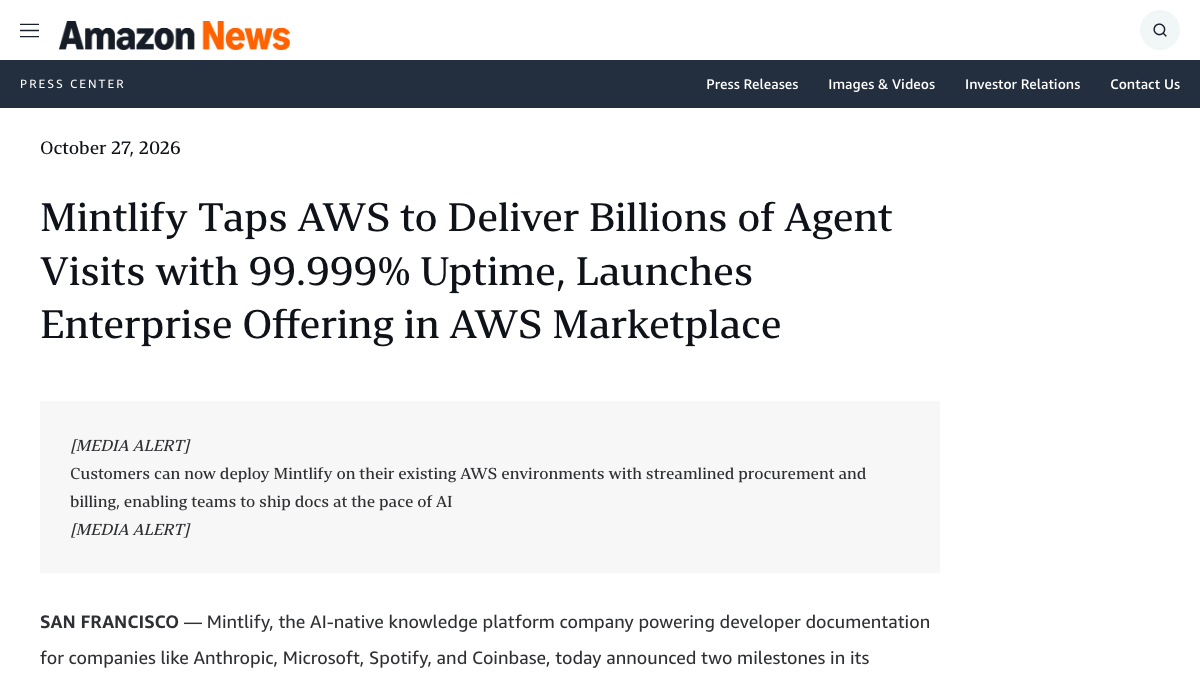


The development documentation that a company has put a lot of effort into writing may be opened by an agent next, which is preparing to call interfaces on behalf of users. In the [cooperation announcement](https://press.aboutamazon.com/aws/2026/10/mintlify-taps-aws-to-deliver-billions-of-agent-visits-with-99-999-uptime-launches-enterprise-offering-in-aws-marketplace) released on October 27th, Mintlify stated that over three-quarters of the traffic to their hosted documentation was coming from AI agents; on the same day, Mintlify Enterprise entered AWS Marketplace. The increase in machine readers was combined with the implementation of corporate procurement portals and was included in the same announcement.
Putting these two aspects together has changed the selling rationale for documentation platforms. In the past, companies purchased documentation tools mainly to make it easier for developers to find answers. Now, documentation also plays a role in helping agents understand and choose products. If parameters, permission conditions, or call steps are not clearly explained, problems may arise before users even see the product.
Announcement reveals that in the past year, the platform has served over 300 million human visitors and 2 billion visits by intelligent agents. These figures are provided by the company, and since the definitions of "visitors" and "visits" differ, they cannot be used to calculate the ratio of humans to machines. Moreover, more than three-quarters of the traffic volume refers only to the documents hosted by Mintlify, and thus cannot represent the entire internet.
The procurement path is more specific than another edit button.
For corporate buyers, the more tangible change announced is in the procurement channels. The Enterprise version purchased through AWS Marketplace offers SSO, advanced security controls, custom terms, and private quotes; customers who are already in negotiations with Mintlify can apply for a private quote to complete their purchases under their own AWS account.
A business leader may have confirmed that the tool is useful, but the project still has to go through contract, security, and billing processes. This new approach brings the product into the familiar procurement pathways of enterprises. It does not make public promises about how much time each customer can save, nor does it automatically convert adoption into approval, but it does reduce some of the work that suppliers have to do in explaining how the deal is made from scratch.
The platform also emphasizes reliability in this transaction, claiming that services running on AWS achieve 99.999% availability. This figure should be regarded as an operational metric disclosed by the supplier; however, the announcement does not provide sufficient information for buyers to derive their own guarantees regarding SLA, failure compensation, or individual site reliability. When purchasing infrastructure, it is important to separate historical performance from contractual obligations in order to make a more accurate assessment of the actual delivery.
For the procurement team, Marketplace also changed who would participate in the evaluation first. The tool is no longer solely tested by the development team before being contracted separately; it can now be integrated into the company's existing cloud expenditure, supplier review, and budgeting processes. SSO addresses access conditions, while private quotes and custom terms deal with the method of closing a deal. These two sets of capabilities do not solve the same problem. Only when both technical integration and commercial procurement are successful will the 'enterprise version' mentioned in the announcement become a service that customers can actually deploy.
For the document owners, the increase in machine traffic also brings more specific maintenance requirements. If there are contradictions between the page structure, parameter names, permission prerequisites, and sample code, the intelligent agents may carry incorrect steps forward into subsequent tasks; such issues may not necessarily manifest as pages that cannot be opened. Therefore, availability indicators can only indicate whether the service is online, but they cannot replace the accuracy of the content, the synchronization of versions, or the functionality of the samples. Announcements disclose the scale of access and the performance of the infrastructure, but the quality of the content remains the responsibility of the product team itself.
The document begins to participate in the process of product selection.
The role transformation of documents has gone beyond the scope of simply checking answers. When a user finds that an example is outdated, they can seek assistance from customer service; on the other hand, an agent entrusted with a task needs to determine the next steps to take based on the information on the page. As a result, product knowledge has shifted from after-sales documentation to the front end of the adoption process.
This analysis is based on the usage paths, and it is not yet possible to derive a causal relationship between document traffic and revenue. Machines may repeatedly crawl the same content, and multiple visits do not necessarily lead to purchases. Mintlify predicts that by the end of the year, the proportion of agent traffic could reach 90%, but this is still just a prediction and cannot be written as a definite result in advance.
For software companies, this launch provides an executable option: to incorporate the documentation platform into their existing cloud procurement processes, and then assess whether their knowledge is sufficient for both humans and machines to use together. The change begins at the entry point—agents are coming into contact with documentation earlier and earlier, and the procurement department now has a ready-made channel for transactions. Only when both ends can work smoothly will there be a chance for documentation to evolve from something that is "added afterwards publication" to a necessary part of product delivery that must be maintained from the start.