Key Points
- Kalshi and Polymarket US break the monthly trading volume record
- Regulated US platforms dominate market trading activities in forecasting
- November elections may drive growth beyond sports contracts
Kalshi and Polymarket US both broke their monthly trading volume records before the end of October, highlighting how rapidly the market in the United States is expanding as the mid-term elections in November approach.
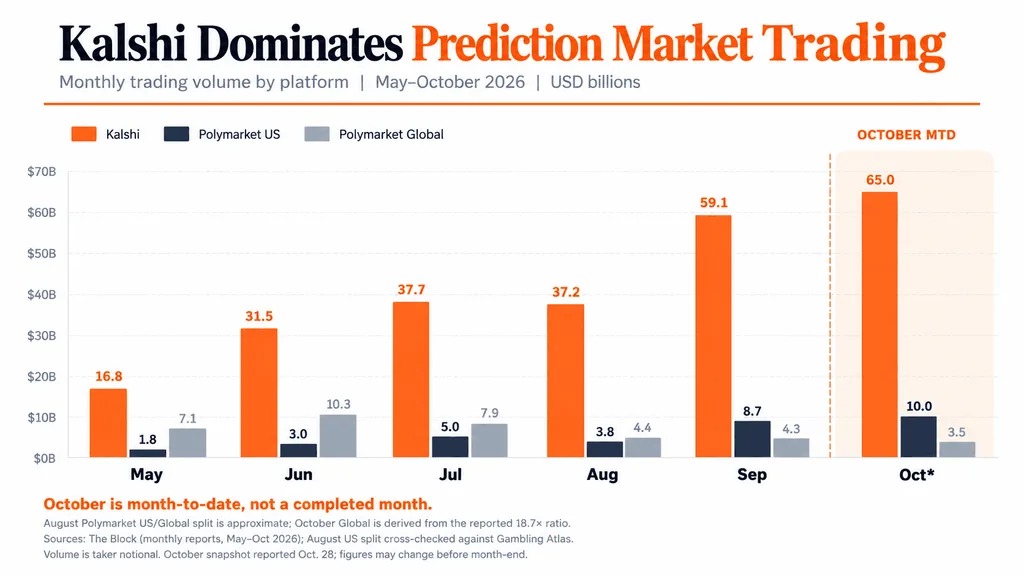
Kalshi In October, the trading volume was approximately 65 billion US dollars, which is 10% higher than the record in September. Polymarket US It reached 10 billion US dollars, an increase of about 15% compared to the previous monthly total.
In the latest data snapshot used in the report, the size of open contracts also set a record, with Kalshi at 2.05 billion US dollars and Polymarket US at 384 million US dollars.
Kalshi accounts for 83%, while Polymarket is shifting transactions to the United States.
In the comparison between The Block and Kalshi, Polymarket US, and Polymarket Global, Kalshi accounted for nearly 83% of the combined trading volume.
A year ago, the trading volume of Kalshi in October was approximately $4.4 billion, which was roughly comparable to that of the international platform Polymarket. However, in October this year, the trading volume reported by Kalshi was 18.7 times that of Polymarket Global.
Of these three platforms combined, two exchanges regulated by the United States contributed 95.6% of the trading volume.
Polymarket's entry into the US market stems from its acquisition of the derivatives exchange QCEX, which is licensed by CFTC, for $112 million.
At the same time, Kalshi has increased its visibility through partnerships with major sporting events such as the US Open.
Sports-driven expansion is also giving rise to the demand for comparative services. For example, WagerBeasts aggregates sports betting odds and market-based forecasts, allowing users to compare prices from different providers, including some forecasting market platforms.
Such services indicate that a broader ecosystem is forming around sports betting predictions, but the comparison of odds is not the same as the trading volume of exchanges.
The share of predictive markets is increasing compared to spot trading in the crypto sector.
The Block also reported that the ratio of its predicted market trading volume to spot exchange trading volume rose to 11.42 in October, compared to 7.34 in September.
This indicator has been rising for 10 out of the previous 12 months, indicating a relatively higher level of market activity in forecasting.
However, this figure is a ratio based on a specific dataset and should not be interpreted as meaning that the amount of dollars processed by the market is 11.42 times that of cryptocurrency spot exchanges.
The financial report of Robinhood also provides another indication of the industry's business expansion.
The company predicted that its market business generated $173 million in revenue during the third quarter, while cryptocurrency trading revenue amounted to $120 million.
The company also considers Bitcoin and gold contracts to be areas of growing demand, although sports remains its largest forecast category.
The mid-term elections in November will test growth beyond the sports sector.
The mid-term elections held in the United States on November 3rd will be an important opportunity to test whether political contracts can become another major source of transactions.
Regulatory uncertainty remains another challenge. As our market comparison explains, event contracts under federal regulation may face different legal requirements compared to traditional sports betting that is regulated by the states.
The predictive market is also reshaping the brokerage economy. Robinhood previously generated 21% more revenue from event contracts in the second quarter than from stock trading.
Luke Fraser
Luke Fraser is an investigative journalist known for his clear and objective reporting on blockchain and digital assets.