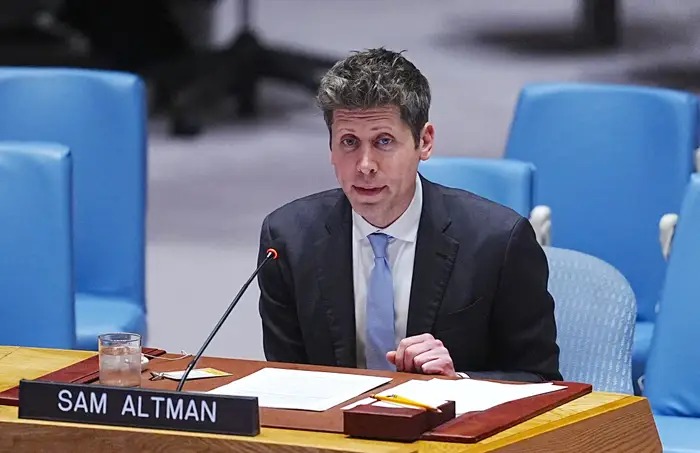


OpenAI CEO Sam Altman stated that he felt conflicted regarding OpenAI's solution to some of the greatest problems in the field of mathematics.
"As I said, I don't think this is a bad thing for AI," Altman said to President John Collison of Cheeky Pint during the program released on Thursday, "and I believe that, overall, the world should understand how the universe operates. But I do have empathy for this approach."
Some well-known mathematicians have been criticizing AI for promoting cutting-edge models to solve some of the most complex mathematical problems. OpenAI once withdrew from a “math hackathon” organized by Caltech because current and former Caltech mathematicians, as well as other professionals in the field, stated that such activities “are likely to have a destructive impact on the mathematics community.”
In addition, 28 Fields Medalists issued an open letter warning that "the AI company, by using the solution of mathematical problems as a benchmark for testing, is harming the field of mathematics and the mathematical community."
After announcing that its model had solved a problem that had remained unsolved for 90 years, OpenAI received widespread attention. This problem is related to a set of formulas that predict how liquids and gases move. Clay Mathematics Institute had offered a reward of $1 million for anyone who could determine whether these formulas would always behave as we expect in the physical universe; this was one of the most challenging problems in the “Millennium Problems” series. OpenAI stated that its AI model found an example showing that these equations are not always true, and that ultimately a “singularity” would occur, where vortices begin to spin at infinite speed.
Altman said that OpenAI is "exploring" how to ensure that people in these highly specialized fields can have the best possible future while continuing scientific research.
“I hope to find a way to treat with as much sensitivity as possible the groups that have driven these fields forward over the centuries,” he said, “but that’s very difficult.”
Collison tried to comfort Altman, reminding this CEO, OpenAI, that 'even when ports become automated, the dock unions will not be happy about it.'
Altman said that part of the reason for his different feelings about the entire experience came from a channel on OpenAI Slack called “Model Name - Hold My Beer”, which is derived from the internet meme “If you think this is already crazy, then just wait and see”. (He didn’t clarify whether this is a model that has already been released.)
“People just throw it at the hardest problems they can think of,” says Altman, “and people don’t really think that the models can actually do all that.”
This AI model deals with 'the most difficult research problems people encounter in their academic careers.' Altman said that he was so excited at the time that he 'couldn't sleep at all.'
Besides excitement, he also felt other emotions.
“I also feel more sadness and melancholy, along with a sense that something is coming to an end, and that’s much stronger than I expected,” said Altman.
The CEO, OpenAI, stated that any mathematician, with enough effort, can solve even the most complex problems, and this is "beautiful" in its own right. Altman said that AI is changing this equation.
“What I mean is, of course, most mathematicians wouldn’t be able to solve the Millennium Prize problems,” he said, “but the idea that you might be able to do so is there.”