On October 30th, the price of PEPE fell to $0.0000049. Previously, it was reported that hackers from Binance sold 7.77 trillion tokens, worth nearly $31.66 million, putting pressure on an already volatile cryptocurrency market.
On October 30th, the trading price of PEPE was close to $0.0000049, and it once fell to $0.0000044 during the session.
Lookonchain reports that the attackers of Binance sold 7.77 trillion PEPE, worth approximately 31.66 million US dollars.
A trader known for buying PEPE early is said to have bought another 45.08 billion tokens after this sale.
PEPE Futures trading volume has increased, while the number of open contracts has decreased, indicating that traders are reducing their outstanding leveraged positions.
The technical levels that need attention include a support level of $0.0000045, as well as a resistance level between $0.0000050 and $0.0000052.
According to blockchain tracker Lookonchain, the attackers exchanged the stolen PEPE at an average price of nearly $0.0000041, which was part of a larger-scale sale involving multiple cryptocurrencies. The transactions were converted back into ETH, and this meme coin subsequently rebounded from its intraday low of around $0.0000044.
As of press time, PEPE is trading at $0.00000491, a 1.29% decline over 24 hours, according to crypto.news market data. Its trading range once expanded to $0.0000057, indicating significant price fluctuations on that day.
Binance hacker sold 7.77 trillion PEPE, market weakened
This reported selling event occurred on October 29th, following a security vulnerability at Binance, during which attackers gained unauthorized access to the exchange-controlled encrypted wallets.
Lookonchain identified that in addition to PEPE, the transaction also involved UNI, ENA, LINK, AAVE, ONDO, and WLD. These seven tokens combined brought about 70,480 ETH, which was approximately equivalent to 158.25 million US dollars at the time.
Among them, PEPE accounts for $31.66 million of the total amount, which is one of the larger single sales. The tracker stated that the attackers have completed these transactions, but the资金 movements of other wallets are still under review.
On-chain analyst Darkfost reported separately that in this incident, nearly $38.55 million of PEPE was transferred. His previous estimates covered different stages of the activity and should not be added to the completed sales.
As reported earlier today, attackers exploited Ethereum's EIP-7702 authorization system to gain control of the Binance hot wallet. The exchange estimates that this security vulnerability affected approximately $6.3 billion in crypto assets.
Amidst the decline in Bitcoin and several major altcoins, this large-scale sale of PEPE occurred. However, the existing transaction data does not provide evidence to determine how much of the daily price fluctuations of PEPE were directly attributable to transactions by the attackers.
After the hackers sold off, PEPE whales bought 45 billion tokens.
As the attacker sold off, another highly anticipated PEPE wallet is said to have returned to the market.
On October 30th, Lookonchain updated that a trader named dimethyltryptamine.eth bought an additional 45.08 billion PEPE, worth nearly $206,500, after the aforementioned hacker sale.
This wallet has attracted attention because it previously invested in this meme coin. According to tracker data, the trader initially spent 0.125 of ETH, which was worth $251 at the time, to buy 5.9 trillion PEPE. Later on, its value peaked at $100 million.
The volume of purchases in October this time was far smaller than the amount sold by the attackers. Calculated at 45.08 billion units, it is only approximately 0.58% of the 7.77 trillion PEPE units sold by the hackers.
Another well-known holder also continued to increase their holdings of this token before the security incident. On October 27th, crypto.news reported that after Arkham identified a wallet associated with the founder of Tron controlling 2.82% of the total supply of PEPE, Sun Yuchen's holdings were disclosed.
The buying momentum of these wallets indicates that some large traders are still actively trading during periods of volatility, but individual transactions do not prove that market demand will continue to recover.
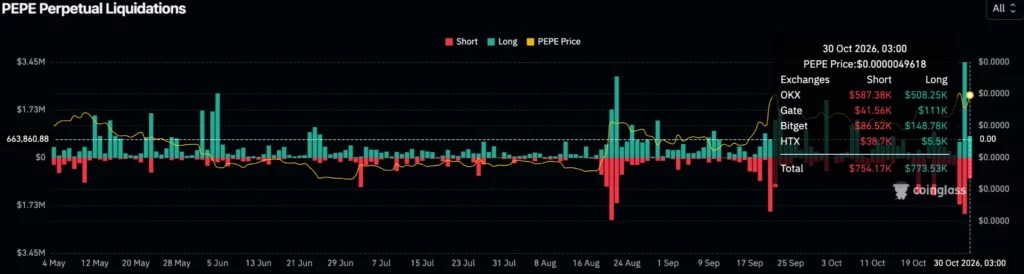
PEPE Futures trading volume increases, while the number of open contracts decreases.
During periods of price volatility, derivatives trading has noticeably heated up. CoinGlass data shows that the trading volume of PEPE futures increased by 59.84%, approaching 1.52 billion US dollars.
In the provided snapshot, the open interest decreased by 10.09% to $369.85 million. This decline indicates that despite the increase in trading activity, the total value of open futures positions has reduced.
Another settlement data at around 03:00 showed that the affected positions amounted to approximately $1.53 million, of which long positions were $773,530 and short positions were $754,170. OKX accounted for the largest portion of these recorded settlements.
The amounts of long and short positions are almost equal, indicating that traders on both sides have been affected by the price fluctuations. However, this does not indicate whether the next trading session will be dominated by buying or selling orders.
PEPE Price analysis indicates a resistance level of $0.0000050
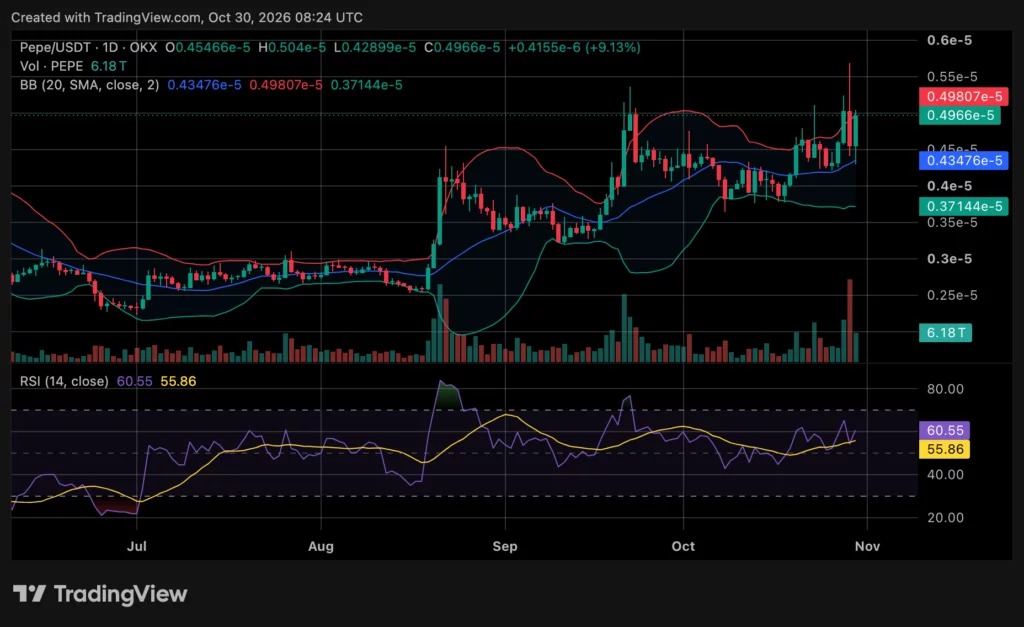
The PEPE daily chart shows that the price rebounded from $0.0000044 to around $0.0000050, although sellers had previously rejected higher prices around $0.0000056.
The Relative Strength Index (RSI) is at 60.55, which is higher than its moving average of 55.86. This reading indicates that momentum is improving, but it has not yet reached the 70 threshold that is generally considered to be overbought.
The current resistance level is still around $0.0000050, followed by the range of $0.0000055 to $0.0000057. If $0.0000045 is lost, $0.00000435, which is near the middle band of the Bollinger Bands, may become a focus of attention.
Cryptography analyst Trader Symba has identified a potential cup and handle pattern on the 12-hour chart, with resistance levels ranging between $0.0000050 and $0.0000052.
The analyst stated that if the price continues to break through and successfully retests, it could open up a range between $0.0000065 and $0.0000068, approaching the upper edge of that pattern.
Disclosure: This article does not constitute investment advice. The content and materials on this page are for educational purposes only.