On October 21st, OpenClaw founder Peter Steinberger estimated on the stage of Cloudflare Connect that the cost he incurred last month for work related to AI was approximately 10 million US dollars. The audience let out exclamations, to which he added, "Not all expenses were useful."
A few weeks ago, another Peter – Peter Piekarczyk – also came up with a staggering calculation. He noticed that on Lauren Tan’s Cursor personal homepage, it was shown that 1.5 trillion token were used over the past 30 days. So he wrote on X: “Estimating at $8 per million token, that means Lauren consumes about $384,000 per day, which amounts to $132 million annually.” Even assuming Cursor can get a 10% discount from a major client, the annual cost would still be around $13 million.
This set of numbers quickly attracted a lot of attention because it transformed the invisible token into a pay slip that everyone can understand. Before doing the calculations, it’s important to realize just how exaggerated 1.5 trillion is. A statistics report from the project management platform Jellyfish on 12,000 developers shows that a typical user (at the 50th percentile) uses about 51 million token per month, while a user at the 90th percentile uses about 380 million. Roughly comparing, the usage amount of Lauren is about 29,000 times that of a typical user; the 603 billion token disclosed by Peter Steinberger in May is about 12,000 times that of a typical user.
How is this “bill” calculated?
Lauren Tan currently serves as an engineer in the SpaceXAI Grok team. She has a diverse career background: she studied finance in university and initially got in touch with programming by writing VBA macros at Excel. Her professional career began with UI design, later she shifted to front-end development and React, participating in React Compiler projects; after the AI trend emerged, she focused on Agent workflows and developed pstack, a set of intelligent agents known as skills.
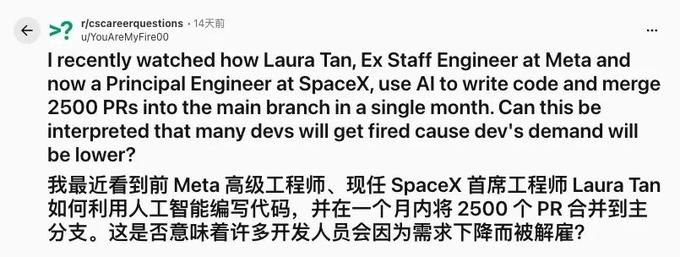
She also knows well how to manage her technical image. In mid-September, during a video speech, she mentioned that she "integrates 2000 PR into the production environment every month" – which means that on average, she can submit nearly 100 PR per working day. This number is incredible and undoubtedly an outlier.
On September 21st, she posted this video featuring "2000 PR" to the top of her X feed, but the caption read "Last month, I integrated 2500 PR into the production environment," which sparked a new round of discussion.
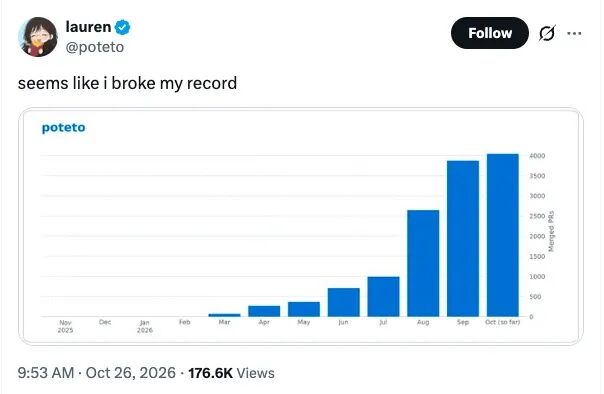
On October 26th, she posted again saying, "It seems we've broken a record," accompanied by an image of 4,000 PR. The numbers keep getting higher with each post, and each time it is publicly released.
Previously, her Cursor personal homepage showed that approximately 1.5 trillion token were used over the 30 days of September.
Marketing in itself is not a sin, but when you put an extreme example on display for everyone to see, you have to be prepared for others to use it to make exaggerated claims about its effectiveness.
Peter Piekarczyk converted this public figure into US dollars: estimating an average of 8 US dollars per million token, which results in about 384,000 US dollars per day, about 11 million US dollars in 30 days, and an annualized amount of 132 million US dollars. According to his calculation, this means "an engineer spends 132 million US dollars in a year."
He then assumed that Cursor could get a 90% discount from Anthropic, which means settling at 10% of the original price. The cost would then be reduced to about $38,000 per day, about $1.1 million for 30 days, and approximately $13 million annually. Calculated based on a senior engineer's annual salary of $500,000, this amount is equivalent to hiring 26 senior engineers.
Considering that the models she uses may differ, if all use Grok, it would cost about 4.8 million US dollars in 30 days; if all use Opus or Sonnet, it would cost about 13.2 million US dollars; if estimated based on a mix of 40% input, 40% output, and 20% cache reading, it would cost about 11.5 million US dollars. With different discounts applied, the monthly cost for this mixed usage could even drop to 5.8 million or 9.9 million US dollars.
Agent There are still cases where caching hits occur in programming. Assuming that the price read from the cache is about one-tenth of the normal input price, it still amounts to 1 million US dollars per month.
However, the algorithm of Piekarczyk is still controversial.
Cursor The homepage statistics of token can be divided into at least four categories: normal input, model output, cache writing, and cache reading, with significant price differences. Taking Opus 5.5 as an example, it costs about $4 per million units of normal input, about $20 for output, and about $0.20 for cache reading.
A screenshot of the usage amount with Opus 5.5 shows that 73.3 billion token corresponds to approximately $30,000, which is about $0.41 per million token; among these, cache reads and writes account for the majority of the costs. If this average cost is applied to Lauren's 1.5 trillion token, the result is approximately $615,000 per month.
There is another factor to consider: Lauren performs in-depth, long-running agent tasks, and thus hits the cache more frequently than ordinary users. Long-running tasks reuse the same context repeatedly, which further increases the proportion of this cost in the total expenditure. In the price of Opus announced by Anthropic, cache reads cost $0.20 per million token, while regular inputs cost $4. If all operations are billed at the cache read rate of $0.20 per million token, the monthly cost would be approximately $300,000; of course, this is just an extreme lower limit.
Piekarczyk later also took a step back: even if one's algorithm overestimates by 10 times, or Cursor uses its own GPU, then estimating at about 0.80 US dollars per million token, the monthly cost would be around 100,000 US dollars.
On October 9th, Piekarczyk initiated a poll to ask about everyone's monthly AI budget limit at work, with most people reporting a budget of less than $500 per month. When compared to the Lauren estimated monthly expenses, the contrast is quite striking.
For comparison, in May of this year, Peter Steinberger also shared a screenshot of CodexBar on X: the usage of OpenAI API over the past 30 days was approximately 1.305 million US dollars, involving 603 billion token and 7.6 million requests. Later, he explained that the screenshot was calculated based on the price of Codex for Fast Mode, and the estimated cost after shutting down Fast Mode was about 300,000 US dollars.
The $10 million figure for this October is an oral estimate from the event site, but there is one thing that is consistent: their order of magnitude is completely different from the budget of just a few hundred dollars per month for ordinary developers.
Work methods that ordinary people should not attempt
Steinberger describes this kind of investment as exploring "what software development would look like if Token costs were no longer a limitation." His team of three was running about 100 Codex instances at that time.
These Agent clusters are capable of autonomously reviewing Pull Request, scanning submission records for security vulnerabilities, merging duplicate GitHub Issue, and writing repair code. Some Agent will proactively submit PR according to the overall project roadmap; others continuously monitor performance benchmarks and report any performance regressions to the team's Discord server. According to The Decoder, some Agent even participate in meetings and generate PR based on the features discussed.
Lauren 1.5 trillion per month, token. No matter how it's calculated, it's still an amount that ordinary people cannot afford. So what has this money driven? According to her own public statements, she is now able to integrate 4000 PR into the production environment with a high degree of confidence each month. The key to this figure lies not in generation, but in verification.
The most important skill when using Agent is verification. By verification, I mean ensuring that Agent actually runs the code, CPU tracks or takes snapshots, iOS the emulator is activated, or operating the application in the way users would interact with it, to test and confirm that its functions are working properly. Verification can close the loop of work. It may not guarantee that Agent writes excellent code, but it can at least help write correct code; and that is already a big step towards building trust.
Her verification skills enable Agent to check its own work and continuously iterate until the task is completed. The logic is as follows: Agent that can check its own output will keep working until the task is finished; whereas Agent that cannot do so can only hand over diff to you and then stop. In that case, you become the slowest link in the entire cycle.
At 4,000 PR per month, if each one requires 5 minutes of inspection by a person, that would total about 333 hours, which is more than the working hours of one person in a whole month. Manual review cannot be used as a verification layer; the inspection system must operate without human intervention and must run in parallel with the Agent that generates the code.
In this cycle, the role of the engineer is more like that of an "engineering manager for Agent". Lauren says that if one doesn't even trust the output of a single Agent, it's impossible to expand to a hundred Agent.
She believes that the vast majority of people don't make use of Agent at all: "99% of people only utilize 1% of the true potential of GrokBot. They run just one Agent; there's neither 'looping ( loop)' nor 'charts ( graph)'. I manage a team composed of over 20 GrokBot Agent; we operate entirely autonomously. I have a chief of staff, a project manager, Agent, and over 20 task-executing Agent – this is the new technological stack for engineers."
The pstack workflow she made public is essentially the concrete implementation of this multi-Agent arrangement. Through step-by-step script guidance ( Playbook ), development tasks are standardized into sequential stages of understanding, design, coding, review, and verification. It achieves this by concurrently scheduling sub-agents locally (such as those for analyzing behavior / how and auditing risks / interrogate ) to perform their respective duties.
In fact, what pstack records and refines are the vertical validation skills (such as Control Glass) that she gradually developed over time. She started when she first joined Cursor with no knowledge of the existing codebase. By observing the recurring failure patterns in Agent locally, she built these skills one by one. Although such multi-Agent collaborative processes consume a lot of resources in the cloud, for them to run with high confidence locally, the codebase itself must also be suitable for Agent to take over.
GrokBot was initially a new application developed quickly from Vibe Coding. Humans hardly ever read the code, and there were insufficient architectural constraints. In this mode, Agent would prefer the easiest way to write code when performing tasks, leading to an increasingly messy codebase. As a result, the functional boundaries and performance risks got completely out of control. To allow Agent to take over development in a safe manner over the long term, the codebase must be restructured to be easily understandable by models, with clear modification paths that are inevitably subject to verification.
To this end, Lauren used over 600 PRs to restructure GrokBot into an architecture with an internal code name of Dune. Some of these PR components are quite compact, ranging in size from a few dozen lines to several hundred lines or even up to a thousand lines. Under this restructuring approach, the quality checks for the Dune architecture are extremely stringent: useEffect is completely disabled to eliminate implicit side effects; writing comments is strictly prohibited to prevent the model from being misled by useless context containing outdated historical information, which could lead to over-inference; at the same time, dependency graphs are carefully verified to ensure that the main and renderer directories of Electron never import from each other.
When this high-density reconstruction guardrail was completed, due to the agent's instinct to take shortcuts being forcibly reversed by the CI red line, the entire system's lifecycle management became completely automated.
In the specific scenario of Cursor, this set of personal experience has been packaged into pstack, which contains 23 Playbook (workflow scripts) and over 20 engineering principles. It is regarded by Lauren as the "only shortcut" to ensure that the discipline of a particular project passes the testing phase successfully. In some circles, it has been highly praised. However, when considering the complex configuration costs involved, one cannot help but question how much practical value this highly customized set of doctrines actually holds for ordinary developers in general development scenarios.
" AI Slop " Factory under the Privilege of Computing Power
This delivery model, which relies on the accumulation of extreme resources, is essentially a capital privilege that only a very small number of people can enjoy. As Peter Steinberger rightly states, "not all consumption is useful"; this kind of blind consumption is often merely a process of trial and error. When such extreme cases that deviate from commercial ROI (return on investment) are pushed into the public spotlight, engineers from technical communities such as Reddit immediately launch a fierce outcry against them.
In the hot discussions of reddit, frontline developers bluntly pointed out that this frenzied behavior of merging thousands of PR instances every month with unlimited funds is not at all a fundamental revolution in software engineering. Instead, it is a case of using brute computational power at no cost to continuously pour large amounts of “AI Slop” (i.e., AI junk content) into the code repository without any regard for efficiency.
The mockery from peers hits the weak point of this violent genre: the real bottleneck in software development is never the “absolute quantity” of code generated, but rather the long-term maintainability of the system. In the face of a monthly budget for AI that is generally less than $500 for ordinary engineers, once the guise of “unlimited Token consumption” is stripped away, poorly thought-out micro PR will completely get out of control.
This kind of pipeline that relies on exorbitant prices for blind trial and error and stress-based anti-fault restructuring actually seems to shorten the delivery path, but in reality, it cedes the dominance over system design from the elegant, holistic thinking of human architects to the mechanical stacking of machines within sandboxes. This privilege of computational power, detached from the masses, often results not in efficient assets in the production environment, but rather in a huge technical debt that ordinary people are utterly unable to maintain in reality.
But in the logic of commercial marketing, this huge consumption of computing power for publicity is indeed worthwhile. The founder of T3 did some calculations; he estimated that the actual “internal cost” was between $25,000 and $50,000 per month. He stated clearly, “The value of such exposure is far more than $25,000 per month; some companies spend over $1 million on events, yet the attention they receive is not even comparable to a single tweet posted by Lauren.” From Cursor’s perspective, this is more like an unsolvable public relations myth. Even if it costs several million dollars per month as rumored, the return in terms of product promotion and traffic is well worth it.
Lauren I also responded to the cost issue in an interview, acknowledging the absolute dependence of her methodology on laboratory privileges: 'I work in the AI laboratory, where token is unlimited, so I cannot say that everyone should follow my methods exactly.' However, she also characterized this logic as a type of upfront investment-output ratio game: spending Token in restructuring and adding constraints is to ensure that even the most basic Agent can produce good code, thereby allowing product managers and designers to deliver functionality directly. 'The value of Agent lies in enabling you to do things that were previously impossible, not in throwing Token at every small problem.'
Despite her firm belief that "it is possible to achieve a similar state without going bankrupt," this still cannot conceal a cruel technological reality: without the unlimited support of a laboratory's Token foundation, high-frequency automated verification loops are simply not feasible. For ordinary customers and users who are extremely sensitive to costs, the high verification expenses represent an insurmountable barrier.
Source of this article: InfoQ