


A US fusion startup claims that it has converted mercury into gold. Could the potential increase in gold supply strengthen the case for Bitcoin as a superior “digital gold”?
People often say, "What shines isn't necessarily gold," but this month that saying takes on a completely different meaning: an American fusion startup claims to have created gold using mercury.
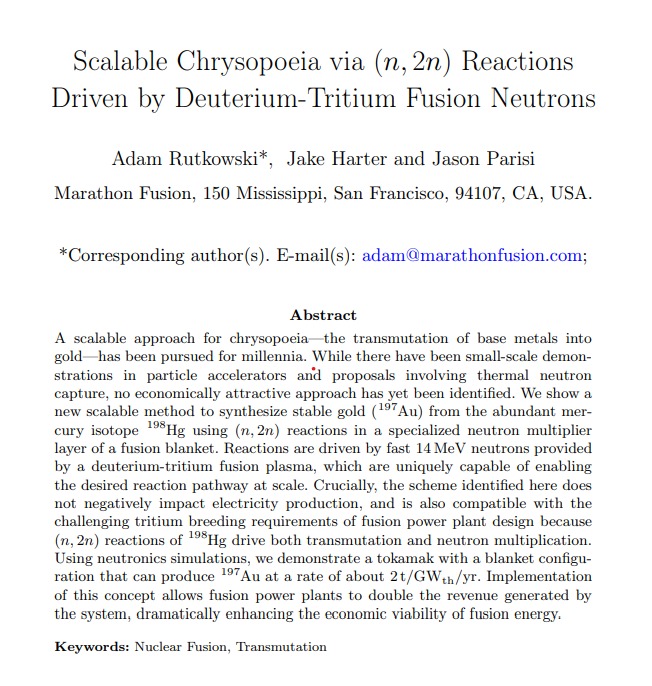
This is not a chemical trick, but rather relies on nuclear transmutation. According to the research paper from Marathon Fusion, high-energy neutrons from deuterium-tritium fusion reactions can bombard mercury-198, resulting in the formation of a radioactive isotope, which then decays into stable gold-197.
So, what would happen if gold really had some so-called “infinite minting loophole”? And what would that mean for Bitcoin, this “digital gold” that has a fixed upper limit on its supply?
Coinbase, the Chief Executive Officer, believes that the development of events is favorable to Bitcoin and compares this practice of "creating brand-new gold through alchemy" to the diamond industry cultivated in laboratories. "But you can't invent anything that would increase the supply of Bitcoin," he said, "The total number of Bitcoins will only be 21 million."
"We've received an incredible amount of interest from people who want to use it in jewelry," said Schiller, "And just like regular gold, I think it will mainly be used as a store of value."
However, before gold enthusiasts start to panic, there is still a long way to go for the achievements of Marathon to prove that gold can be produced on a large scale at low cost.
Metals Focus, the managing director of a precious metals research company, stated regarding Magazine: "We are still a long way from reaching the stage where we can discuss production on a meaningful level."
"Although the association with alchemical dreams makes it a great headline, I believe that gold miners will still be able to keep their jobs in the foreseeable future!"
Can gold really be manufactured on a large scale?
The underlying nuclear processes are scientifically feasible, but turning them into economically viable industrial processes is a completely different matter.
Marathon indicates that its rate of producing stable gold is 10 times that recorded by CERN. CERN is the European Organization for Nuclear Research, where scientists use powerful accelerators to study the fundamental components of matter.
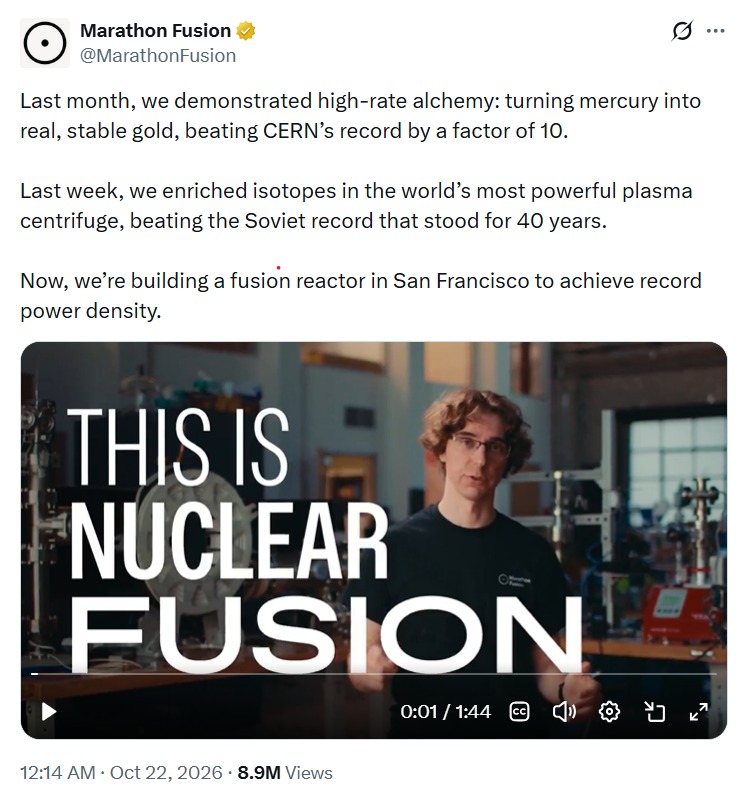
However, during the ALICE experiment of CERN, which ran from 2015 to 2018, it is estimated that only 29 picokilograms of gold atomic nuclei were produced, and these nuclei existed for an extremely short time before being destroyed in collisions.
The company has not publicly disclosed the exact production volume of the experiment. Marathon Research Engineer Jake Harter told Magazine, that the current production volume is still extremely small, "it's still at a microscopic level," but the company hopes to achieve "macroscopic milligram-level production" by 2027.
Therefore, the larger figures in the Marathon paper represent predictions for future fusion power plants, rather than being based on current production levels.
The paper model shows that each gigawatt of thermal fusion power can produce about two tons of gold per year. In contrast, the World Gold Council states that the global gold production from mines in 2025 was 3,672 tons, so the output of a single future fusion power station is not considered large by comparison.
Even to achieve these goals, Harter says that the company must also expand the production of mercury enrichment used for gold extraction, and of course, it will also be necessary to build the fusion reactors themselves.
"During the process of maturing this technology, we will also conduct research on material compatibility, mercury pumping, and gold extraction," he said.
Will gold follow the path of laboratories in cultivating diamonds?
It’s hard not to draw a comparison between Armstrong and Marathon – namely, nuclear gold versus lab-grown diamonds. Since 2018, as production has increased, the wholesale price of lab-grown diamonds has dropped by more than 90%. Unlike earlier diamond substitutes such as zirconium, the new generation of lab-grown diamonds are chemically identical to mined diamonds, yet their price is just a fraction of the latter. Could the same thing happen to gold?
Marathon Fusion Research Paper. Source: Marathon Fusion
eToro investment platform's market analyst, Nagham Hassan, stated that it is understandable to compare it with diamonds cultivated in laboratories, but the 'economic logic is completely different.'
She said that the reason diamond production has become cheaper with the expansion of factories is that mass manufacturing has reduced costs; whereas producing gold through nuclear fusion “requires extremely complex infrastructure that currently does not exist commercially.”
Another complex factor is that the gold produced is radioactive.
Harter said, "This kind of gold needs to be stored for over a decade before its radioactivity drops to levels close to that of bananas." However, since most gold is "originally stored as an investment," he believes this will not become a major obstacle to its earlier commercialization.
The bigger problem is that it is still unclear whether its economic viability is truly established at this time.
Kavalis said, 'There is no evidence to indicate that this process is commercially viable. Although there are theoretical revenue projections, there is no explanation regarding the costs of operating the reactor.'
If gold becomes less scarce, will Bitcoin benefit?
Bitcoin is often referred to as digital gold because its supply is limited by protocol rules, with a maximum total of 21 million coins. However, Armstrong believes that no one will be able to invent a method to create more Bitcoin in the future.
If future technologies such as nuclear fusion can create another source of gold supply, it could theoretically put downward pressure on gold prices.
Fabian Sch, a professor of distributed ledger technology and fintech at the University of Basel, stated regarding "Magazine": "For any asset, if the available supply increases significantly, it will put downward pressure on its market price, assuming all other conditions remain the same."
"Assuming that it is possible to produce on a large scale at low cost, gold is no exception either."
However, considering that the first batch of fusion reactors are not expected to appear for at least another ten years, and there are still many doubts regarding the economic viability of this new type of "alchemy," it is unlikely that this will significantly boost the price of Bitcoin anytime soon.
Therefore, at least for now, the work of Marathon seems more like an engaging experiment with potentially interesting applications, rather than an imminent threat to the gold market.
Peter Schiff and his companions can now breathe a sigh of relief.
Magazine: A private and fast USDT will emerge on Bitcoin. Can it compete with Ethereum and Tron?