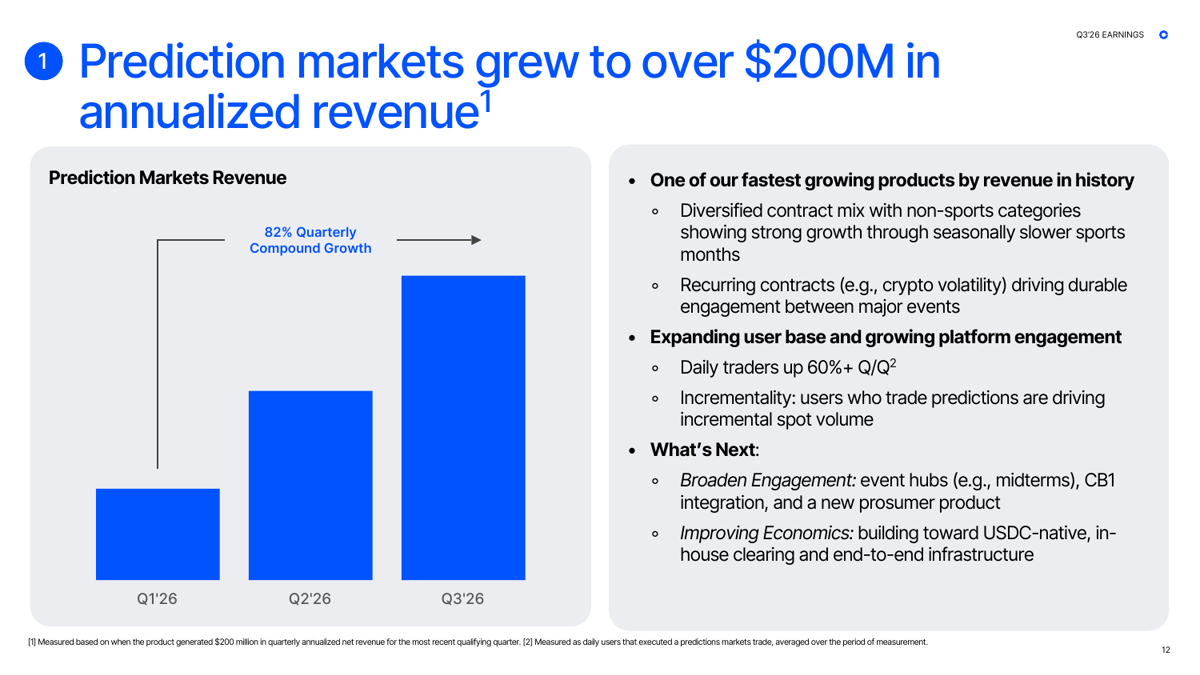


Coinbase The most eye-catching figure in the third quarter is not the Bitcoin trading volume, but a product that was still considered an fringe business last year: its annualized revenue from predictive trading has exceeded $200 million. The number of users participating in predictive trading daily has increased by more than 60% month-on-month, and since the product's launch, the compound growth rate of revenue on a quarterly basis has reached 82%.
This set of data appears in a quarter when the crypto market was relatively weak. Coinbase still recorded a net profit of $719 million, but the adjusted net profit was only $78 million; the adjusted EBITDA was $333 million, representing a 60% quarter-on-quarter increase and the 15th consecutive quarter of positive results. The gap between net profit and adjusted profit serves as a reminder that one cannot judge the quality of operations based solely on a single prominent GAAP figure.
What has truly changed is the revenue structure. Subscription and service businesses accounted for 49% of the net revenue in the third quarter, meaning that the company no longer relies solely on the fluctuations in spot trading for its income. By combining market forecasting, stablecoins, membership fees, and lending services, the revenue sources of a “exchange” have been diversified into multiple streams.
Predictive trading brings users back to the spot market
What the market is selling is not a new token, but positions on the outcome of events. Users trade around sports, political, or crypto events, and the platform generates revenue from these activities. According to Coinbase, even during the relatively quieter season for sports events, the annual revenue from this business still exceeds $200 million, and the users participating in the predictions also bring in additional spot trading volume.
This linkage is more important than the revenue figures themselves. A user who originally only opened the app during currency price fluctuations may now return more frequently for event contracts; after entering the prediction market, they also start trading spot products on the side. Products begin to drive traffic towards each other, and what Coinbase refers to as “Everything Exchange” is not just about putting more buttons on the same page, but about enabling one type of transaction to activate another.
The main business has not disappeared either. Coinbase reports that the market share of encrypted transaction volume has risen to 10.7%, showing growth for the fourth consecutive quarter, with contributions from both spot and derivatives markets; the platform's assets account for 12.5% of the total market value of the entire crypto market, returning to previous high levels. It is predicted that the market is expanding its business boundaries, rather than aiming to replace the foundation of exchanges.
$22 billion USDC becomes another source of revenue
In the third quarter, the average holding of USDC within Coinbase products reached $22 billion, a year-on-year increase of 49%, accounting for approximately 30% of the average market value of USDC. The company also stated that it achieved about 50% of its USDC economic earnings over the past year. The larger the balance of stablecoins and the longer their retention period, the lower the dependence of related earnings on quarterly trading sentiment.
This also explains why subscriptions and services account for nearly half of the net revenue. Spot trading fees can change dramatically depending on market conditions and users' risk preferences, while stablecoins, custody services, membership programs, and lending provide relatively steady income. Although these sources of income may not always be stable, they help to mitigate the impact of single market cycles on the company.
Coinbase One Paid members increased by 24% year-on-year, setting a new high. According to the company's disclosure, the average income of these users is 3.5 times that of regular users, and their average balance is 4.2 times higher. The long-term transaction retention rate is over 50%. The membership system has transformed the relationship from "charging a fee for each order" to a long-term account management model: users deposit more assets and use more products, while the platform also receives more predictable revenue.
These are all operating indicators disclosed by Coinbase themselves. The adjusted net profit and the adjusted EBITDA also fall under the non-GAAP criteria and need to be understood in conjunction with the financial report definitions. The "annualized revenue" predicted for the market is also a conversion of the current operating speed to an annual basis; it does not equate to $200 million in revenue that has been confirmed over the past twelve months, nor is it an inevitable result for the next year.
Exchanges start to value themselves based on user relationships.
Coinbase is still subject to the influence of currency prices, trading volumes, and regulatory changes. The third-quarter data did not prove that it has emerged from the crypto cycle, but it did reveal the risks associated with the company's reorganization of this cycle. During periods of spot market prosperity, its trading business provides momentum; when market conditions soften, USDC balances, membership fees, and other services support revenue; meanwhile, the forecasting team attempts to create new activities with less correlation to currency prices.
There is also an implicit change in this structure: the most valuable asset of the platform is not just the order flow, but rather users who have completed identity verification, are willing to store their assets for a long term, and continuously try new products. Predicting rapid market growth, Coinbase One indicates that users are of even higher value, suggesting that the company is transforming one-time traders into multi-product customers.
The core story of the third quarter is not about “Coinbase making how much money,” but rather where that money comes from. A 49% share of subscriptions and services, a $22 billion USDC balance, and a projected annual market revenue of $200 million all point to one thing: the exchange is striving to transform its revenue from a source that fluctuates with coin prices into a platform supported by multiple user scenarios. Whether it can survive the next round of market downturns depends on whether these new trends can continue to retain real users even as the enthusiasm fades.