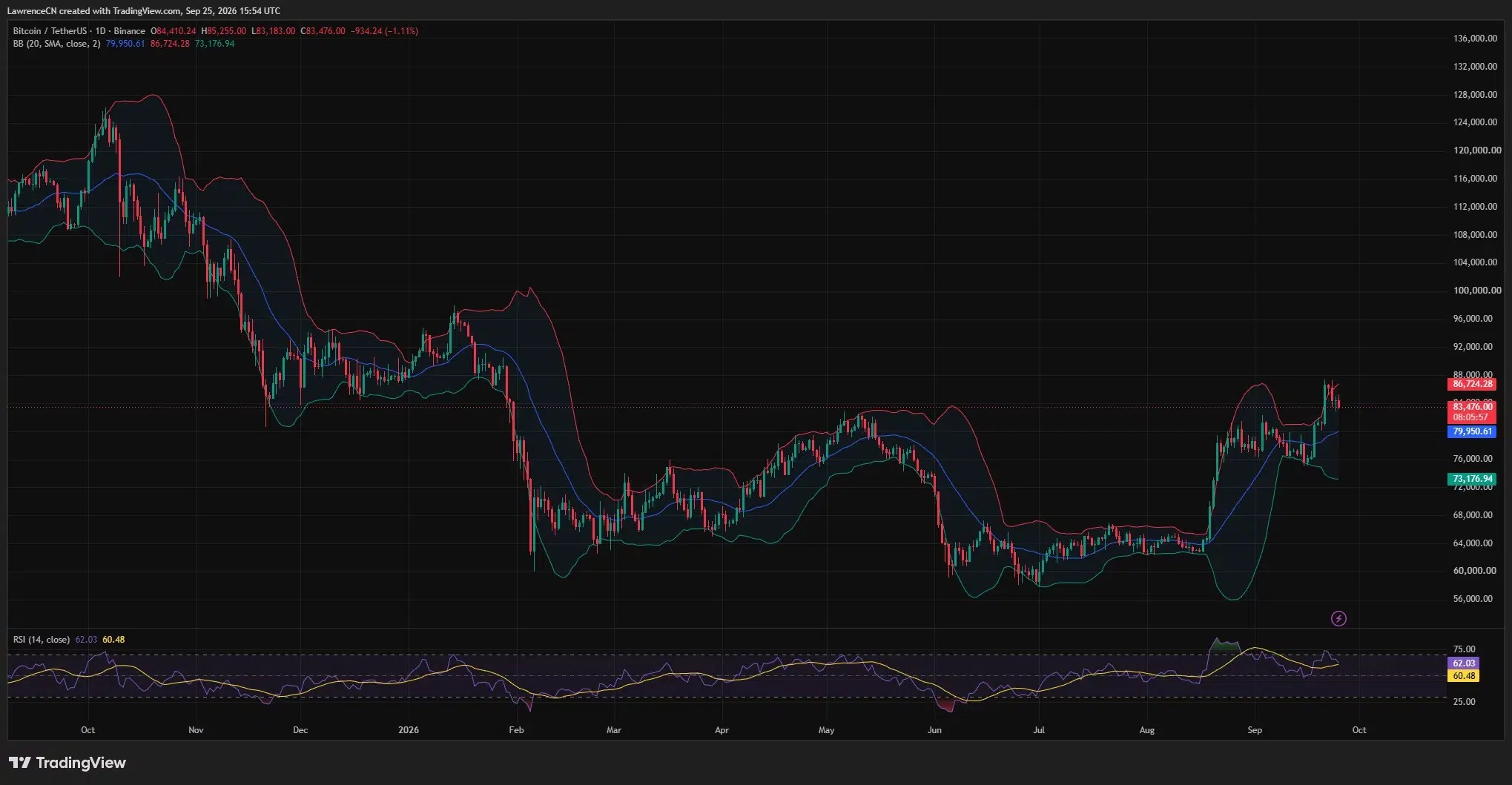
Log Scale CEO predicts that Bitcoin will reach a new high in 2027
Log Scale Investments CEO Mike Flaum predicts that Bitcoin will reach a new historical high in 2027, and denies that its price still follows a reliable four-year cycle.
- Flaum predicts that Bitcoin will set a record in 2027, stating that the four-year cycle has come to an end.
- Galaxy The latest research suggests that Bitcoin has hit its bottom in June, revising the previous downward forecast.
- Fidelity indicates that the improving market signals are still not sufficient to confirm that a sustained rebound has begun.
- Grayscale When evaluating Bitcoin, they place more emphasis on the economic environment and interest rates rather than the halving schedule.
Bitcoin Magazine relayed the predictions of Flaum after an interview on October 30th. During the interview, this investment executive discussed Bitcoin cycles, corporate vault companies, and securities backed by their Bitcoin holdings.
His judgment implies that although there is still disagreement among investment institutions about how to interpret the rebound of Bitcoin after its low point in 2026, a new record high has already appeared on next year's calendar.
Bitcoin's four-year cycle is once again challenged
In the interview, Flaum denied the four-year cycle framework and expressed confidence that Bitcoin would set a new record again in 2027. The discussion extended from whether the cycle was no longer valid to whether a new high would be reached before the next halving.
The chapter list published by Bitcoin Magazine shows that these two parts are located at 18 minutes and 48 seconds and 20 minutes and 31 seconds respectively. The entire conversation is part of a longer discussion, with topics also including Strategy, Strive, as well as the financing structures used by companies holding Bitcoin.
The view of Flaum challenges the notion that Bitcoin halvings can provide a reliable timeline for market peaks and declines. Within this framework, investors will compare the current market with previous periods where halvings preceded bull market highs, followed by bear markets.
However, other investment institutions have also raised doubts about this framework, although their respective explanations and predictions vary.
Galaxy's latest views on Bitcoin differ from previous warnings
As indicated by the constantly changing judgments of Galaxy Research, the relevant evidence has also evolved within this year.
In an analysis on June 9th, the institution argued that although the range of price fluctuations has narrowed, Bitcoin's four-year cycle is still evident in market and on-chain data. Based on historical comparisons, the indicative baseline scenario suggests a bottom range of between $40,000 and $46,000.
As previously reported by crypto.news, an earlier periodic assessment by Galaxy found that only 4 out of 13 historical bottom indicators were triggered.
But in October, his company-level research supervisor Alex Thorn reached a more optimistic conclusion.
In a study released on October 26th and initially sent to clients on October 22nd, Galaxy indicated that they believed the bear market had ended in June, and that Bitcoin had entered a phase of accumulation.
Evidence supporting this judgment includes: Bitcoin has held above the 200-week moving average and has once again crossed above the 50-week moving average for five consecutive weeks.
The institution also listed some conditions that could weaken this judgment, including the weekly closing price falling below the then 50-week moving average of $76,540, and the price failing to recover within a month.
Fidelity sees the recovery signal, but remains cautious
Fidelity adopted a more cautious attitude when announcing the end of the downward phase.
The bear market assessment suggests that this rebound could be the beginning of a sustained upward trend, or it might just be a brief respite within an ongoing bear market.
Some investors are paying attention to November 2026, as the previous major bear market bottom for Bitcoin occurred in November 2022. Fidelity emphasizes that past cycles have never strictly followed a four-year schedule, therefore it is not possible to reliably identify turning points.
Fidelity Digital Assets, Vice President of Research, and Chris Kuiper pointed out that the adoption process occurs in stages and waves. They also stated that, historically, extending the holding period is more beneficial than attempting to accurately predict the bottom of a market trend.
A signal report released by the institution on October 28 stated that in the early fourth quarter, the momentum, profitability, and engagement of digital assets were all improving.
Fidelity indicates that profitability, sentiment, and momentum indicators suggest that the market environment may be transitioning from a recovery phase to an expansion phase. However, the mining economy, adoption rates, stablecoin activities, and on-chain demand still send mixed signals.
Grayscale Prioritizes the economic environment over the halving schedule
Grayscale Research Supervisor Zach Pandl provided different interpretations of Bitcoin price behavior.
In an analysis on July 22, Pandl compared the “halving-driven cycle theory” with a framework centered around economic growth and inflation-adjusted interest rates.
He pointed out that past bear markets in Bitcoin often occurred alongside slowdown in growth, rising real interest rates, or both. Grayscale tends to believe that Bitcoin is increasingly responding to the same economic forces that affect other major assets.
The judgment regarding Pandl is conditional: if the Federal Reserve stops raising interest rates and economic growth remains resilient, the low point for Bitcoin may have already been reached.