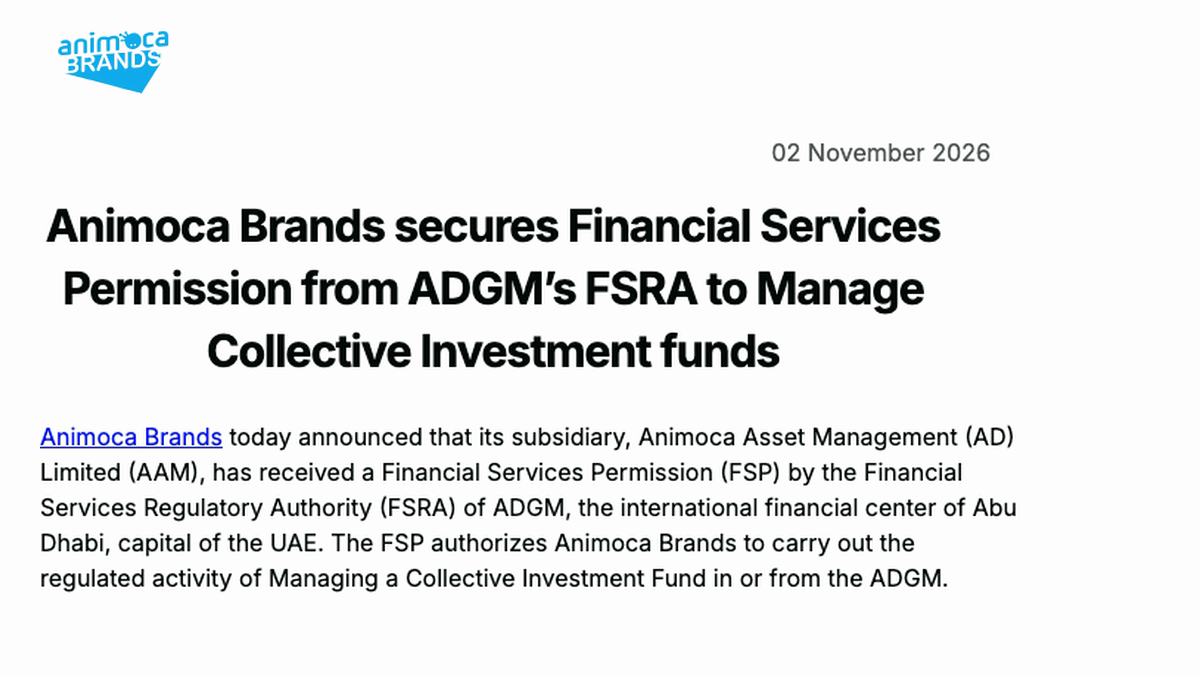


Moving from "principle-based approval" to formal licensing means that a digital asset company can conduct fund management within a regulated framework, but this does not imply that the new funds have already raised capital or started investing. On November 2nd, Animoca Brands announced that its subsidiary Animoca Asset Management ( AD ) Limited has obtained a financial services license from the Abu Dhabi Global Markets Financial Services Regulatory Authority, allowing it to carry out regulated activities in managing collective investment funds within ADGM or from ADGM.
This license corresponds to the fund management entity and the scope of activities. Animoca Brands itself owns the Web3 investment portfolio and digital asset business, but it is its Abu Dhabi subsidiary, AAM, that has obtained the license. The announcement does not automatically include all of the group's investment activities under the same license, nor does it list any newly approved funds for sale.
In November 2025, Animoca announced that it had received principle-based approval, although it was still required to meet certain conditions and obtain final regulatory approval at that time. The announcement of the financial services license now indicates that this regulatory phase has progressed forward. By comparing these two points in time, one can understand the changes more clearly than just looking at the mere "approval": in the previous phase, the company was allowed to continue to fulfill the conditions, while this license authorizes it to carry out specific regulated activities.
Who will be in charge of licensing? How to invest without answering questions about the products themselves?
Collective investment funds pool the funds of multiple investors, and the manager executes strategies according to the fund documents. Regulatory permits first constrain the qualifications of the manager, governance, and the activities carried out within ADGM. When investors actually decide whether to contribute funds, they also need to review the specific fund's strategy, asset range, fees, liquidity, custody, and risk disclosure.
Animoca stated in the announcement that it intends to expand its institutional capabilities and strengthen the connection between institutional capital and digital assets. This statement outlines the company's business direction, but it does not provide details such as the scale of asset management, the target amount for the first fund, the deadline for fundraising, or expected returns. Describing "can manage" as "has already managed how much capital" would go beyond the facts provided in the announcement.
The company also mentioned its ecological layout, which includes autonomous agents AI and digital property rights. These components are part of the group's business framework, but this does not imply that licensed entities can include any tokens or AI projects in products targeting investors without having the necessary fund documentation and appropriate authorization. A license is a prerequisite for conducting activities; it does not serve as a guarantee for the quality of each underlying asset.
ADGM Licensing also has regional and entity boundaries
ADGM is the international financial center of Abu Dhabi, and the Financial Services Regulatory Authority is responsible for financial regulation within its jurisdiction. Permits allow AAM to manage collective investment funds within ADGM or from ADGM, but these permits cannot directly replace sales licenses from other countries and regions. If the funds are to target investors in different jurisdictions in the future, they must also comply with local marketing and suitability rules.
For institutional investors, this development may add another regulated entry point for managing digital asset funds; for Animoca, it combines its existing project investment experience with formal fund management capabilities within the same group framework. However, "institutionalization" does not automatically reduce the volatility, valuation, and liquidity risks of underlying digital assets, and managers still need to address these issues through specific product design.
The announcement does not clarify whether permission is granted to manage retail funds, nor does it indicate whether future products will adopt an open-end, closed-end, or some other structure. Collective investment funds are a category of regulated activities and do not constitute a complete description of a single product. When investors come across “Financial Services Permission”, they should first verify the licensed entity and the permitted activities before awaiting the fund documentation, rather than relying solely on the group’s brand.
The real change that has occurred this time is that AAM has moved from principle-based approval to the formal financial services licensing stage, gaining the qualification to manage collective investment funds under the ADGM framework. What has not yet happened is the establishment of a new fund that has been officially named, with its scale disclosed, and which has begun fundraising. By separating the licensing process from the products, we can both observe the progress of digital asset institutions entering the traditional regulatory system and maintain our ability to assess the specific investment risks involved.
The subsequent evidence that is truly worth tracking will include the scope of permission in regulatory registration, the official documents for the first fund, the custody and valuation arrangements, and which qualified investors it is open to. Before these materials become available, the most accurate description is "the manager has obtained the qualifications," rather than "a certain digital asset fund has already been launched."