

Historical data has provided strong support for the trend of the U.S. stock market after mid-term elections, but the current abnormal concentration of the market structure poses an unprecedented challenge to this pattern.
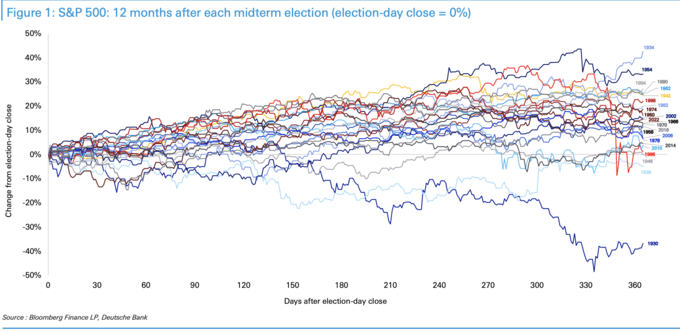
According to Zuifeng Trading Desk, a latest research report by Deutsche Bank shows that since World War II, the S&P 500 index has recorded gains within 12 months after each mid-term election, with all 20 instances resulting in positive returns, and an average increase of 14.4%. This record far exceeds the average performance of ordinary years.
However, Deutsche Bank strategists also warn that the current index concentration is the highest among all historical samples mentioned above, and the performance of a few ultra-large market capitalization stocks will largely determine whether this streak of success can continue into the 22nd time.
At the interest rate market level, Deutsche Bank's fixed income strategists pointed out that the yield on 10-year U.S. Treasury bonds tends to decline after mid-term elections, especially when the election results lead to a "new divided government" scenario, with a more significant drop. Given the current expectation that the Democratic Party is likely to win control of the House of Representatives, the market's pricing logic regarding policy deadlock may dominate interest rate trends in the short term.
Deutsche Bank’s report systematically analyzed the 12-month performance of the S&P 500 index after each mid-term election since 1930, and the conclusions were highly consistent: an increase is almost the norm.
Specifically, since 1946, the probability of the S&P 500 experiencing an increase within 12 months after midterm elections has been 100%, meaning that all 20 instances have resulted in positive returns, with an average increase of 14.4% and a median increase of 13.7%. If we extend the time frame to 1930, out of 24 elections, there were 22 instances of increases, representing a win rate of 92%, with an average increase of 13.0% and a median increase also of 13.7%.
In contrast, the probability of increase for all calendar years since 1928 is only 67%, with an average increase of 8.1% and a median of 11.6%; since 1946, the average increase for ordinary years has also been only 9.1%. This means that in the year following midterm elections, the average performance leads ordinary years by about 4 to 5 percentage points at the mean level, and by about 2 percentage points at the median level. The above data represent price returns and do not include dividends.
In 24 samples, there were only two instances where the market declined within 12 months following midterm elections, both of which occurred in extreme macroeconomic environments.
In 1930, the shadow of the Great Depression loomed over the markets. A wave of bank failures, deflation, and the introduction of the Smoot-Hawley Tariff Act all pressured the market, causing the S&P 500 to plummet by 37% within 12 months after the election. Deutsche Bank described it as "a once-in-a-century financial and economic collapse, rather than an ordinary political cycle year."
The situation in 1938 was likewise special. The economic recession from 1937 to 1938 had just ended, and Europe was shrouded in clouds of war. Within 12 months after the elections, the market fell by 5.1%. Additionally, 1946 was almost an exception as well; at that time, post-war inflation and demobilization pressures weighed on the economy, causing the market to rise by only 0.1%, practically remaining stagnant.
Deutsche Bank's report indicates that the market tends to rise after mid-term elections, and the fundamental reason lies in the systematic elimination of political uncertainty.
During a four-year political cycle, years of mid-term elections are typically the period when market performance is weakest. Uncertainty surrounding election results and policy directions reaches its peak before voting, and markets often hit bottom in autumn—with the historical average low point occurring at the end of September. After the elections, markets buy into what are now "known outcomes." A typical result of mid-term elections is a divided government and policy deadlock, which in turn reduces the risk of major policy changes, posing a positive factor for the markets.
Deutsche Bank's report also pointed out that the situation in 2026 was different from in the past: there was no significant decline in the market as is typically seen historically, but since the end of May, the market has been in a sideways consolidation phase, which to some extent still reflects the usual characteristic of a softened market before voting.
Despite the highly optimistic historical data, Deutsche Bank strategists clearly pointed out the core risk of this cycle: an unprecedented level of index concentration.
The report indicates that the current concentration of the S&P 500 exceeds that of any period in the aforementioned historical samples, with a handful of extremely large-cap companies contributing the vast majority of the index's returns. This means that even if most stocks rise, as long as a few core heavyweight stocks perform below market expectations, the index as a whole could experience a decline. Deutsche Bank believes that this is precisely how the 92% win rate record is most likely to be broken.
In addition, the policy path of the Federal Reserve constitutes another important variable. The report indicates that the current interest rate hike cycle priced by the market is one of the most modest in history, and if the actual interest rate hike path returns to historical normal levels, it will have a shock on the market.
At the interest rate level, research by Deutsche Bank's fixed income team shows that the yield on 10-year U.S. Treasury bonds tends to decline in the 60 years following mid-term elections, and the decline is even more significant when the election results lead to a "new divided government" scenario – the market typically interprets this as a sign of policy deadlock and weaker fiscal stimulus.
The report also indicates that there is a significant positive correlation between the stock market and the interest rate market in the trend following the election. Historical experience shows that for every 2% decline in the S&P 500 within a week after an election, the yield on 10-year U.S. Treasury bonds correspondingly falls by about 10 basis points. Given that the impact of these election results on policy is limited, strategists at Deutsche Bank believe that interest rate trends will largely follow the direction of the stock market.
Combining historical data with the current market structure, Deutsche Bank's overall judgment is that historical trends tend to support a broad market rise over the next 12 months, with both the average and median increases falling within the double-digit range. However, given the current index concentration, whether the streak of gains can be extended to the 22nd time will likely depend on the performance of a few key heavyweight stocks—this is the variable that investors should pay the closest attention to after these mid-term elections.
~~~~~~~~~~~~~~~~~~~~~~~
The above wonderful content is from the Chui Feng Trading Platform.

For more detailed interpretations, including real-time analysis and frontline research, please join [Chui Feng Trading Desk ▪ Annual Membership].