The world's largest stablecoin issuer, Tether, slightly reduced its gold reserves in the third quarter of 2026, ending a trend of continuous increases in previous quarters.
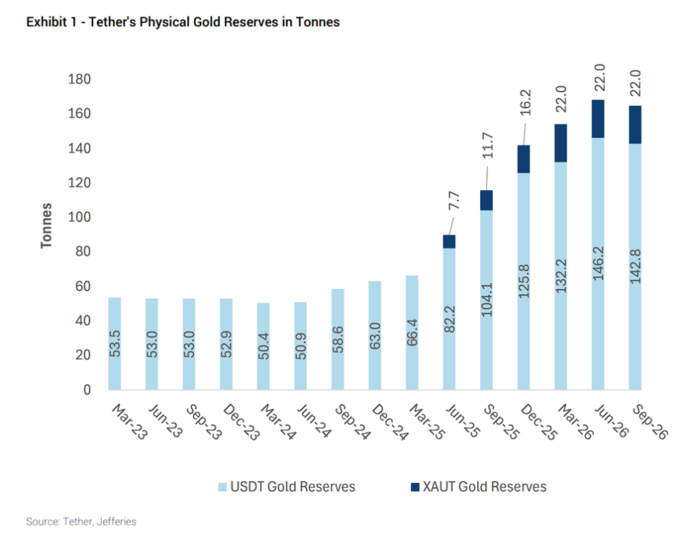
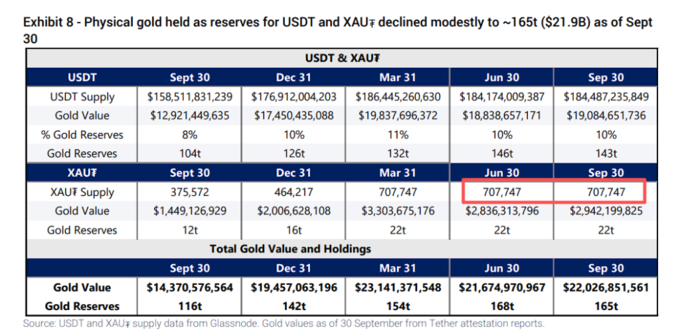
According to a research report published on November 3 by Jefferies cited by Zuifeng Trading Desk, as of September 30, 2026, Tether disclosed a total gold position of about 165 tons, equivalent to approximately $21.9 billion, which is a decrease of about 3 tons from the end of the second quarter's figure of around 168 tons. This is the first time in recent times that there has been a month-on-month decline. This reduction is entirely due to the shrinkage in the gold position in USDT's reserves, while the gold reserves corresponding to XAU ₮ have remained unchanged.
Jefferies believes that, given the current position size of Tether, any changes in their buying activities could have a significant impact on the gold market.
It is worth noting that the supply of USDT remained relatively stable in the third quarter, at approximately 184.5 billion US dollars, which indicates that this reduction in holdings was not driven by a decrease in the issuance of stablecoins. At the same time, the amount of Bitcoin and other investment assets held by Tether at the end of the period increased, but the disclosed information does not indicate whether gold was directly converted into the aforementioned assets.
Analysts also stated that Tether's overall role in the physical gold market has not changed, and a moderate reduction in holdings over a single quarter is not sufficient to determine a shift in their long-term intention to increase holdings.
Position size: From 90 tons to 165 tons, Tether has become an important player in the gold market.
The demand for physical gold from Tether comes from three channels: first, it is used to support the reserve gold for USDT; second, it is used to support the reserve gold for the gold token XAU ₮; third, it is gold investments in the balance sheet purchased with interest income. Currently, public data only covers the first two aspects, which means that the 165 tons visible to the market represent only the lower limit of their physical gold holdings.
From the perspective of historical growth trends, the gold holdings of Tether increased from about 90 tons in June 2025 to 165 tons in less than one and a half years, representing an increase of nearly 83%. Specifically, as of September 30, 2026, the value of gold in USDT's reserves was approximately 19.1 billion US dollars, equivalent to about 143 tons, which is about 3 tons less than the previous quarter; the value of gold in XAU's reserves was about 2.9 billion US dollars, equivalent to about 22 tons, remaining unchanged from the previous quarter.
Jefferies reports that if the gold purchase volume of Tether is compared horizontally with that of central banks around the world, the net gold purchase volume of Tether (the combined volume of USDT and XAU ₮) from the beginning of the year to date is approximately 27 tons, which is higher than that of the Czech Republic, but lower than Poland's 122 tons, China's 103 tons, Uzbekistan's 55 tons, and Kazakhstan's 41 tons. Thus, it has secured a place among the world's major gold buyers.
Reason for reduction in holdings: USDT supply is stable; funds may be flowing into assets such as Bitcoin.
The reduction in gold holdings in the third quarter occurred against the backdrop of a basically unchanged supply volume of USDT, which is different from the logic of 'stablecoin expansion driving an increase in gold reserves' seen in the past few quarters. The supply volume of USDT increased slightly from approximately $184.2 billion at the end of the second quarter to about $184.5 billion by the end of the third quarter, with almost no change.
At the same time, the holdings of Bitcoin and other investment assets at the end of the period for Tether have increased. Jefferies pointed out that the disclosed documents do not clearly state whether the reduction in gold reserves is directly related to the increase in the aforementioned assets, but the temporal overlap between the two has drawn market attention to the internal asset reallocation at Tether.
Nevertheless, the increase in gold prices during the third quarter partially offset the impact of the decline in holding volumes. The book value of gold in the USDT reserves rose from approximately $18.8 billion in the previous quarter to about $19.1 billion, showing a situation of "decreasing volume and increasing price".
XAU No new demand for expansion at present; the market value of tokenized gold has reached $5.2 billion.
In terms of the tokenized gold business, the supply of the gold token XAU ₮ under Tether remained unchanged at 707,747 tokens in the third quarter, corresponding to approximately 22 tons of physical gold, with a market value of around $2.9 billion. Another major tokenized gold product, Pax Gold ( PAXG ), is issued by Paxos Trust Company. Both products represent ownership of one troy ounce of specific gold bars stored in Swiss vaults, and their prices are linked to the spot gold price.
Jefferies reports that as of September 30, 2026, the combined market value of XAU ₮ and PAXG rose to approximately $5.2 billion, representing a month-on-month increase of about 21% and a year-on-year increase of about 100%. However, there was a decline after October 31.
In September this year, Tether announced a partnership with Shiga to launch self-managed financial products that support XAU ₮, USDT, and Bitcoin in Africa and the Gulf Cooperation Council (GCC) region, with the aim of expanding the distribution channels for tokenized gold. However, according to third-quarter data, this partnership has not yet translated into a visible increase in demand for physical gold, as the supply of XAU ₮ remained flat month-over-month.
Structural logic remains unchanged: CEO specifies that 10%-15% of the portfolio should be allocated to gold.
The analyst, identified as Jefferies, clearly stated in the report that a moderate reduction in holdings over a single quarter does not represent a shift in Tether's overall gold allocation strategy. Since June 2025, the gold positions disclosed by Tether have seen a significant increase, and the expansion of XAU's ₮-related business has also continued to broaden its potential market.
At the strategic level, Tether CEO Paolo Ardoino has previously stated that he plans to allocate 10%-15% of the portfolio to physical gold, and this portion of gold is independent from the reserve gold that supports USDT and XAU ₮. To date, the company has not disclosed any adjustments to this strategy.
Jefferies believes that stablecoin reserve allocation and tokenized gold remain emerging sources of demand for physical gold by institutions. The amount of gold purchased by Tether is expected to fluctuate across quarters, but its role as an important participant in the gold market will continue.
Credit: Wind Trading Desk, citing the research report from Jefferies dated November 3rd.