

Apple releases a mixed financial report: Against the backdrop of a double-digit decline in global smartphone shipments in the third quarter of this year, iPhone revenue growth still exceeded Wall Street's expectations, driving Apple's total revenue to grow more than anticipated; however, in China, an important overseas market, Apple's performance fell significantly short of expectations, and the growth rate of service business revenue also slowed further.
More importantly, management proactively disclosed their outlook during the financial report conference call: the pressure of high memory costs is expected to continue to intensify in the coming quarters, and gross margin is also set to decline further.
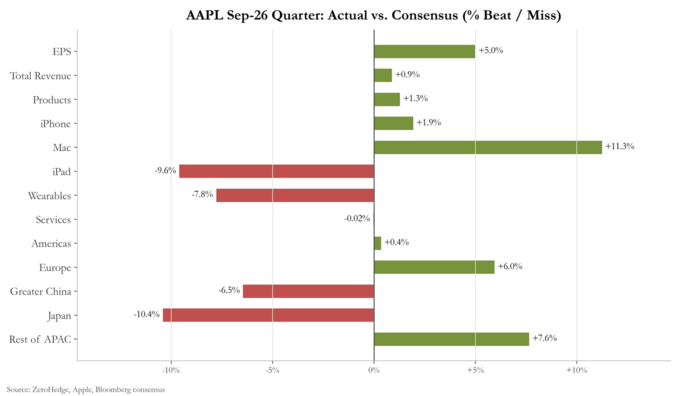
After the U.S. stock market closed on Monday, November 2nd, Eastern Time, Apple announced that for its fourth fiscal quarter ending September 26, 2026, revenue increased by 11.7% year-over-year to $114.477 billion, exceeding Wall Street's forecast of around $113.47 billion, and also surpassing Apple's previous growth guidance range of 9% to 11%. Earnings per share (EPS) after dilution increased by about 14% year-over-year to $2.10, which is 5% higher than the market's expectation of $2.00.
The highlights of this financial report still come from iPhone and Mac. iPhone's revenue increased by 17.5% year-on-year to $57.583 billion, setting a new high for the fiscal quarter end in September, exceeding analysts' expectations by more than 1.9%; Mac's revenue was $10.792 billion, up 23.7% year-on-year, also exceeding analysts' forecasts by over 11%. Service business revenue reached $31.573 billion, a record high for a single quarter, but it was roughly on par with and slightly below the market's expectation of $31.58 billion. The year-on-year growth rate further slowed to less than 10%, marking the lowest growth rate in over three years.
The profit side was also strong, but it benefited from one-time factors. Apple's gross margin in the fourth fiscal quarter was 47.9%, which is at a low level for the year, with about 1 percentage point coming from the favorable impact of tariff refunds from the Trump administration; EPS also includes a contribution of about $0.05 from tariff refunds. Excluding this factor, Apple's earnings were still better than expected, but the extent of exceeding expectations was more modest.
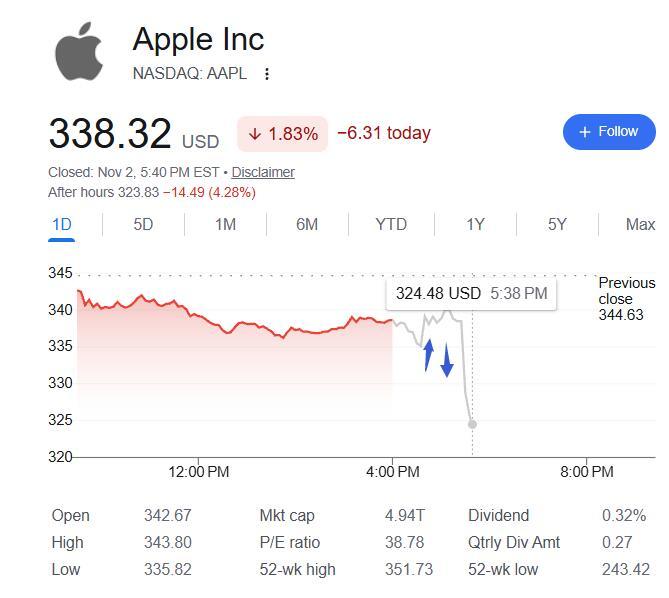
When the financial report was released, Apple's stock price, which had already fallen by more than 1.8% on Monday, initially rose slightly by 0.4% after the market closed. However, it soon returned to a downward trend. After falling nearly 2%, it briefly turned upward before turning down again, and then fell by more than 4% after the market closed. The volatility in the stock price after closing indicates that the market does not consider this a poor financial report; rather, the previous valuations and expectations were already quite high. Revenue from the Greater China region was nearly 6.5% lower than analysts' forecasts. Weak performance in iPad and wearable devices, as well as the service business not meeting expectations, along with the gross margin being boosted by one-time tariff refunds, are the aspects that investors are more sensitive to under the backdrop of "high valuations and low tolerance for errors."
Before the financial report was released, media pointed out that Apple's stock price had risen by more than 20% from its low point at the end of June, with its market value increasing by about $1 trillion over the past four months. The forward price-earnings ratio is around 35 times, nearly twice that of the S&P 500 index, and it is at a high level in Apple's own historical valuation. Analyst Martin Yang noted that Apple's stock is currently trading at 36 times next year's expected earnings, which is a premium compared to the overall market level. However, he expects Apple's earnings growth rate to be only 1%, which is slower than that of similar tech companies. He directly stated, "We don't think there is enough upside to support this premium," and emphasized that Apple needs to boost iPhone sales growth and reverse the slowdown in its service business in order for him to be more optimistic about the stock. With such valuations, the market's expectation for the financial report is not just to meet standards, but to be almost flawless.
Analysis suggests that the subsequent decline in Apple's stock price reflects, to some extent, investors' re-evaluation of its niche businesses and the quality of its sustained growth amidst high valuations. In other words, this financial report proves that Apple's fundamentals are still strong, but not strong enough to absorb all the valuation pressures resulting from its significant rise over the past few months.
Revenues and EPS both exceeded expectations, with annual revenue for the full fiscal year reaching a record high.
Apple's total revenue for the fourth fiscal quarter was $114.477 billion, compared to $102.466 billion in the same period last year, representing a year-over-year increase of 11.7%. This growth rate has slowed down from 16% in the third fiscal quarter. Not only did this performance exceed market expectations, but it also indicates that Apple has continued to maintain double-digit growth since the third quarter.
On an annual basis, Apple's revenue for the fiscal year 2026 reached $478.834 billion, a 15.1% increase from $416.161 billion in the fiscal year 2025, setting a new record high for the company's fiscal year. The annual net profit was $132.175 billion, a year-on-year increase of 18%; the annual diluted EPS was $8.98, a year-on-year increase of 20.4%.
Apple stated that it set a revenue record for the September quarter, with iPhone reaching a new high for the same period. The service business also hit a historic high, and the company said it is entering the holiday season with "the most ambitious product lineup" yet, including iPhone, Duo, iPhone, the 18 Pro series, a new generation of home hardware, the introduction of Touch for the first time, as well as the all-new Siri AI.
CFO Kevan Parekh emphasizes that Apple's net profit in the fourth fiscal quarter and EPS both set quarterly records for September, with annual revenue reaching a new high. The base of active devices also reached new highs in all major product categories and regions.
iPhone and Mac drive hardware growth, while the initial release in the Duo cycle plays a pulling role.
In the fourth fiscal quarter, Apple's product revenue reached $82.904 billion, a year-on-year increase of 12.5%, exceeding Wall Street's forecast of $81.85 billion. Among them, iPhone and Mac were the main drivers of this growth.
In the fourth fiscal quarter, iPhone reported revenue of $57.583 billion, a 17.5% increase from $49.025 billion in the same period last year. This growth rate slowed down from 22% in the third fiscal quarter but was still higher than analysts' expectations of $56.49 billion. Apple executives mentioned during the third-quarter earnings call that supply constraints for components would affect performance in the fourth fiscal quarter, and they anticipated that iPhone revenue growth would likely be in the double-digit range of around 15%. The final 17.5% growth indicates that the demand for new products and high-end models offset some of the pressure from supply limitations.
The market is particularly focused on foldable screens iPhone Duo. This model has a starting price of $1,999 and represents one of the most significant iPhone design changes for Apple in recent years. Since the fourth fiscal quarter only included a limited sales period after the new product was launched, the data for this quarter can only reflect early demand. However, iPhone revenue exceeding expectations indicates that the start of the new product cycle is not weak. Bloomberg previously mentioned that the delivery time for Duo orders has been postponed to next year, indicating a combination of tight supply and strong demand; nevertheless, limited supply and some reports regarding screen durability may still affect the purchasing pace of non-early users.
Mac performed even stronger. In the fourth fiscal quarter, Mac reported revenue of $10.792 billion, a year-on-year increase of 23.7%, significantly exceeding the market's expectation of $9.7 billion. This is one of the most notable aspects of this quarter's financial report that exceeded expectations and also indicates that previous market concerns about the impact of supply restrictions on Mac have been partially alleviated.
Despite the high enthusiasm of consumers and the strong demand that Apple's supply chain is unable to fully meet, management also acknowledges that against the backdrop of continuous price increases for devices, whether consumers will slow down their frequency of iPhone device upgrades without attractive new features remains an unresolved major issue.
iPad and wearable devices are weighing down the hardware architecture
Not all hardware categories have performed strongly.
iPad reported revenue of $6.229 billion in the fourth quarter, a year-on-year decrease of 10.4%, below the market expectation of $6.89 billion. In the previous quarter, iPad still saw a year-on-year growth of about 6%, but this quarter there was a decline, indicating that the category is facing pressures in terms of new product rollout, demand release, or comparative bases.
Wearable devices, home products, and accessories generated revenue of $8.3 billion, a year-on-year decrease of 7.9%, which was also lower than the market's expectation of $9 billion. This segment includes Apple Watch, AirPods, and other home-related products. The weak performance in this area has made Apple's hardware growth more dependent on iPhone and Mac.
Therefore, although the total product revenue exceeded expectations, the internal structure was not balanced: iPhone and Mac outperformed significantly, while iPad and wearable products fell far short of expectations. This is also one of the reasons why the stock price failed to maintain its initial post-market gains after the financial report was released.
Service business reaches a record high, but growth rate hits a new low in over three years
Apple's service business reported revenue of $31.573 billion in the fourth fiscal quarter, setting a new record for a single quarter. However, this figure was slightly lower than the market's expectation of $31.58 billion. Additionally, the year-over-year growth rate slowed from around 12% in the third fiscal quarter to 9.8%, marking the lowest growth rate since the second quarter of 2023.
Service business has always been a key part of Apple's valuation system, as it boasts high gross margins, stable cash flow, and is tied to a vast base of installed devices. In the fourth fiscal quarter, the gross margin of the service business was approximately 76%, which is higher than the 75.3% from the same period last year and continues to significantly exceed that of the hardware business.
However, management clearly stated during the financial report conference call that the growth rate of the service business will continue to slow down in the next quarter. This outlook is particularly concerning for investors, as the slowdown in the service business is not a temporary issue but stems from structural pressures. Courts and regulatory agencies around the world are continuously restricting Apple's ability to charge developers high commissions of App Store, which constitute the largest portion of the service business. What is more noteworthy is that ChatGPT applications, one of the previously significant sources of revenue for App Store, have begun to direct potential subscribers to their own websites for direct payment after a rift arose between Apple and OpenAI over a trade secret dispute, thereby bypassing Apple's "toll booths."
Service revenue in the third fiscal quarter was $30.74 billion, a year-on-year increase of 12%; although it continued to grow to $31.573 billion in the fourth fiscal quarter, the year-on-year growth rate declined to around 10%. With Apple's overall valuation at a historical high, the service business "basically met expectations" rather than significantly exceeding them, which could be seen by investors as a factor lacking further momentum for the stock price to rise.
The Greater China region still performed strongly year-on-year, but it was 6.5% lower than Wall Street's expectations.
Regionally, in the fourth fiscal quarter, Apple recorded revenue of $17.539 billion in the Greater China region, a year-on-year increase of 21%. On the surface, this represents a very strong growth, maintaining the year-on-year growth rate of over 20% from the previous quarter. However, it is the lowest quarterly growth rate of the past year and significantly lower than Wall Street's forecast of $18.75 billion, as well as the $18.82 billion recorded in the third fiscal quarter. In other words, although the Greater China region continued to experience high year-on-year growth, there was a 6.8% decline quarter-on-quarter, which is not as optimistic as the market's expectation of a slight decrease of only 0.4% quarter-on-quarter.
Apple's performance gap in China has a significant impact on its stock price. The Chinese market is not only an important consumer market for Apple's high-end products but also a crucial window for investors to assess global demand for its products and new product cycles. The current financial reports do not indicate a weakening of demand in the Greater China region, but the fact that "high growth is still below expectations" is sufficient, in a context of high valuations, to trigger profit-taking by investors.
In the fourth fiscal quarter, Apple's revenue in most other major regional markets exceeded expectations, with only Japan falling short. In the Americas, revenue was $48.68 billion, a year-on-year increase of 10.2%, compared to analysts' forecast of $48.51 billion; in Europe, revenue was $32.008 billion, a year-on-year increase of 11.5%, against analysts' forecast of $30.21 billion; in Japan, revenue was $6.54 billion, a year-on-year decrease of 1.4%, whereas analysts expected it to be $7.3 billion; and in other Asia-Pacific regions, revenue was $9.71 billion, a year-on-year increase of 15.0%, compared to analysts' forecast of $9.02 billion.
Gross margin boosted by tariff refunds, but high memory costs are the real concern; guidance for the next quarter lowered to 45% to 46%
Apple reported a gross profit of $54.82 billion in its fourth fiscal quarter, with a gross margin of 47.9%, which is higher than the approximately 47.2% in the same period last year. The company disclosed that the gross margin for this quarter included a positive impact of about 1 percentage point due to tariff refunds; the dilution of EPS also included a positive impact of about $0.05.
This means that, excluding the factor of tariff refunds, Apple's gross margin for this quarter is approximately 46.9%, which is lower than the reported figure and also slightly below the level of the same period last year; EPS is around $2.05, still higher than the market expectation of $2.00, but the extent of exceeding expectations has significantly narrowed.
CFO Kevan Parekh clearly stated during the financial report conference call that memory costs are the main source of pressure on gross margin this quarter, and the impact of high memory costs will be even more significant in the next quarter. Apple had previously stocked up on components at lower prices, but this inventory is rapidly depleting, and in the future, it will have to purchase memory at higher prices. Accordingly, Apple's guidance for the gross margin for the December quarter is between 45% and 46%. Parekh emphasized: "This mainly includes the impact of higher memory costs, as well as some costs related to the launch of Siri AI." This guidance range represents a significant drop of nearly 2 to 3 percentage points from the actual gross margin of 47.9% this quarter and is also far below what Wall Street had previously expected, becoming the direct trigger for the accelerated decline in stock price after the financial report conference call.
CEO John Ternus also issued a warning regarding profit margins during the conference call, confirming that the pressure of high memory prices will continue for the coming quarters. This has led外界 to re-evaluate whether Apple's previous price increase strategy was truly effective in offsetting the rising costs.
On the expense side, Apple's operating expenses in the fourth fiscal quarter amounted to $19.189 billion, which was in line with expectations. Of this, research and development expenses were $11.730 billion, a year-on-year increase of 32.3%; sales, general, and administrative expenses were $7.459 billion, a year-on-year increase of 5.8%. The significant increase in research and development expenses may be related to new hardware forms, AI features, Siri AI, and more investments in device innovation. However, this also resulted in an operating profit growth rate that was slightly lower than the revenue growth rate.
In the fourth fiscal quarter, Apple's operating profit was $35.631 billion, a year-on-year increase of 9.9%; the operating margin was approximately 31.1%, which is lower than the 31.7% from the same period last year. For a mature giant like Apple, this is still a very high level, but the market will be watching to see whether Apple can continue to maintain its profit margin resilience during a time of increased investment in AI and new products.
Siri AI arrives late, while the new CEO takes on the pressure.
The brand-new Siri AI was officially launched this quarter, but the external reviews are not optimistic. Apple's voice assistant, which has long been criticized, already seems outdated as soon as the new version hit the market – competitors such as Instinct, Muse, and other AI assistants are already capable of performing multi-step complex tasks for users, while Siri is still limited to setting kitchen timers. The related launch costs of Siri AI have also been reflected in the pressure on the gross margin guidance for the next quarter.
The new CEO John Ternus took over from Tim Cook on September 1st of this year, becoming Apple's third CEO in 29 years. He is now in charge of a giant company with a market value approaching $5 trillion—Apple's stock price has repeatedly broken through the $5 trillion mark during trading in recent weeks, eventually closing above that threshold, but then fell back down again. What Ternus inherits is not only the glorious legacy left by Steve Jobs and Tim Cook but also the extremely high market expectations that come with it. Apple was able to enjoy a premium as a "safe haven in the AI storm" in the past because of its efficient capital utilization and ample cash flow, without having to spend billions of dollars competing for the AI frontier like its competitors. However, if Ternus cannot accelerate Apple's innovation engine, this "safe haven" premium will face real challenges.
Cash flow remains Apple's greatest advantage; the company repurchased $86.4 billion throughout the fiscal year.
Apple's cash flow performance remains outstanding. In the fiscal year 2026, the company's operating cash flow amounted to $145.097 billion, an increase of about 30% from $111.482 billion in the previous fiscal year. After deducting approximately $9.041 billion in capital expenditures, free cash flow grew by about 38% to $136 billion, continuing to place it among the top global tech giants.
Compared to companies such as Alphabet, Meta, and Amazon which have faced pressure on their free cash flow due to investments in AI infrastructure, Apple has maintained a low capital expenditure model. This is also one of the important reasons why the market has regarded it as a "tech safe haven" over the past few months.
In terms of shareholder returns, Apple repurchased $86.39 billion in common stock throughout the year and paid out dividends and equivalents amounting to $15.721 billion, totaling approximately $102.1 billion returned to shareholders. Compared to the $90.7 billion in stock repurchases during the fiscal year 2025, the scale of stock repurchases in fiscal year 2026 decreased by more than 4.7%.
For the entire fiscal year 2026, Apple's shareholder return amounted to $102 billion, which represented a ratio of about 75% to its free cash flow. This level of shareholder return was significantly lower than in the previous quarters, as the return in those earlier quarters consistently exceeded the level of free cash flow.
Apple's board of directors also announced that it will distribute a cash dividend of $0.27 per share, which will be paid to shareholders registered as of the close of trading on November 12 on November 16.
As of the end of the fourth fiscal quarter, Apple had $36.305 billion in cash and cash equivalents, and a total of $100.630 billion in current and non-current marketable securities; commercial paper and short- and long-term debt totaled approximately $80.111 billion. Overall, Apple continues to maintain a net cash position, and its balance sheet exhibits strong resilience.