On November 3, the Commodity Futures Trading Commission (CFTC) of the United States announced that sustainable futures linked to individual stocks could begin trading on appropriately registered U.S. exchanges.
This decision marks another step towards the all-day stock market that cryptocurrency traders have long enjoyed. However, trading stock perpetual contracts is fundamentally different from directly holding stocks themselves.
How to trade stocks without holding them?
Unlike traditional futures, these contracts do not have a fixed expiration date. As long as traders meet the margin requirements and pay the applicable funding costs, they can hold their positions indefinitely.
Taking a 5x leverage ratio as an example, traders may only need to pay a margin of $80 to control a position worth $400.
But leverage is two-way: if the price moves unfavorably by 5%, it could erase about $20 before deducting costs, which is 25% of the original margin.
The perpetual market typically operates through the payment of funding rates between long and short positions, aiming to keep the contract price as close as possible to its underlying asset. The funding arrangements vary across different platforms.
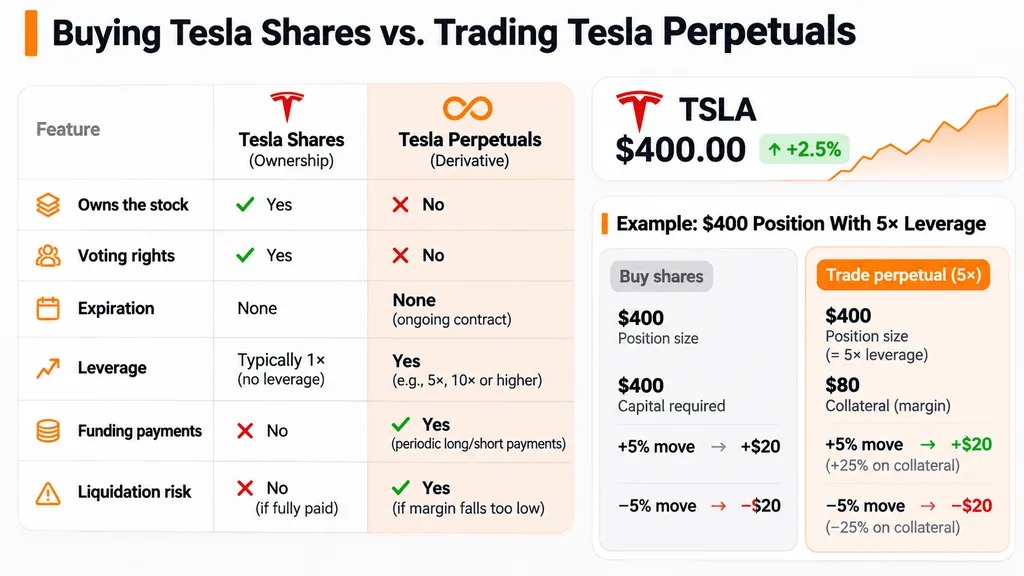
This also distinguishes derivatives from certain tokenized stock structures, the latter of which may represent different legal rights depending on the issuer.
Why would Wall Street and crypto exchanges be interested?
Cryptocurrency exchanges have proven the market's demand for sustained stock exposure.
Coinbase launched perpetual stock futures for eligible international customers in March, while Binance offered contracts linked to Tesla earlier in 2026.
Regulatory changes in the United States could bring more of such activities to domestic trading venues in the US.
The product declarations for CFTC now include perpetual contracts that have been approved and use companies such as NVIDIA and Tesla as reference targets.
Meanwhile, Intercontinental Exchange (ICE), the parent company of the New York Stock Exchange (Intercontinental Exchange), announced a partnership with a market based on Hyperliquid.
ICE and Trade [ XYZ ] intend to develop a regulated US trading venue that will offer perpetual positions covering stocks, commodities, currencies, and cryptocurrencies.
However, these companies still need to obtain additional approval before launching the proposed market.
What happens when Tesla's stock market is closed?
The biggest challenge lies in determining a reliable price when traditional exchanges are not operating.
This may lead to price discrepancies, reduced liquidity, and sudden adjustments when regular trading resumes.
Previous experiments regarding continuous stock trading have already exposed these unresolved issues.
In addition, there are also legal obstacles. An alliance supported by Cboe and Citadel Securities has challenged the authorization of CFTC, claiming that the institution has overstepped its authority.
Therefore, the regulatory approval does not mean that every American investor will be able to trade these products immediately.
Adrian Cole
Adrian Cole has been engaged in financial market reporting for over 6 years, with a focus on cryptocurrencies, stocks, and macroeconomic trends. He tracks Bitcoin, major altcoins, U.S. stocks, interest rates, commodities, as well as data that drives market fluctuations. Over the years, he has written hundreds of market updates and analysis articles, with an emphasis on price trends, investor sentiment, and the connections between traditional finance and digital assets.