Key Points
- S&P 500 earnings unexpectedly drop to a four-year low
- 84% of companies still exceeded Wall Street's expectations in terms of profitability.
- Despite the narrowing of the profit margin exceeding expectations, U.S. corporate profits are still growing significantly.
U.S. companies are still exceeding Wall Street's expectations in terms of profitability, but the margin of excess has narrowed to one of the smallest levels in four years, despite a disproportionately high proportion of companies in the S&P 500 index reporting profits that surpassed forecasts.
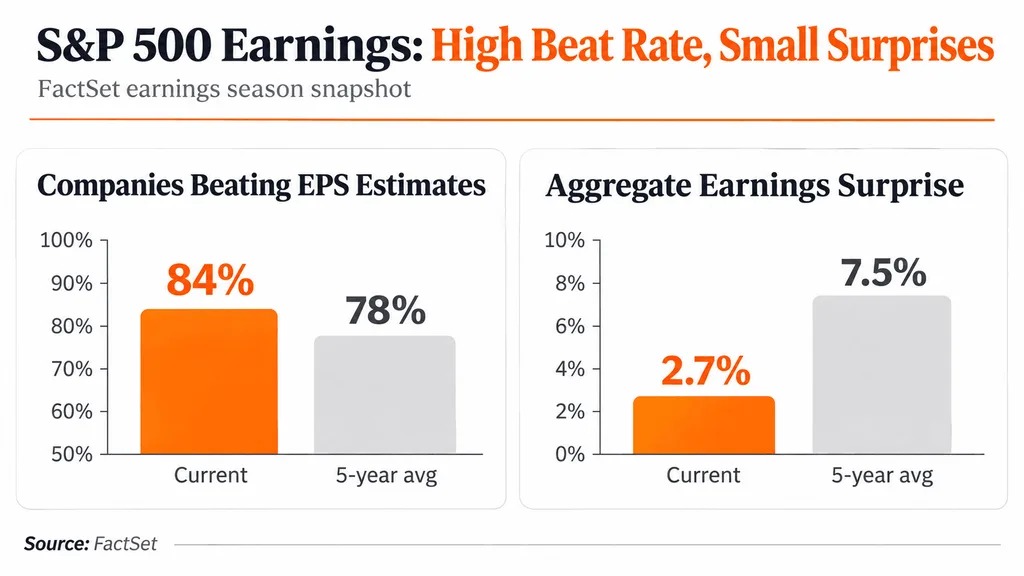
According to the financial report update released by FactSet on November 6th, companies that have announced their third-quarter results have achieved overall profits that are only 2.7% higher than the market's consolidated expectations, compared to a five-year average of 7.5%.
If this figure remains unchanged at the end of this financial reporting quarter, it will be the smallest positive earnings surprise since the fourth quarter of 2022. Back then, corporate earnings were only 1.3% higher than expected.
84% of companies exceeded their profit expectations, but the extent of exceeding expectations remains limited.
This "proportion exceeding expectations" is still higher than the five-year average of 78% and the ten-year average of 77%, indicating that the overall profitability of enterprises still exists on a widespread basis.
However, the extent of these “surpassing expectations” presents different scenarios.
The overall profit was only 2.7% higher than expected, significantly lower than the five-year average of 7.5% and the ten-year average of 8%.
The reason this distinction is important is that "how many companies exceed expectations" measures the frequency at which companies surpass their forecasts, whereas "the magnitude of overall profit surprises" measures the size of the gap between actual profits and projected profits.
Despite intensified selling on Wall Street, corporate profits still grew by 31.4%
Despite the unexpected narrowing of profit margins, the overall profitability of the company is still expanding rapidly.
FactSet It is expected that the year-on-year growth rate of combined earnings for the S&P 500 constituents will be 31.4%, which is higher than 30.1% a week ago and also higher than 29.1% at the end of September.
If this data is confirmed, it will be the third consecutive quarter with a profit growth rate of over 25%.
All 11 sectors achieved annual profit growth, with the energy, information technology, and materials sectors leading the gains.
Revenue performance was also strong, with 74% of companies exceeding expectations, and overall revenue was 2.1% higher than anticipated.
However, as investors re-evaluate the costs of expanding computing infrastructure, the valuation of AI stock has significantly shrunk.
This differentiation was particularly evident in October: at that time, most of the components of the S&P 500 index rose in value, while large technology companies faced large-scale selling off.
Investors question the expenditures of AI, and the valuation of the S&P 500 falls
This valuation multiple has fallen from 19.0 at the end of September, indicating that the price investors are willing to pay for each dollar of future expected earnings is decreasing.
This repricing coincides with a new round of selling in the tech sector and an intensification of market scrutiny over the infrastructure financing of AI.
For companies such as CoreWeave, the higher borrowing risks further increase the difficulty for investors to predict future profitability.
However, a smaller-than-expected overall profit margin does not necessarily indicate that a company's financial performance is deteriorating.
Analysts still expect that fourth-quarter earnings for the S&P 500 will grow by 28.4%, with an annual earnings growth rate of about 33.3%.
Wall Street's previous forecasts already took into account a considerable profit expansion, so companies now face increasingly high expectations.
Maya Bennett
Maya Bennett is a financial journalist whose reporting covers cryptocurrency, stocks, and a broader range of market trends. Her areas of focus include Bitcoin, major digital assets, the stock market, monetary policy, as well as economic developments that influence investor sentiment. She is adept at transforming rapidly changing market situations into clear and concise reports.