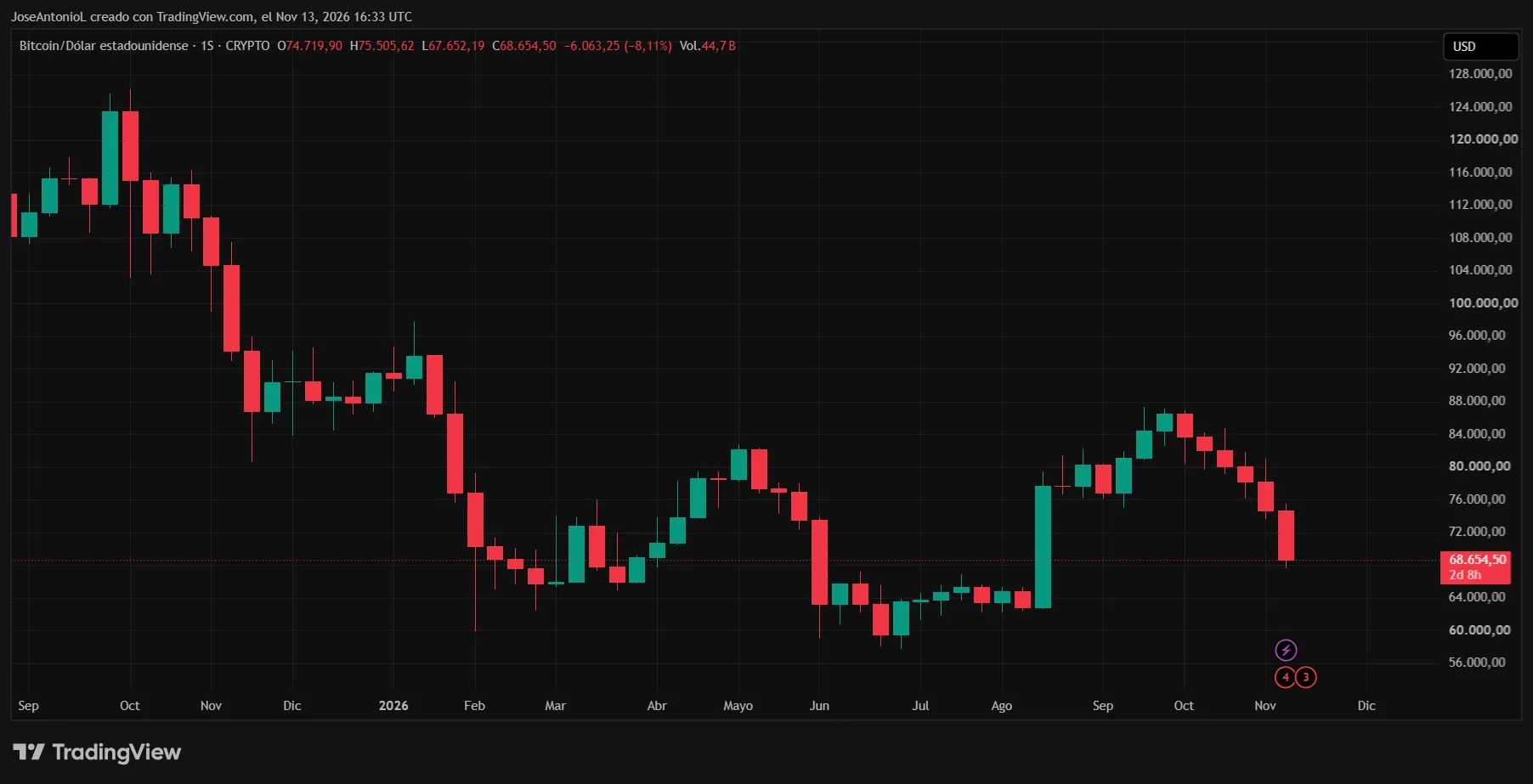
Bitcoin fell to around $68,500 on Friday, hitting its lowest level in 12 weeks and erasing most of the gains since late summer.
According to market data from Friday, BTC fell by about 4.5% in the past 24 hours and has seen a cumulative decline of 9.5% this week. Ethereum has been hovering around $1,925, while Solana has fallen below $80, with a selling sentiment spreading to major cryptocurrencies.
November low point
Inflation adds weight to the December resolution
Chicago Fed Chair Ostin Gulbsby warned on Friday that inflation is no longer limited to energy and tariffs alone; rising costs of services and healthcare, as well as demand from AI data centers, are all contributing to increased price pressures.
According to Reuters, Goolsby stated: "Are we on the path to returning to 2%? My current feeling is that we are not, and we must address this issue."
Gulbsby did not explicitly support a rate hike in December. However, other Federal Reserve officials were more direct in their statements.
On Tuesday, Federal Reserve Board member Christopher Waller stated that he supports raising interest rates by at least 25 basis points, or 0.25 percentage points, at the meeting on December 8-9.
He also set a threshold for considering more radical measures.
In an official speech, Waller said, "If the inflation data for October CPI to be released later today is similar to the readings from the past two months – with core CPI inflation at around 0.3% or even higher – then more robust policy measures may be necessary."
Subsequent reports indicated that the core CPI index had risen by exactly 0.3%, exceeding the expected 0.2% and also meeting the conditions for Waller to consider raising interest rates by 50 basis points.
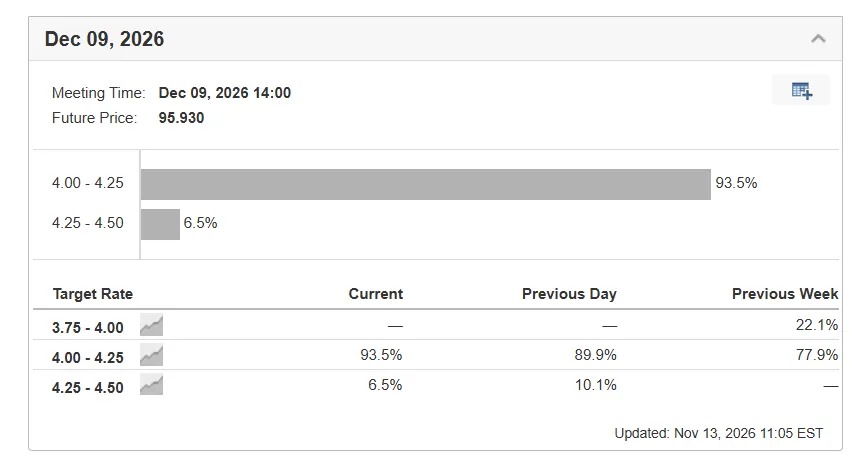
The market also reacted accordingly. On November 13th, futures market interest rate probabilities indicated that the market believed the probability of a 25-basis-point interest rate hike was 91.9%, and the probability of a 50-basis-point hike was 8.1%.
These numbers reflect traders' expectations, not the decisions of the Federal Reserve. The current target interest rate range of the Federal Reserve is 3.75% to 4.00%.
The producer price report released on Friday also added to these concerns. Wholesale prices rose by 0.3% in October, lower than expected, but still increased by 6.5% year-on-year, marking the largest annual increase since 2022.
For Bitcoin, higher interest rates would make traditional interest-bearing investments more attractive, thereby reducing the appeal of speculative assets.
ETF Increased capital outflows exacerbate selling pressure
Meanwhile, in the US spot Bitcoin market (ETF), there has been a net outflow for six consecutive trading days, with a total outflow of approximately $1.49 billion from November 5th to November 12th.
On Thursday, there was a net outflow of $47.7 million, continuing the five-day trend of outflows and adding further pressure to an already weak market.
This does not mean that institutional investors have given up on Bitcoin. These funds still hold a cumulative net inflow of about $55.5 billion at present, but it also reflects the level of nervousness among investors.
ETF demand is weakening, and leveraged traders are forced to close their positions, which may accelerate the decline in prices when buying orders are scarce.
Bitcoin Price: What Do Technical Indicators Show?
The daily chart of Bitcoin currently shows a clear sequence of "lower highs and more lows," confirming a short-term bearish trend.
Its Relative Strength Index RSI has dropped to 25.4. A reading below 30 is generally considered oversold, indicating that selling pressure may have become excessive.
The Average Directional Index ADX is at 25.3, indicating that a trend has formed. Combined with the downward price movement, this suggests that bearish momentum is still evident.
There is still a relatively long-term positive signal: the 50-day exponential moving average is still above the 200-day EMA, maintaining a bullish structure above the moving averages. However, the price of Bitcoin has fallen below the shorter-term moving averages, indicating that recent momentum has turned against buyers.
The immediate support level is around $67,650, which is also the low point during trading on Friday. If this level is lost, there is a possibility of further decline to a deeper support area around $64,000.
On the upside, Bitcoin needs to recover to $70,815 and $72,775 first before it can challenge the stronger resistance zone between $74,355 and $75,937.
Extreme oversold readings coexisting with strong downward momentum indicate that there is still room for a short-term rebound in prices, but it is not yet sufficient to prove that a bottom has been formed.
Currently, traders are faced with two important macroeconomic indicators: the minutes from the Federal Reserve's meeting on November 18th, and the PCE inflation report released on November 25th. Both of these datasets could influence market expectations regarding the interest rate decisions in December.