There is further progress in the legal dispute between Apple and Epic Games regarding the policies of the App Store app store.
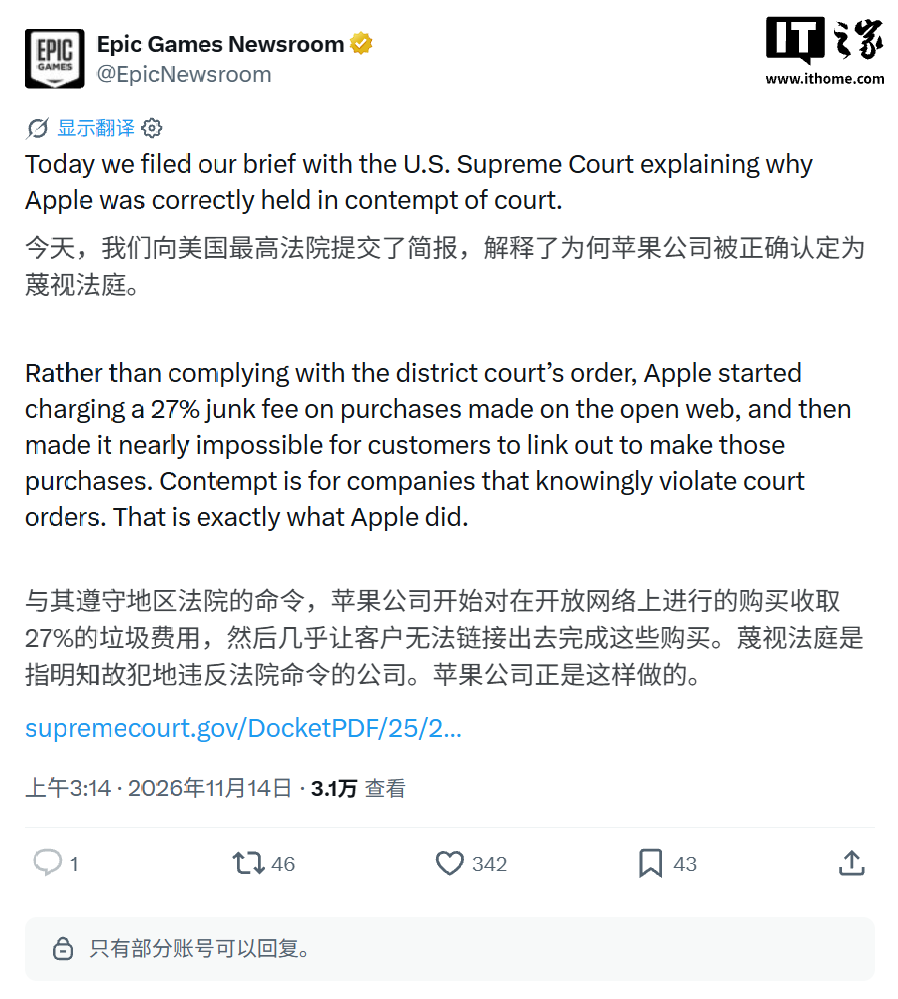
On November 13th local time, Epic Games submitted the latest legal documents to the United States Supreme Court, requesting that the previous appeal filed by Apple be dismissed and that the court's ruling of contempt against Apple made by the lower courts be upheld.
According to Reuters, Epic has also expanded its legal team this time by hiring Nicole Sahalski (from the American law firm Mayer Brown), a senior lawyer specializing in token issuance le Saharsky, to assist in dealing with the upcoming Supreme Court litigation.
Sakharovsky has participated in debates over 32 cases at the United States Supreme Court. Currently, he will work together with the legal teams of Cravath, Swaine, and Moore (who have long-term collaborations with Epic) to handle this case.
The core of this dispute is whether Apple has complied with the previous court ban regarding the anti-guidance (anti-redirection) policies for App Store Anti-steering. Epic sued Apple in 2020, questioning Apple's control over transactions within the iOS app, as well as the restrictions on how the app is distributed.
In 2021, the Federal District Court of California in the United States required Apple to allow developers to include external links in their applications, directing users to complete purchases through methods other than Apple's own payment system. Apple subsequently relaxed the restrictions on external links, but still charged a commission of up to 27%, and imposed limitations on how these links were displayed.
In 2025, the United States Federal District Court of California ruled that Apple had violated the relevant ban, finding it guilty of civil contempt of court. The Ninth Circuit Court of Appeals subsequently upheld the contempt ruling, but made adjustments to the portion of the lower court's order that prohibited Apple from collecting any commissions from external transactions.
Epic indicates in the latest submitted documents that Apple has not truly complied with the court's requirements, but rather continues to hinder users from navigating to external payment channels through new charging and design restrictions.
Epic points out that Apple charges a 27% commission on purchases made from external websites, making it almost impossible for users to complete such purchases through in-app links. Epic refers to this fee as a "nuisance charge," believing that its actual effect is to continue maintaining Apple's control over in-app transactions.
Epic still accuses Apple in the document of planning to circumvent court bans from the very beginning, and of maintaining the original anti-competitive effects through internal decisions and related restrictive measures. Epic believes that the previous rulings by the court were intended to allow developers to guide users towards using external payment methods, thereby giving consumers more choices, but Apple's new policy actually weakens this goal.
Apple, on the other hand, denies violating the court order. Apple argues that the specific wording of the previous ban did not explicitly prohibit it from charging commissions, and therefore it cannot be deemed to have contempted the court merely because the court later deemed its practices to be in violation of the spirit of the ban. Apple is represented by Gregory Gare, who once served as the Deputy Attorney General of the United States Department of Justice ( Gregory Garre ).
According to the case schedule published by the U.S. Supreme Court, the court plans to hear Apple's appeal against the contempt of court ruling on January 11, 2027. This hearing will focus on whether the court can determine that the parties constitute civil contempt of court based on the actual purpose and spirit of the injunction. The case number is Apple Inc v. Epic Games Inc (25-1311).