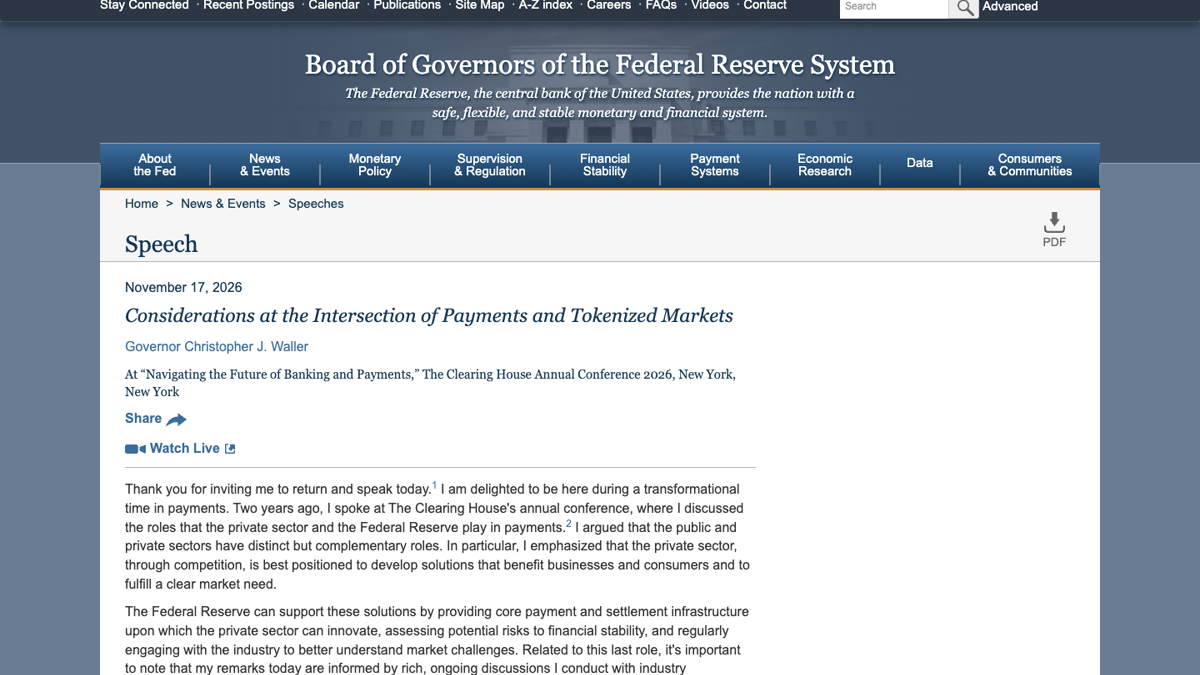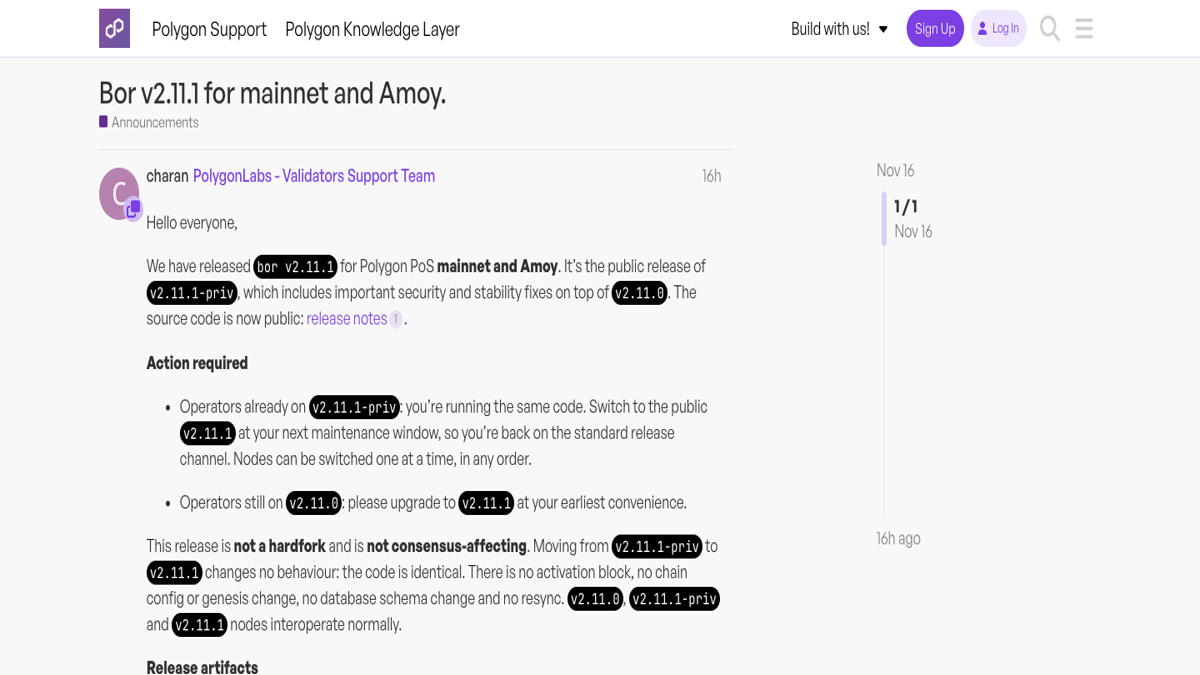


Federal Reserve Board member Christopher Waller discussed tokenized payments on November 17 in New York, specifically mentioning the issues exposed by recent events at Binance. A report title cited in the lecture notes read that Binance suspended trading after becoming the target of the largest cyberheist in history.
This speech took place at the 2026 annual meeting of the Clearing House Association. Two years ago, Waller discussed the division of labor between the public and private sectors in payments at the same meeting. This time, the topic shifted to the intersection of blockchain and existing markets. He said that these views stemmed from continuous exchanges with participants in traditional finance and decentralized finance, including a payment innovation roundtable he hosted at the Federal Reserve on September 18th.
First, explain these three words in plain language.
Waller first defined the terms. A blockchain is essentially a database, and the difference lies in who can store copies of it, who can read it, and who can modify it. Tokenization is about changing the form of assets so that they can be used on another platform. He used casino chips as an analogy: cash cannot be used on a gambling table, but once it is converted into chips, it can.
A smart contract is a piece of code embedded within a database, and it will only execute and record transactions when all conditions are met simultaneously. He gave an example: stablecoins are already being used in the background for debt settlement among members of card organizations, and the Clearing House Association is also building a network for tokenized deposits for clearing and settlement.
He describes the current situation as a competition between newcomers and established institutions. Open blockchains operate non-stop throughout the year, and smart contract code is often made public, allowing anyone to write and launch a contract on the same day; established institutions, on the other hand, have customer relationships, network effects, and market credibility. Some institutions build their own chains that they ultimately control, some form alliances to build together, and others collaborate with emerging blockchain companies. Waller believes that the market does not need to converge into a single model; rather, it is more likely that multiple approaches will coexist. The question that arises is which ones are trustworthy.
Who is responsible in case of an error?
The focus of the speech is on trust. He stated that trust in the field of payments needs to be measured over years, even decades; it is difficult to earn but easy to lose. Waller listed several specific issues: who bears the responsibility when scammers use smart contracts to carry out their crimes automatically; how are the operators of new systems responsible in cases where private keys are stolen or lost, transactions are misdirected, or quotes are incorrect; what should be done when assets get trapped on a failed blockchain? He referred to such chains as “zombie chains,” meaning networks that are rarely developed or used on a daily basis.
He believes that these issues cannot be resolved solely by technology. When assets are transferred across networks, legal identity, ownership, economic terms, compliance obligations, and liquidity must all be taken into account; the legal handling of tokenized claims, settlement records, custody, bankruptcy, and disposal determine whether institutions can enter the market on a large scale. Systemically important transactions may require the most conservative design, sacrificing some of the creativity of open networks in exchange for greater privacy and control.
Settlement template for stock purchases on Saturday
Waller envisioned a scenario where investors buy a tokenized stock on Saturday. Since most traditional systems are closed on weekends, using tokenized currencies allows for simultaneous payment and delivery of the stock, reducing the risk of one party failing to fulfill their obligations while the other does. This approach of either completing everything or not completing anything at all is known as atomic settlement.
But he echoed the reminder from market participants that atomic settlement should not be the only model. High-frequency capital market transactions place more emphasis on preserving liquidity; net settlement and batch settlement, which only require payment for the net amount, are still useful. He expects that multiple payment schemes will coexist, with stablecoins, tokenized deposits, and tokenized money funds all entering the market, and companies may use several of them simultaneously.
The most clear stance in the speech is regarding central bank money. Waller stated that central bank money does not need to be present in every transaction or on every platform, but its existence at the foundational level of the system is essential; traditional large-value and real-time payment channels have already been used for the inflow and outflow of stablecoins, as well as for the settlement of tokenized deposit transactions.
For readers who hold stablecoins or trade on centralized platforms, they can use Waller's questions as a criterion for judgment: when evaluating a tokenized product, first consider who is responsible in case of private key theft or loss, misdirected transactions, or pricing errors, and then check whether its funding channels with the banking system are secure. Waller emphasizes that these are his personal views and do not represent those of the Federal Reserve Board or the Open Market Committee.
At the end of his speech, he also discussed tokenization and AI agents together. Waller stated that agent-based commerce is still in its early stages, and the two may catalyze each other, while also facing the same issues regarding trust, standards, and whether to have open or closed networks. In areas where market forces cannot resolve these issues, and which fall within the jurisdiction of the Federal Reserve, the Fed can act as a connector and convener.
Federal Reserve governors have included the Binance incident in their official speeches. What the tokenization market needs to present next is a responsibility framework in case of incidents, not just faster settlement speeds.