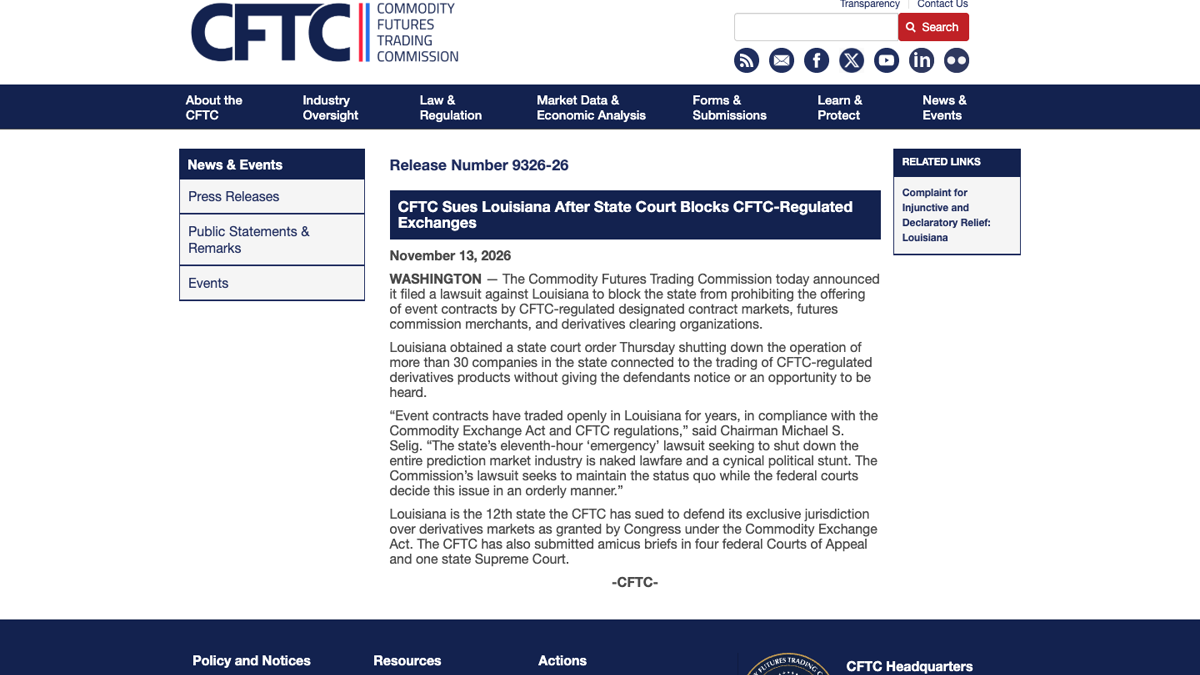


On November 12, Louisiana applied to the state court and obtained a temporary restraining order that very same night, prohibiting 32 institutions from offering event contracts to residents of the state. The following day, the Commodity Futures Trading Commission (CFTC) of the United States and the U.S. government sued the state in federal court.
This 38-page indictment was filed on November 13th with the Eastern District Federal Court of Louisiana. Among the 32 institutions named by the state court are designated contract markets, futures brokers, and derivatives clearing institutions registered under CFTC, which are commonly referred to in the outside world as prediction markets and their trading and clearing chains.
Ban Overnight
The restraining order issued by the state court is quite broad: it prohibits the operation, listing, acceptance, liquidation, settlement, brokerage, market-making, or any other means of providing ‘event contracts’ to individuals located in Louisiana, which are referred to as bets under state law. The scope of application covers sports, elections, award ceremonies, as well as other contracts that are considered sports betting under state law.
CFTC stated that this application was unilaterally made, and the defendant was neither notified nor given an opportunity to make a statement. On the same day, the predictive market platform Kalshi had just applied to the federal court for a temporary restraining order in an attempt to prevent the state government from enforcing the law. According to the indictment, the state government did not proceed with the cases through the proper legal process but instead obtained a restraining order from the state court first.
The indictment outlines the previous escalation process. In December 2025, the State Gambling Commission issued a notice classifying contracts related to sporting events as illegal gambling. On August 1, 2026, Act No. 182 was enacted, which expanded the definition of “computerized gambling.” Practitioners could face fines of up to $100,000 and imprisonment of up to 5 years, while accomplices could be fined up to $20,000 and also sentenced to 5 years in prison; courts could also freeze relevant bank accounts upon application by the Attorney General.
This bill defines as such any games that allow participation or use of a dual-currency payment system on the internet or mobile devices, which can be used to exchange for prizes or cash and that simulate gambling. It also authorizes the Attorney General and the Chairman of the Gambling Regulatory Commission to issue stop orders directly. According to the indictment, anyone involved with these contracts may face severe civil and criminal penalties.
Dispute over Federal Exclusive Jurisdiction
The central argument of the federal government is that the Commodity Exchange Act grants CFTC ‘exclusive jurisdiction’ over futures, options, and swaps on regulated exchanges. Since the event contracts fall under the category of swaps, state gambling laws are thereby preempted by federal law. The indictment requests the court to declare state laws invalid in these transactions and to prohibit state governments from enforcing or extending the restrictions imposed on November 12th.
President Michael Selig, in a strong-tongued statement in the press release, described the state government's "emergency" lawsuit as a blatant legal battle. The press release stated that Louisiana is the 12th state CFTC to file a lawsuit in defense of its jurisdiction, and the organization has also submitted amicus curiae opinions to four federal appellate courts and one state supreme court.
The indictment also proves that the federal government is not standing by idly. It lists the enforcement actions taken by CFTC regarding these contracts: a U.S. military personnel was prosecuted for trading contracts related to the ouster of Venezuelan President Maduro using non-public information, and a Google employee was prosecuted for trading contracts related to the “annual search” rankings using internal information; in 2022, CFTC imposed a fine on Polymarket and ordered it to cease its operations in the United States.
The indictment also lists recent regulatory actions taken by CFTC: on October 19th, it issued a rule in the Federal Register that further defined swaps, clarifying that gambling under state regulation does not fall under the category of swaps; previously, it had signed memorandums of understanding on information sharing with the National Basketball Association (NBA), Major League Baseball (MLB), and the National Hockey League (NHL). It emphasizes that the prediction market is provided with liquidity by institutional market makers on the public order book, who earn from the bid-ask spread, which is different from sports betting companies that extract profits from fixed odds.
Users should first check which state they are in.
For readers who trade in the prediction market, the most immediate factor affecting their operations is geographical location: The state court ban targets individuals located in Louisiana. The indictment mentions that similar disputes in other states have resulted in rulings in favor of the exchanges by federal courts, including the Kalshi case by the Third Circuit Court of Appeals, as well as a case involving Coinbase Financial Markets by the Northern District Federal Court of Illinois. However, the progress of these cases varies from state to state.
The federal government has requested the court to issue a ban as soon as possible; the case has just been filed. The change that has already occurred is that the debate over the legality of predictive markets has escalated from companies filing lawsuits on their own to the federal government directly suing state governments.