The three pillars of AI trading have all weakened simultaneously, leading to a fierce sell-off in U.S. tech stocks. Market concerns regarding the AI bubble and a slowdown in economic growth have rapidly intensified.
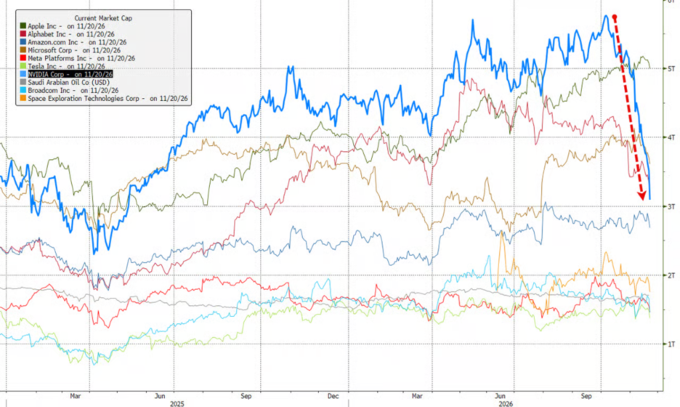
This week, the Philadelphia Semiconductor Index ( SOX ) tumbled by more than 10%, experiencing the worst single-week performance since 2001, with the overall market value of the chip sector evaporating by about $2.3 trillion. NVIDIA's stock price has fallen for the seventh consecutive week, setting a new record for the longest streak of declines since 2008, and its market value has shrunk by about $2.7 trillion since its historical high, which is equivalent to a loss equivalent to that of Amazon.
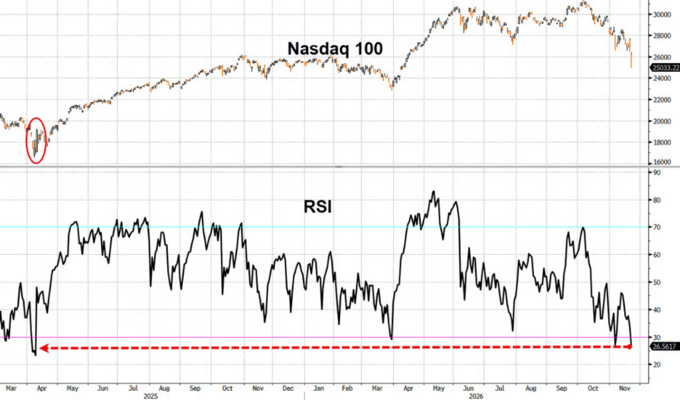
The sell-off quickly spread throughout the U.S. stock market. The S&P 500 index fell for seven consecutive trading days, with a weekly decline of over 9%, marking the largest weekly drop in recent years; the Nasdaq 100 index also fell by more than 10% in a single week, erasing all of its gains for the year. The VIX index once broke through 40, and market panic intensified sharply.
It is worth noting that although NVIDIA's financial results were impressive, and several record-breaking events occurred one after another, they failed to boost market confidence. The change in financing attitude of these giants, along with the Federal Reserve's hawkish stance remaining unchanged, has led the market to re-evaluate the underlying support for this current market trend.
Chip stocks suffered the worst one-week sell-off since 2001; NVIDIA tumbled by as much as Amazon's decline.
This week, the Philadelphia Semiconductor Index fell by more than 10%, with the market value of the chip sector evaporating by approximately $2.3 trillion, marking the worst single-week performance since 2001.
NVIDIA was not spared either. Despite the company's latest quarterly results and performance guidance exceeding market expectations, its stock price has continued to fall for seven consecutive weeks, setting a new record for the longest streak of declines since 2008. On Friday, the stock price tumbled further, closing at its lowest level since May 2025.
Since its historical high in October, NVIDIA's stock price has fallen by approximately 47%, and its market value has shrunk by about $2.7 trillion, which is equivalent to the market value of Amazon. Currently, the company's market value is around $3.03 trillion, which is now lower than Alphabet.
It is worth noting that NVIDIA's fundamentals have not significantly weakened: the company has exceeded seller expectations for the 17th consecutive quarter, with fourth-quarter revenue guidance reaching $130 billion, higher than the market's expectation of $125 billion. The company has also raised its growth forecast for fiscal year 2028 from 70% to 75%. The focus of market concerns is now shifting to the financing and growth model of the AI ecosystem.
NVIDIA reduces its involvement with the “AI Central Bank” role; ecosystem financing support shifts towards prudence
According to MarketWatch, NVIDIA's new chairman Harvey Jones has made it clear that Jensen Huang will not return to the company, and at the same time, signals have been sent to tighten customer financing support: the company will only provide financial support once projects meet physical requirements such as land, electricity, and construction.
The Goldman Sachs TMT team interprets this as NVIDIA taking a proactive step to reduce its role as a “AI central bank.” Previously, NVIDIA was not only a chip supplier but also supported the AI ecosystem through financing guarantees and other means. Now, with a more cautious attitude, this could impact new cloud computing companies that rely on NVIDIA's guarantees or purchasing support.
Nohshad Shah points out that founders like Jensen Huang are able to push the company to undertake high-risk investments that professional managers find difficult to justify to the board of directors. Goldman Sachs, on the other hand, Rich Privorotsky, believes that NVIDIA, which was previously seen as a "long put option" in the AI ecosystem, has now reversed this role and has even become a "short put option" for the market.
Anthropic Sets a record; IPO Turns into a liquidity black hole; AI Assets face mass sell-offs
Anthropic was originally seen as another test of the confidence in the AI industry. This Claude developer set a price higher than the issuance range, raising funds amounting to 107.3 billion US dollars (including 26 billion US dollars allocated to chip and cloud suppliers), completely diluting a valuation of about 1.5 trillion US dollars.
However, IPO failed to boost the market and instead triggered a liquidity shock. Anthropic shares opened at $111.50 but were quickly sold off. The Nasdaq 100 index shifted from a 2% gain before trading to a 2% decline, and the AI stock basket also turned from a 4% increase to a 2% drop. The market value of the S&P 500 index evaporated by about $1.3 trillion that day.
Market participants believe that investors' efforts to raise funds in advance for IPO have exacerbated the selling of other assets. Gold, cryptocurrencies, copper, and NVIDIA stocks were all sold in the days leading up to IPO. Bloomberg cited analyses stating that the abnormal decline in Bitcoin before its issuance is consistent with investors' behavior of raising funds for subscriptions.
By the close of trading on Friday, the stock price of Anthropic fell to around $83.10, nearly returning to its issue price of $83, representing a decline of over 25% from the high of $115.10 on Thursday. The underwriters have fully exercised their over-allotment rights, selling an additional 147 million shares, which means that potential tools to stabilize the stock price are further reduced.
Fed hawks exert pressure, and the fragile market structure amplifies the downward trend
The Federal Reserve further strengthened its tightening signals this week. Governor Waller reiterated his support for a 50-basis-point interest rate hike, noting that the inflation rates for about 70% of core service items still exceed 3%. The Fed may need to reverse all three of last year's preventive rate cuts and even take additional measures. He also stated that policy actions may be necessary to "deter the market."
The October meeting minutes also show that some officials tended to favor raising interest rates, and many participants believed that the demand from AI needed to continue to put pressure on supply and drive up prices. Bloomberg data indicates that the indicator of Fed officials' hawkish or dovish stances has risen to the most hawkish level since 2023.
The market structure further exacerbated the selling pressure. According to Goldman Sachs’ data, the net long-short leverage on fundamental grounds dropped by another 7.6 percentage points this month, reaching its lowest level in over five years. Market makers held a large number of short gamma positions before the expiration of options on Friday, which made it easier for the decline to trigger further hedging sales.
Goldman Sachs data shows that on Wednesday, the average depth of trading in S&P 500 futures was only $4.2 million, making it one of the least liquid trading days in the past four years. However, funds have not completely withdrawn: as of the week ending November 18, global equity funds saw a net inflow of $59.2 billion, and technology funds saw a net inflow of $12.3 billion, indicating that some investors are still buying on dips.
Bond market shifts to growth concerns, AI trades face repricing
In tandem with the decline in the stock market, so too did U.S. Treasury yields. Despite Fed officials continuously sending hawkish signals, the yield on 10-year U.S. Treasuries fell for five consecutive trading days, dropping from 5.17% to 4.90%, ending the longest period since 2007 during which yields remained above 5%.
Goldman Sachs Rich Privorotsky believes that long-term yields may have begun to reflect the risks of policy mistakes. As yields decline, the break-even inflation rate is also contracting, and this combination indicates that market attention is shifting from inflation to economic growth and liquidity.
In other words, market concerns are changing: investors are no longer only focused on stubborn inflation and high interest rates; they also begin to worry that tightening policies might be excessive, as well as whether the current AI investment boom can continue to support economic growth.
Baird Managing Director Ted Mortonson stated that the market in the first half of 2026 was filled with excessive excitement, speculation, and complacency, while since this month, market sentiment has shifted towards fear and panic.
The judgment regarding Privorotsky is more cautious: before the central bank's policies truly shift, a market rebound could still present an opportunity to sell.