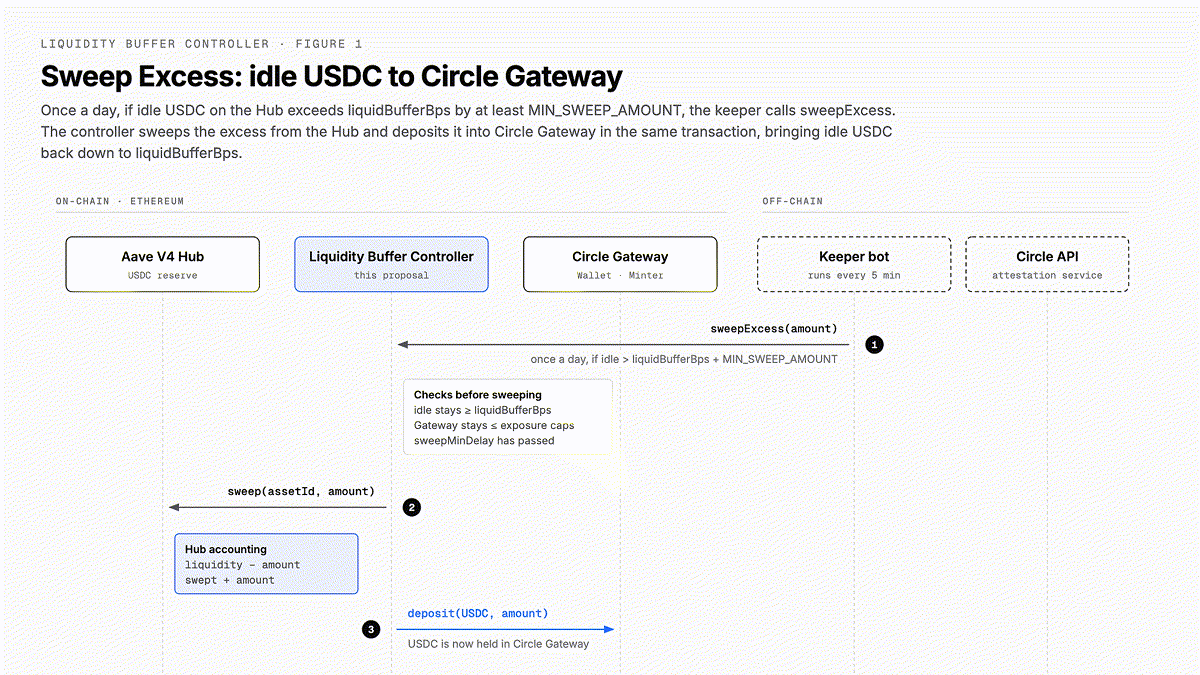


On November 20th, TokenLogic submitted a proposal at the Aave governance forum, proposing that Aave V4's Ethereum core center transfer some idle USDC to Circle Gateway to generate earnings. The normal recall process is nearly instant, but if Circle proves to cause service interruptions, on-chain withdrawals will take about 7 days.
This is the first liquidity buffer controller of Aave V4, developed in collaboration by TokenLogic and Aave Labs. The motivation is straightforward: borrowers only pay interest on the USDC they have borrowed. When the utilization rate is low, there is USDC that remains unused in the central system and thus generates no revenue. The proposal is currently in the feedback collection stage and has not yet been voted on.
Money was transferred away, but the interest rate remained unchanged.
The key to the mechanism lies in bookkeeping. The USDC that is transferred out is recorded in a separate account for transferred-out balances, and the utilization rate is calculated by dividing the amount borrowed out by the sum of idle funds, borrowed amounts, and transferred-out amounts. The transferred-out funds are still considered as supply, so both the utilization rate and the borrowing interest rate remain unchanged as a result.
The difference lies in whether it can be used or not. Only the idle portion can be extracted or lent out. The USDC that is transferred out cannot be withdrawn or borrowed by the depositor until it is recalled. Therefore, the controller must maintain a sufficient amount of idle USDC at the center and recall it quickly when the idle balance is low.
The reason for choosing Circle Gateway is that the deposited USDC can be redeemed almost instantaneously at a 1:1 ratio, with no slippage. The proposal argues that this does not increase new counterparty credit risk, as the USDC deposited in the center already relies on the issuer Circle. What is added is operational risk, which involves Circle certification services, off-chain execution robots, Gateway contracts, as well as the time it takes for funds to flow back.
5% minimum requirement, 9% buffer, and a cap of 10 million
The off-chain robot checks every 5 minutes. Once the idle USDC falls below 5% of the supply, it begins to recall funds, with a maximum of 10 million USDC per recall. There is an interval of about 30 minutes between each recall until the supply is replenished to 9%. Transfers out are allowed only once a day, and they must exceed a buffer of at least 100,000 USDC before they can be executed. Funds can only move from the center to Gateway and then back to the center; the robot is not capable of transferring money to other places.
The parameters have been tested using historical capital flows. The proposal considers each of the 6,949 withdrawals and loans since August 1st as a potential starting point for a run on the bank. It assumes that the idle funds before each such point were exactly at the minimum threshold, and then replays all subsequent inflows and outflows. In the combination of a 5% minimum threshold and a 9% buffer, a starting point with 0.46% would result in the depletion of idle funds and a rollback of transactions, which is below the acceptable threshold of 0.5%.
Based on the actual traffic since August, when replaying the process continuously, this set of parameters resulted in 21 transfers out and 20 recalls over a period of three months, with no failures in any withdrawals or loans. The longest duration during which idle funds were below the minimum threshold was about 21 minutes, which occurred on October 28th; during that time, there was still 0.2% to 5% of the available funds supplied by the center.
There are two upper limits for the open position: a maximum of 10 million USDC within Gateway, and it must not exceed 25% of the central supply. The amount of 10 million coincides with the upper limit for a single recall, allowing all funds to be retrieved at once. In the replay, the maximum holding of Gateway was 9.7 million USDC, which accounts for 16.9% of the supply.
Even the worst-case scenarios are clearly described. Circle demonstrates that recall is not possible when services are unavailable; administrators can then pause the controller and switch to on-chain withdrawals that do not rely on Circle. Currently, the delay is 7 days, which corresponds to 50,400 blocks. The proposal also points out that if Gateway accounts for 10% of the supply and the idle funds are exhausted, the reported utilization rate will only be 90%, which is below the optimal utilization rate threshold of 92%. As a result, the interest rates for borrowing will not rise sharply, and the signals for urging repayments and replenishing the supply will become weaker.
The earnings are not substantial. The supply of this center USDC increased from 9 million US dollars to 59.3 million US dollars within three months, with a recent utilization rate of about 91%. Calculated at an annualized rate of 2.9% according to Gateway, the estimated annual net income is about 14,000 US dollars; if the average utilization rate drops to 85% to 88%, the current supply would result in an annual income of about 47,000 to 93,000 US dollars.
TokenLogic disclosed in the proposal that it is the service provider for Aave DAO, as well as the beneficiary of the related capital flows and KPI listed in this proposal. The process requires that a consensus be reached on the forum first, followed by voting in Snapshot; only after approval can it be submitted for execution in AIP. Approximately three months after going live, the parameters will be re-evaluated, and when the supply increases to around 200 million to 250 million US dollars, the upper limit will also need to be reassessed.