Key Points
- Berkshire Hathaway still rose by nearly 14% despite market fluctuations
- Argus Research downgrades BRK.B rating from 'Buy' to 'Hold' due to valuation concerns
- Berkshire's defensive attributes face the test of weaker quarterly earnings
Despite market turmoil, Berkshire Hathaway's stock price has risen by nearly 14% in 2026 due to investors pulling out of artificial intelligence companies. However, Wall Street has begun to question whether the strong performance of this corporate group has pushed its valuation too high.
Nevertheless, on November 20th, Argus Research downgraded its rating of BRK.B from "Buy" to "Hold" due to valuation concerns, stating that the stock had surpassed the institution's previous target price of $550.
Why Has Wall Street Downgraded the Stock Rating of Berkshire Hathaway?
This reduction does not imply that the company is facing an imminent financial crisis. On the contrary, it reflects that investors may have paid a fairly high premium for the defensive attributes of this corporate group.
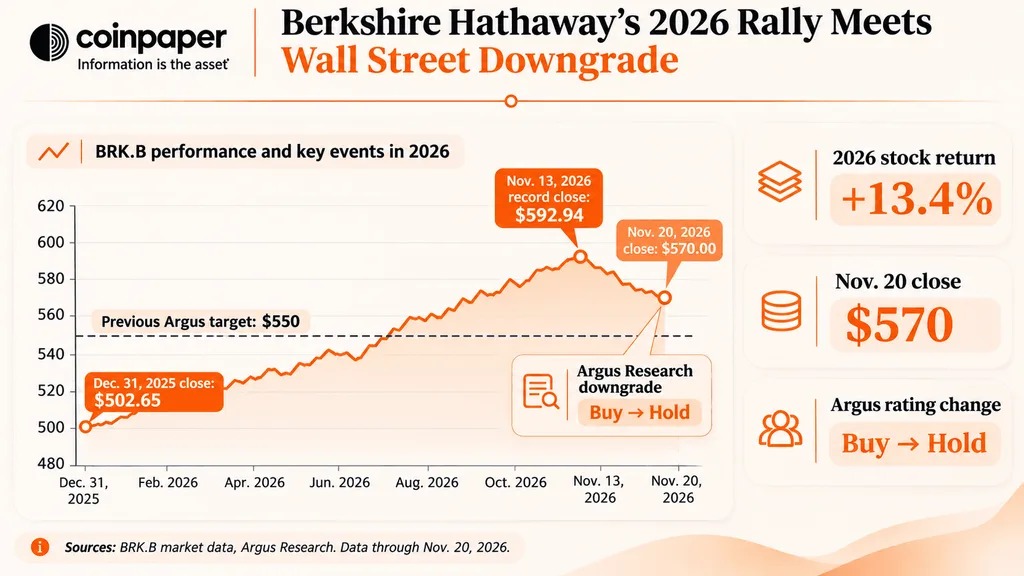
On November 13, Berkshire Hathaway set a closing record of $592.94, but then it fell back, closing on Friday about 3.9% below that high point.
The company recently announced that its operating profit for the third quarter was $12.71 billion, which is a decrease of 5.8% compared to $13.49 billion in the same period last year.
Net profit decreased by approximately 28% to $22.11 billion, partly due to changes in investment returns.
According to the financial reports submitted by Berkshire Hathaway to the U.S. Securities and Exchange Commission, the operating profit for the first nine months of 2026 was $37.03 billion, which is higher than $34.29 billion in the same period of 2025.
While NVIDIA and NASDAQ stocks tumbled, Berkshire Hathaway performed even stronger.
Berkshire's relative resilience stands in contrast to the severe setbacks encountered by artificial intelligence companies.
As of the week of November 20th, the Nasdaq index fell by about 10%, recording its worst single-week performance since March 2020.
At the same time, NVIDIA is facing new accounting reviews, and investors have begun to question the valuation of tech stocks as well as the sustainability of spending on artificial intelligence.
However, Berkshire Hathaway has not been completely immune to the weakness in the tech sector.
Can Berkshire Hathaway's stock price continue to rise after the downgrade?
In the midst of ongoing market volatility, Berkshire's financial flexibility may still be an advantage.
As of the end of September, this corporate group held approximately $357 billion in cash, cash equivalents, and U.S. Treasury bonds, providing CEO Greg Abel with ample capabilities for acquisitions, investments, and further share repurchases.
After Warren Buffett stepped down as chairman, the leadership of Abel has once again drawn market attention to Berkshire Hathaway's capital allocation.
Ethan Mercer
Ethan Mercer is a financial journalist who covers cryptocurrency, stocks, and the global economy. He studied economics and finance before turning to market reporting, with a particular focus on Bitcoin, stocks, monetary policy, and investor sentiment. His work focuses on explaining daily market fluctuations and the broader trends behind them.