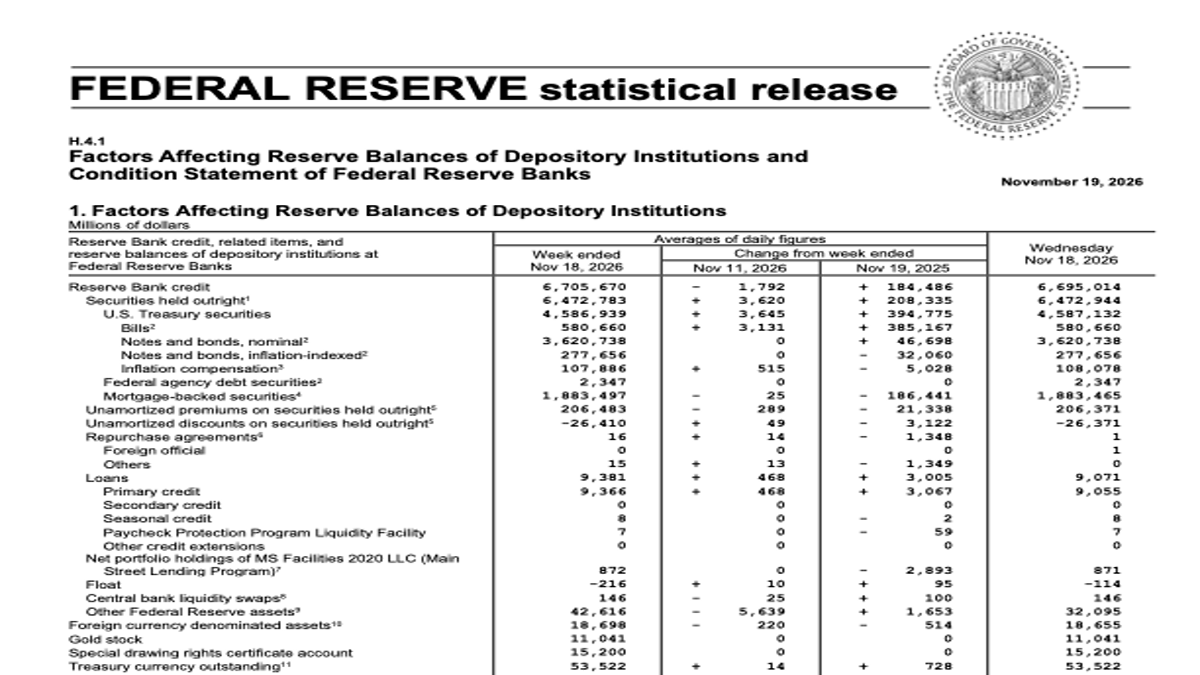


The H.4.1 released by the Federal Reserve on November 19th shows that as of Wednesday, the 18th, total assets decreased by $17.415 billion compared to the previous week, while deposits from financial institutions increased by $31.813 billion. Despite the shrinking balance sheet, the amount of money that banks hold with the Federal Reserve actually increased at the same time point.
This report was released in the early hours of November 20th, Beijing time. Let's first distinguish between two sets of figures: as of Wednesday, the balance of deposit institutions was 3.001790 trillion US dollars, and the average weekly reserve was 2.979656 trillion US dollars; the latter increased by 19.053 billion US dollars for the week. When comparing these figures at specific points in time with the weekly averages, one should not simply add the changes in one column to those in the other column.
Different trends in asset size and reserves
On Wednesday, the total assets amounted to 6.741452 trillion US dollars, a decrease of 17.415 billion US dollars from the previous period. Other assets on the asset side decreased by 17.252 billion US dollars, which is a very prominent figure in the total changes for this period; however, the balance of securities held increased by 468 million US dollars. If one only sees the decrease in total assets and concludes that it was due to selling bonds on an equal scale, it would not correspond with the detailed items in the table.
The balance of treasury bonds at various points in time was 4.587132 trillion US dollars, with a weekly increase of 525 million US dollars; the balance of mortgage-backed securities was 1.883465 trillion US dollars, with a decrease of 57 million US dollars. The latter includes securities related to residential and commercial real estate. The report specifies that the residential portion was 1.876153 trillion US dollars, and the commercial portion was 7.312 billion US dollars.
The loan balance is $9.071 billion, a decrease of $213 million from the previous week; the central bank's liquidity swap is $146 million, which has decreased by $25 million. The directions of changes in different assets are not completely consistent, so the overall change in total assets can only be summarized. The report itself does not interpret this decline in other assets as a new monetary policy decision.
On the liability side, there are two declines that are worth noting simultaneously: the balance of reverse repurchase agreements decreased by $19.21 billion to $317.043 billion on Wednesday, and the balance of the Treasury Department's general account decreased by $19.824 billion to $892.31 billion. During the same period, the balance of deposit institutions increased by $31.813 billion, and the net amount of Federal Reserve bills increased by $1.625 billion.
From this, it can be seen that changes in bank reserves require a simultaneous examination of assets and other liabilities; they cannot be simply replaced by increases or decreases in total assets. This represents the corresponding relationship in the balance sheet. As for whether banks increase their allocation of risky assets as a result, H.4.1 does not track the path of funds entering the stock or cryptocurrency markets, and therefore cannot establish a causal relationship with market trends.
On a weekly average, fiscal accounts are still increasing.
Switching to the daily average table, the general account of the Ministry of Finance amounts to 916.613 billion US dollars, which is an increase of 2.243 billion US dollars compared to the average of the previous week; however, by Wednesday, it had decreased by 19.824 billion US dollars. The co-existence of these two situations indicates that the chosen observation period can alter the description of short-term fluctuations, and they should not be regarded as contradictory data.
The average weekly reverse repurchase balance was $324.423 billion, a decrease of $12.096 billion. Of this, the balance for foreign official and international accounts was $324.124 billion, which decreased by $12.233 billion; while the balance for other reverse repurchases was only $298 million, but it actually increased by $136 million. The report also indicates that there may be slight discrepancies between individual items and the total due to rounding.
This set of structures provides a operational boundary: the total amount of reverse repurchase agreements cannot be directly considered as coming from a pool of funds solely from participants in the same market category. Especially when discussing how much liquidity can be released, it is necessary to first separate foreign official and international accounts from other projects to avoid misinterpreting over $300 billion as the available balance of the same type of instrument.
The total factors contributing to the average weekly provision of reserves amount to 6.804131 trillion US dollars, a decrease of 1.997 billion US dollars; factors that attract funds other than reserves total 3.824475 trillion US dollars, a decrease of 21.05 billion US dollars. Subtracting the latter from the former, we find an increase in average weekly reserves of 19.053 billion US dollars, which is consistent with the corresponding line in the report.
The average weekly increase in circulating cash was 3.491 billion US dollars, the general account of the Treasury Department increased by 2.243 billion US dollars, and other deposits decreased by 12.415 billion US dollars. Several items increased or decreased separately, and finally they all contributed to the total figure. Readers can verify the results by following this set of additions and subtractions; there is no need to create a macroeconomic narrative for each account's fluctuations beforehand.
The same report also includes securities with different identities.
H.4.1 Additionally, there are securities held in custody by foreign official and international accounts, with a balance of 2.813231 trillion US dollars on Wednesday; of this, 2.544011 trillion US dollars are tradable US Treasury bonds. These are listed under memorandum items and are separate from the Treasury bonds held by the Federal Reserve itself, and therefore cannot be added together to constitute the Federal Reserve's Treasury bond position.
The report footnotes also distinguish between the face value of government bonds, inflation compensation, and the remaining principal of mortgage-backed securities. Securities assets are not valued in exactly the same manner in every row. If this weekly table is to be compared with data from other market pricing sources, it is more reliable to first verify the measurement basis rather than directly interpreting changes in balances as trading volumes.
For investors tracking the liquidity of the US dollar, the most useful method of verification for this period is to maintain the same date and scope, and then compare total assets, reserves, fiscal accounts, and reverse repurchases side by side. It has been confirmed that assets decreased on Wednesday while reserves increased; whether this trend continues, and which liabilities will change next, will be answered by subsequent data with the same scope.