














According to research published by DeFiLlama Research, the mump2p network service of Optimum has delivered Ethereum blocks earlier in 91.6% of the observed time slots since its mainnet launch in October, and has reduced the fluctuation in block arrival times by more than half.
In Optimum, mump2p delivers to Ethereum blocks earlier in 91.6% of the 50,273 observation time slots.
The block arrival latency decreased from 388.8 milliseconds (above GossipSub) to 181.8 milliseconds when using mump2p, representing a reduction of 53%.
As of November 10th, the connected staking scale reached 3.44 million ETH, which accounted for approximately 7.9% of the total ETH that had been staked at that time.
Verifiers have found that there are fewer votes with incorrect headers, while the bid earnings for MEV are still just estimated values.
Independent tests show varying results, and the RLNC library of Optimum is still not forkable.
According to DeFiLlama Research, this service will reduce the propagation latency on Ethereum's traditional gossip network from 388.8 milliseconds to 181.8 milliseconds in the observed network. The 53% reduction measures the consistency of blocks reaching different nodes, rather than a halving of the average transmission time for each block.
Optimum accelerates Ethereum block transmission in 50,273 time slots
These data come from a 7-day observation period from November 4th to 11th, covering 50,273 Ethereum time slots. Optimum compared the data of 372 gateways running mump2p, as well as the data of 194 public Xatu monitoring nodes that monitor traditional GossipSub traffic.
Ethereum typically distributes blocks by forwarding proposed blocks to its neighbors through connected nodes. Optimum uses random linear network coding ( RLNC ) to send encoded data combinations over multiple paths. Receiving nodes can reconstruct the block once they have obtained a sufficient number of independent data packets, without having to wait for a specific data packet to arrive.
This service runs alongside the existing Ethereum consensus clients, therefore operators do not need to change the consensus rules. Optimum refers to the receiving service as Signal, and the service for proposers as Accelerate. Signal is free for validators, while self-service use of Accelerate requires at least 200 validator keys.
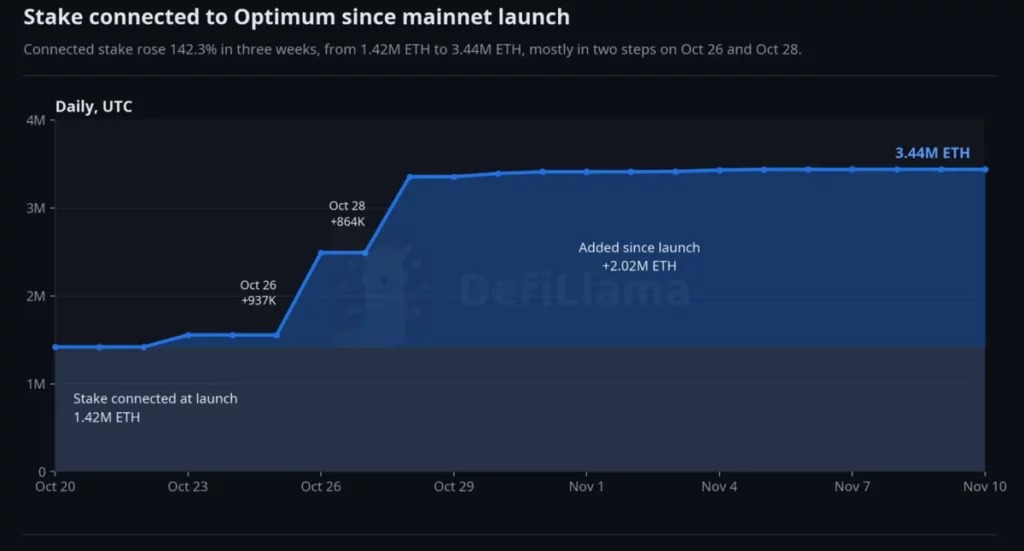
As previously reported by crypto.news, the protocol was launched on October 20th. At that time, 16 operators were managing approximately 22,000 verifier keys and 1.42 million ETH.
The connected collateral scale has reached 3.44 million ETH.
As of November 10th, the scale of staking connected to mump2p has reached 3.44 million ETH, which represents a 142% increase since its launch, and is approximately equivalent to 7.9% of the 43.7 million ETH that were staked at that time. Optimum refers to this metric as Total Value Boosted; it counts the staking operated by participating providers, rather than the ETH deposited into their own contracts.
The adopters include Blockdaemon, Everstake, and P2P.org. Ether.fi requires all 12 node operators to install gateways, involving approximately 1.4 million ETH, which accounts for 41% of the connection pledging scale disclosed by that service. The significant increases on October 26th and 28th contributed to most of the increment during this period.
Operational research shows that verifiers' earnings may improve. In a sample group representing 1.11 million ETH, it was found that the error-headed voting rate decreased from 0.127% to 0.0841% between the research periods of June and September. Another study involving 2,185 verifiers using Blockdaemon recorded a decrease in this ratio from 0.452% to 0.273%.
Faster blocks may give verifiers more time to collect bids for MEV.
For block proposers, receiving and publishing a block earlier will affect the timing of selecting a bid from competitive builder through MEV-Boost. Waiting may bring about better bids, but publishing too late may result in other validators missing that block.
Optimum tested delaying the bidding deadline by 20 to 160 milliseconds in 6 mainnet experiments. The company stated that in cases where the release time was delayed by approximately 160 milliseconds, no more orphan blocks or locally constructed blocks appeared. Developer models estimate that builder bids increased by 8.4% compared to the initial quotes. This is merely an estimate and not the actual revenue that has been realized.
In another analysis of the market disturbances surrounding Binance on October 30th, Optimum reported a 253-millisecond advantage in the 95th percentile latency indicator and achieved acceleration in 90% of the blocks.
The model shows that if an additional 200 milliseconds are allocated for bidding selection, approximately 3,100 blocks could result in over 460 ETH. The additional earnings are hypothetical and depend on the proposer accepting later bids, without introducing any additional dissemination risks.
Independent tests raise questions about network dependence
Performance results are not consistent. A 36-node independent mainnet test discussed on the Lido research forum showed that some Ethereum clients had a faster arrival time, while for others there was little change; however, the results of Nimbus were slower.
The tester wrote, 'Blocks arrived earlier on 3 out of 6 clients,' but the observed differences were not statistically significant. In response, Optimum stated that 'global acceleration is active on the Ethereum mainnet,' which means that nodes that are not connected may also benefit. The company mentioned that redesigning the testing arrangements will help to more clearly distinguish the benefits.
The gateway can be shut down, but verifiers can still continue to use the regular Ethereum gossip network. However, Optimum indicates that its gateway code is open-source, and although the underlying RLNC library is readable, it cannot be forked according to its licensing arrangements.
Its release notes listed v1.3.5 as the current gateway version, and stated that earlier versions v1.3.2 and v1.3.3 are no longer supported due to security vulnerabilities.
Ethereum developers are also separately researching changes to faster slot times and block distribution methods. Researchers working on the EIP-8411 segmented broadcasting design reported that in simulations involving 500 nodes, the median transmission time for executing a payload was less than 1 second. This proposal is still in draft form and has not yet been deployed to the Ethereum mainnet.