

More than half of UK AI decision-makers and IT leaders stated that independent coding assistants would lead to “aloneware” – a type of software that is difficult to support, understand, and maintain.
London, November 23rd / PRNewswire / -- Appian (Nasdaq ticker: APPN), a leader in the field of AI automation, today released a new study targeting decision-makers and IT leaders in the UK. The study focuses on AI assisted development. The findings indicate that companies' investments in rapidly advancing AI software development are inadvertently consuming their innovation capital. 79% of UK business leaders stated that they allocate at least 10% of their current technology innovation funds to testing, deploying, maintaining, updating, integrating, and/or fixing isolated AI software applications.
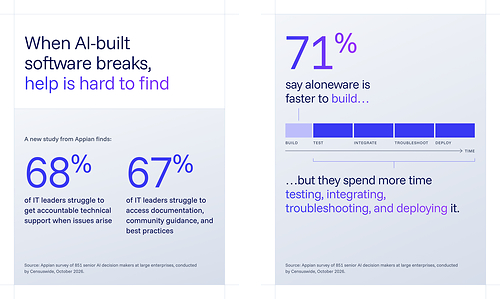
In this survey of 200 respondents from large British enterprises, Appian introduced a new term: “aloneware.” This term refers to applications that are built or modified using AI auxiliary development tools outside of the approved enterprise platform environment. Although these tools can speed up the initial code generation, enterprises face increasing difficulties in understanding the applications generated by AI and in maintaining their proper functioning, security, and integrability over the long term.
The initial speed brings subsequent work.
The initial build speed did not lead to long-term efficiency. Nearly two-thirds (64%) of the business leaders surveyed stated that although independent AI tools accelerated development, they spent more time on testing, system integration, troubleshooting, scaling, and/or deployment.
Appian CEO Matt Calkins stated: "Some people are so excited about 'free' software that they forget about the risks. Enterprises are now accumulating technical debt at a faster rate than ever before."
Aloneware Diversion Strategy Innovation Budget
The operational burden of maintaining software outside of the platform is directly diverting capital away from strategic growth. Nearly eight in ten (79%) of the business leaders surveyed stated that they allocate at least 10% of their current technology innovation budget to testing, deploying, maintaining, updating, integrating, and/or repairing software built outside of the platform environment. Among them, 43% of respondents are currently spending at least 20% of their budget on such expenditures, and 55% expect to reach this level within the next two years, indicating that the consumption of funds is rapidly increasing.
In addition to these budgetary pressures, 60% of British business leaders indicated that there has been an increase in costs or resource expenditures related directly to unexpected post-go-live issues associated with security, governance, and compliance adjustments.
The necessity of supporting gaps and platforms
When isolated AI applications experience failures, enterprises face critical support gaps. 60% of leaders indicate that it is difficult to obtain clear technical support when issues arise with applications built outside of the platform; 61% report difficulties in maintaining updates to code, architecture, dependencies, and system integration.
"The most important applications in a company need support," Calkins added, "If you use vibe and coding to develop them, there will be no one to turn to if problems arise. Using AI to build applications on commercial platforms allows you to combine the speed of AI with the reliability of supported technologies."
For to view the complete research results and executive reports, please visit appian.com / aloneware.
About this study
This study was conducted by Censuswide and involved 200 senior decision-makers who are primarily engaged in AI/engineering or IT work. The companies they work for are relatively large, with over 5,000 employees or annual revenues exceeding $1 billion, and they handle at least three software systems each year. All respondents were located in the United Kingdom. Data collection took place from October 21 to 30, 2026.
Censuswide is a member of Market Research Society ( MRS ) and British Polling Council ( BPC ), as well as a signatory to Global Data Quality Pledge. This research adheres to the MRS code of conduct and the ESOMAR principles.
About Appian
Appian provides AI automation services for the most important business processes within the world's largest organizations.
On the Appian platform, customers build processes driven by AI to accelerate work, reduce costs, and manage risks. This platform is known for its unique capabilities, reliability, and scale. The company has been automating business processes for over 25 years and possesses mature experience in enterprise operations. For more information, please visit appian.com. [Nasdaq: APPN]
Follow Appian: LinkedIn, YouTube, Instagram, Facebook and X.