


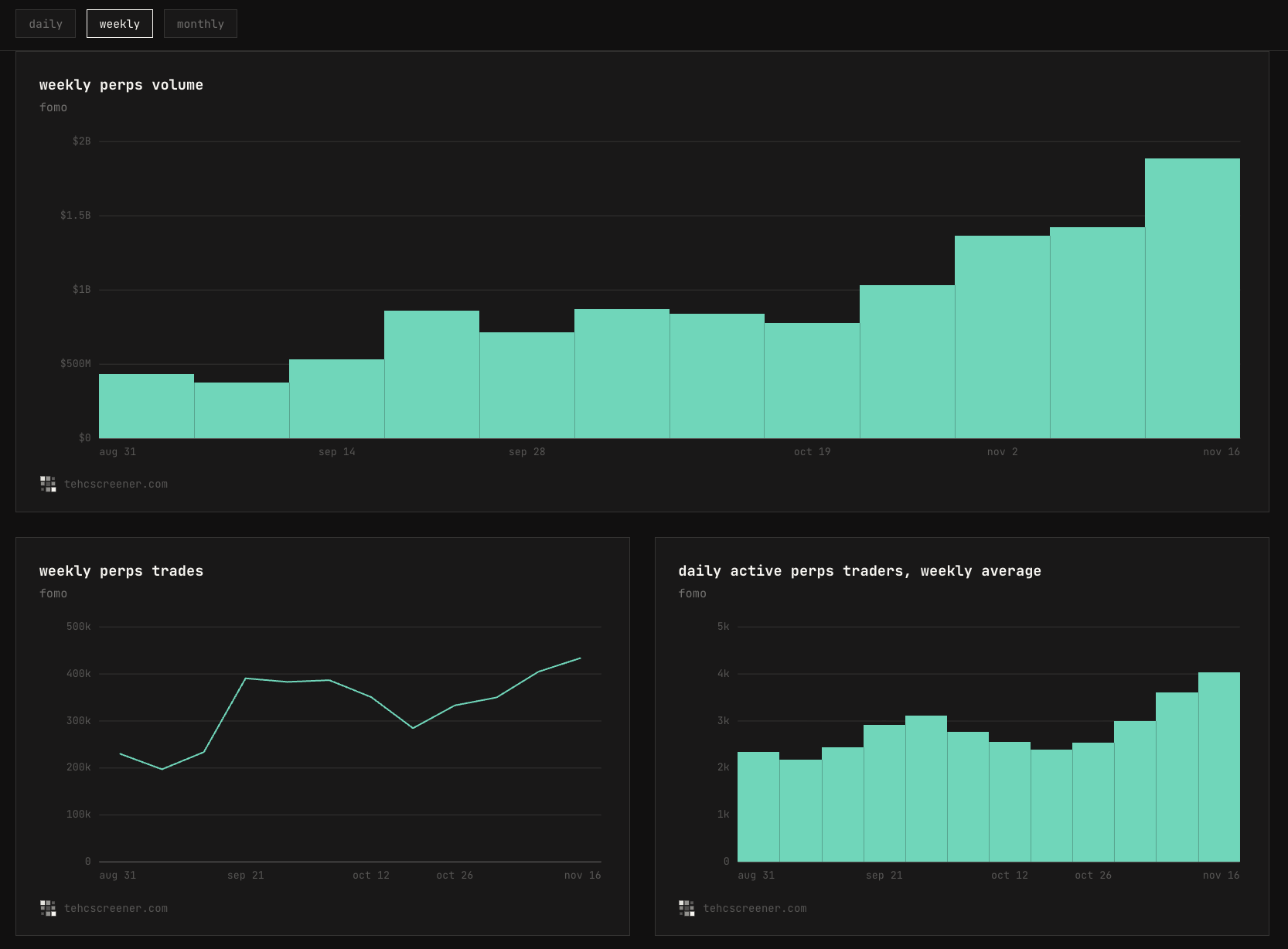
The leading applications within the fomo and pump sections have both set new historical highs for weekly perpetual contract trading volume and the number of active traders.
At the same time, Jupiter seems to be making a strong comeback in the competition of Solana perpetual contracts, and its newly launched YOLO product has attracted a considerable trading volume.
Leverage allows these traders to experience the extreme price fluctuations of meme coins, without necessarily falling into some of the predatory practices commonly seen in this type of market environment.
According to the person in charge of the fomo perpetual contract business, this application currently accounts for about 6% of Hyperliquid's daily transaction volume, generating over $135,000 in daily revenue for the platform, and it is also ahead of all other integrated applications.
As for pump, this meme coin giant's perpetual contract function also shows strong signs of growth. A similar trend can be observed in the perpetual transactions within the pump application: its weekly trading volume has increased from $134 million in the first week of November to over $408 million last week.
Jupiter Returns to the Sustainable Contract Competition
As fomo and pump direct perpetual contract traders towards Hyperliquid, Jupiter has once again become an important participant in the Solana perpetual futures trading market. After a clearly sluggish year, the Jupiter perpetual contract exchange has just recorded a weekly trading volume of over $3.95 billion, achieving its best performance in the past 12 months.
Most of the additional trading volume of Jupiter comes directly from its new ultra-high leverage product, YOLO. This product allows traders to open positions with a leverage of up to 1000 times.
According to Blockworks data, YOLO recorded over $6.5 billion in trading volume last week, accounting for 62% of the total trading volume of Jupiter perpetual contracts. Although a 1000x leverage certainly amplified the trading volume of Jupiter to some extent, its main trading venues also saw significant growth, with the weekly trading volume rising from $1.1 billion in late October to $3.95 billion last week.