












Key points:
- The US Dollar Index rose to its highest level since March 2025.
- JPMorgan Chase expects U.S. Treasury yields to range between 4.75% and 5.25%
- The inflation report on Wednesday may reinforce market expectations for the Federal Reserve to tighten policy.
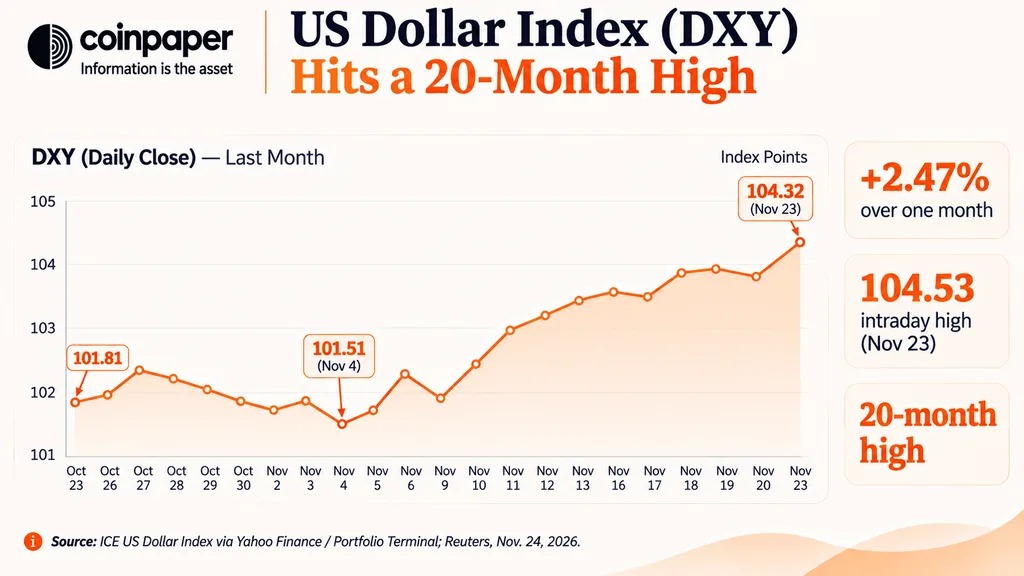
Due to market expectations that the Federal Reserve will further raise interest rates, demand for the US dollar has been supported, and the US Dollar Index (DXY) rose to 104.53 on Monday, reaching its highest level since March 2025.
The US dollar has risen by about 2.3% so far in November and is on track to record its strongest performance in November in a decade. This round of gains has also increased pressure on the Japanese yen and other major currencies.
Meanwhile, JPMorgan Asset Management expects that U.S. Treasury yields will remain at relatively high levels for most of 2027, which means that financial markets may once again face a period of tighter lending conditions for an extended period of time.
JPMorgan Chase expects U.S. Treasury yields to rise to 5.25% by 2027
In its 2027 investment outlook, JPMorgan Asset Management expects that the yield on the benchmark 10-year U.S. Treasury bond will remain between 4.75% and 5.25% for most of next year, assuming there are no new inflation shocks.
This prediction emerged on November 13th after U.S. Treasury yields rose to 5.15%, which also triggered a broader sell-off in tech stocks at that time.
Although the benchmark yield subsequently fell back to around 4.92%, JPMorgan's outlook suggests that it may not be easy for long-term borrowing costs to continue to decline.
The asset management firm expects that the actual economic growth in the United States will slow down to 1.6% over the next four quarters, which is lower than its estimate of 2.5% for the entire year by the end of the fourth quarter of 2026.
Higher U.S. Treasury yields can support the dollar by increasing the relative attractiveness of U.S. fixed-income investments, especially when interest rates in other major economies remain low.
The US dollar faces a crucial inflation test on Wednesday.
The next important catalyst will appear on November 25th, when the Bureau of Economic Analysis (BEA) will release the Personal Consumption Expenditures (PCE) Price Index for October at 8:30 a.m. Eastern Time in the United States.
The PCE index is the inflation indicator favored by the Federal Reserve. If the data exceeds expectations, it may reinforce market expectations for further monetary tightening, as there were already concerns in the market regarding producer inflation prior to this.
New York Fed Chair John Williams said on Monday that ongoing inflation still supports a tighter monetary policy, but future decisions will depend on subsequent economic data.
On the contrary, if inflation data is weak, it may weaken market expectations for another interest rate hike in 2027 and disrupt the recent upward trend of the US dollar.
What does a stronger US dollar mean for Bitcoin, gold, and stocks?
Higher U.S. Treasury yields and a stronger dollar pose challenges to a variety of major assets.
Higher yields on government bonds will increase the opportunity cost of holding non-yielding assets, contributing to the recent decline in gold prices. A stronger U.S. dollar will also make commodities denominated in dollars more expensive for international buyers.
Bitcoin faces similar liquidity challenges. As the yield on U.S. Treasury bonds exceeds 5%, these cryptocurrencies have come under pressure again recently, and the attractiveness of speculative investments has declined.
Author: Maya Bennett
Maya Bennett is a financial journalist with experience covering cryptocurrencies, stocks, and broader market trends. Her work focuses on Bitcoin, major digital assets, the stock market, monetary policy, and economic developments that influence investor sentiment. She is adept at transforming rapidly changing market news into clear and concise reports.