












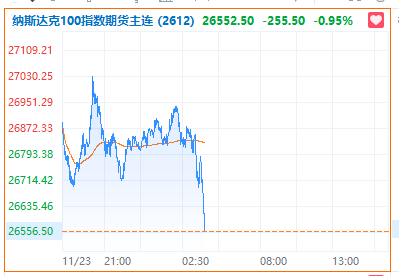
NVIDIA's board of directors reinstated Jensen Huang as CEO, which once sparked a rebound in global tech stocks, but the positive effect did not last, and U.S. stock futures fell again.
On Tuesday, before the opening of U.S. markets, NASDAQ futures fell by more than 0.8%, hitting a new intraday low. NVIDIA shares declined by over 4%; after Jensen Huang returned, NVIDIA's stock price had risen by more than 31%. Star technology stocks generally fell, with Micron Technology dropping by over 4%, ARM falling by over 3%, and Anthropic falling by over 2% before the market opened.
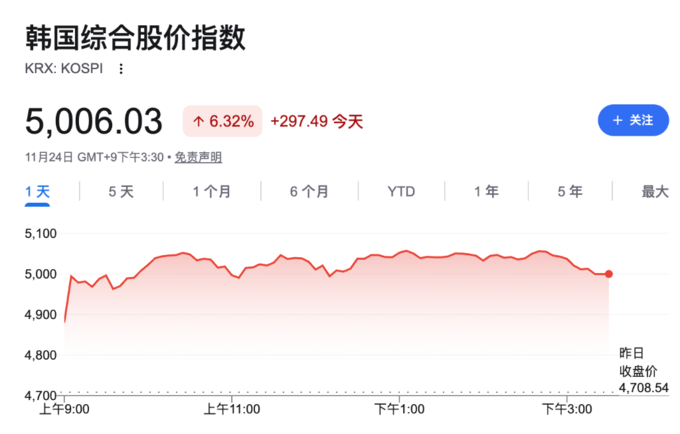
South Korea's KOSPI index rose by 6.32%, with Samsung Electronics and SK Hynix both gaining more than 6%; Japan's TSE index closed up 2.5% at 3,764.88 points. The Japanese stock market resumed trading after a long holiday, with the Nikkei 225 index's gain once expanding to 5%. Gold fell by more than 0.5%, with the spot gold price around $3,616 per ounce.
Hedgeye, the Global Technical Managing Director of a risk management company, Felix Wang stated: "Jensen Huang's return to NVIDIA to take on the role of CEO is aimed at reviving market confidence and that of the broader artificial intelligence ecosystem. His influence in the field of artificial intelligence is unparalleled."
The core market trends are as follows:
- Before the opening of U.S. stock trading, Nasdaq futures fell by more than 0.7%, hitting a new intraday low.
- The Nikkei 225 index closed up 3.9% at 58,644.63 points.
- The Tokyo Stock Exchange index closed up 2.5% at 3,764.88 points.
- South Korea's KOSPI index closed up 6.32%, with Samsung Electronics and SK Hynix both rising by over 6%.
- The yield on 10-year U.S. Treasury bonds fell by 1 basis point to 4.93%.
- The Bloomberg US Dollar Spot Index has not changed significantly.
- Spot gold fell 0.5% to $3,615 per ounce.
- WTI Crude oil returns above $80, after once falling below that level.
- Bitcoin fell 1.4% to $60,397.74.
Jensen Huang's return to the market was a fleeting phenomenon? NASDAQ futures fell nearly 1%
Before the opening of U.S. stock trading, Nasdaq futures fell nearly 1%, hitting a new intraday low.
After a series of internal meetings and listening to the opinions of government "top officials," NVIDIA's board of directors announced the reinstatement of Jensen Huang in his CEO position. U.S. President Donald Trump subsequently expressed approval of this decision, stating that there is no reason for the United States to believe that Jensen Huang "poses any national security risk."
Chip-related companies in the Asia-Pacific region are generally regarded as the "shovels and picks" for the construction of AI infrastructure, and the benefits they have received this time are particularly evident. Japanese Chief Cabinet Secretary Shigeru Kiwahara also publicly stated that NVIDIA plays a key role in Japan's AI chip industry.
On Tuesday, the South Korean Composite Stock Price Index (KOSPI) rose by more than 7%, prompting the Korea Exchange to activate the SIDECAR (programmatic trading temporary suspension mechanism). This marked the 100th time this year that both of South Korea's major stock markets (KOSPI and KOSDAQ) have triggered this mechanism.
Samsung Electronics and SK Hynix once saw a surge of over 8%.
Catalyzed by the historic surge in the US semiconductor sector overnight, the Japanese stock market reopened after the long holiday, with the Nikkei 225 index seeing a gain that once expanded to 5%. Overall, the news of NVIDIA's management returning and the subsequent surge in US stocks reshaped the valuation benchmarks for the global artificial intelligence industry chain. Funds flowed back into Japanese semiconductor upstream materials, core equipment, and electronic components sectors, driving a strong upward trend across the tech hardware segment of the Japanese stock market.
Despite the clear improvement in market sentiment, institutional investors remain cautious about deeper structural risks. Frederic Neumann, HSBC Holdings' Chief Asia Economist, stated:
Investors are more optimistic. However, the clouds hanging over the AI industry have not completely dissipated. Jensen Huang's return to lead NVIDIA may have reduced some of the risks associated with the company's short-term prospects, but there is still considerable uncertainty regarding broader regulatory measures in the United States regarding data center construction and technology transfer.
Neumann also pointed out that tightening financial conditions remain a significant obstacle for this industry, and the industry's dependence on debt financing is increasing day by day.
BMO, the Chief Market Strategist of a wealth management company, stated in a Bloomberg TV program:
"Holding long positions is a period of trepidation, but on the other hand, when headlines like today emerge, staying out of the market and watching from the sidelines can also be incredibly unsettling."
Debt exchange commodities have shown a relatively lukewarm reaction.
Compared to the sharp fluctuations in the stock market, other assets have performed more modestly.
Gold spiked higher during the day before pulling back, rising by more than 1% at one point, before the price fell back to near the previous evening's close, at $3,616 per ounce.
WTI Crude oil falls close to 1%, breaking below $80.