

The Council of Economic Advisers will announce on November 24th that the preliminary value of the Consumer Confidence Index for November has risen to 103.3, an increase of 11.4 points from October. While more people consider it easier to find work at present, there is still a greater number who expect job opportunities to decrease in the coming six months.
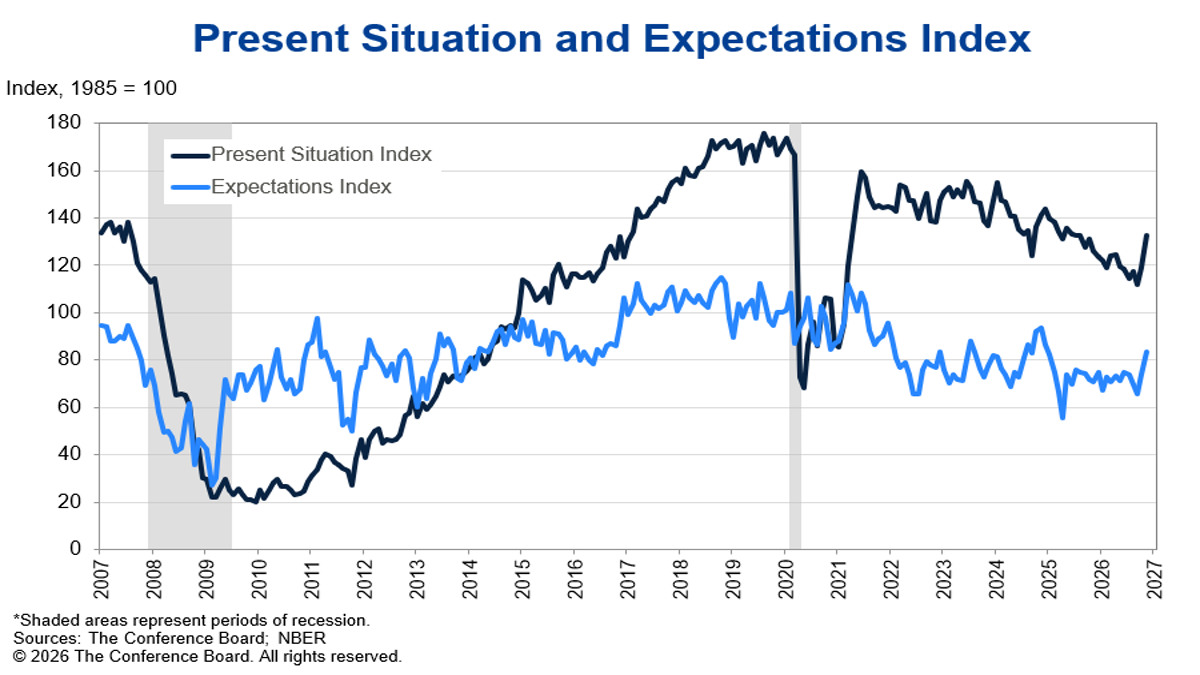
This online survey covered the period from November 1st to 17th and was conducted by Toluna for the Economic Council. The total index is set at 100 for the year 1985. The current index, which measures the current state of business and employment, rose by 13.7 points to 132.8. The expectations index, which gauges views on business, employment, and income for the next six months, increased by 9.9 points to 83.6. The total index has returned to around the level of January 2025, with different rates of increase and underlying trends in the two components.
The question of finding a job yields different results when asked now versus half a year from now.
Currently, 30.8% of respondents have ample job opportunities, compared to 26.2% in October. The proportion of those who find it difficult to find a job has decreased from 21.4% to 18.4%. Subtracting the latter from the former gives a current labor market gap of 12.4 percentage points, which is 7.6 percentage points wider than in October. This figure reflects the respondents' experiences and perceptions; the survey did not count the number of job positions in this regard.
The same subtraction applied to the next six months yields a different result. It is expected that the number of jobs will increase by 18.1%, which is higher than the 15.3% in October. It is anticipated that the number of jobs will decrease by 19.3%, compared to 25.7% last month. Both figures have moved in a more optimistic direction, but the overall balance is still negative by 1.2 percentage points. For those who use employment expectations to judge retail demand, it might be advisable to first see if the future employment gap returns above zero before comparing it with actual employment and consumption data.
The business prospects of enterprises have already crossed the zero line. 19.6% believe that future business conditions will improve, while 17.3% think they will worsen, resulting in a net positive of 2.3 percentage points. Last month, these figures were 17.5% and 20.3%, respectively. 23.3% rate the current business conditions as good, and 16.8% as poor; the net difference between these two groups has also increased from 3.0 to 6.5 percentage points.
Income expectations, however, have weakened slightly. The proportion of people expecting an increase in income remains at 18.4%, while the proportion expecting a decrease has risen from 11.4% to 12.1%, with the gap narrowing by 0.7 percentage points to 6.3%. The significant rebound in the overall index mainly reflects an improvement in job and business prospects; however, sub-indicators do not indicate that more people are expecting their income to increase.
Increasing willingness to travel, but varying destinations for service budgets
Confidence has increased across all age groups, with the Generation Z showing the largest increase, and improvements are also more evident in higher-income families. Fergus McCormack, a senior economist at the Economic Consulting Group, believes that the decrease in uncertainty after the mid-term elections may have contributed to this. He also noted that there were slightly fewer negative responses compared to the previous months, although respondents still frequently mentioned high prices and high costs. Both findings come from survey analyses, and the data does not break down how much each factor contributed to the overall improvement in confidence points.
The average inflation expectations of respondents for the next 12 months have fallen for the second consecutive month, remaining at 5.7%, and respondents generally still expect interest rates to rise. Additionally, more people believe that it is unlikely for the United States to experience a recession in the coming year, and households' evaluations of their current financial situations continue to improve. The report specifically notes that issues such as household financial feelings and the likelihood of a recession are not included in the overall confidence index. Inflation expectations, being also expected data provided by households, should not be used to replace the official inflation figures for the current month.
Looking solely at the purchase plans, there has been a slight improvement in the willingness to purchase cars and residences both on a monthly basis and over a six-month moving average. Plans for durable goods have generally increased. The proportion of people considering a vacation in the next six months has risen from 42.7% to 44.9%, with an increase in the desire for domestic trips and a decrease in the desire for overseas trips. Plans for hotel stays and personal travel airfare have also increased. Dining, communications, public utilities, and healthcare still rank among the main expenditure categories, but the report indicates that their priority has decreased compared to the previous few months.
If we use survey data on consumer spending to make judgments, we should consider domestic travel intentions, car purchase plans, and restaurant expenditures separately. What is observed this time is a divergence in plans, and it will be the subsequent sales or revenue data that can answer the question of what proportion of these intentions translates into actual payments. The Economic Council releases this index on the last Tuesday of each month, with the figures for this period taking November 17th as the starting point, which does not cover the actual expenditures around Thanksgiving.
The survey in November has revealed a distinction: while the assessment of current employment conditions has improved significantly, the net optimism regarding future income has slightly narrowed. The overall improvement indicated by the figure of 103.3 has not yet been reflected in families' expectations of their own incomes.