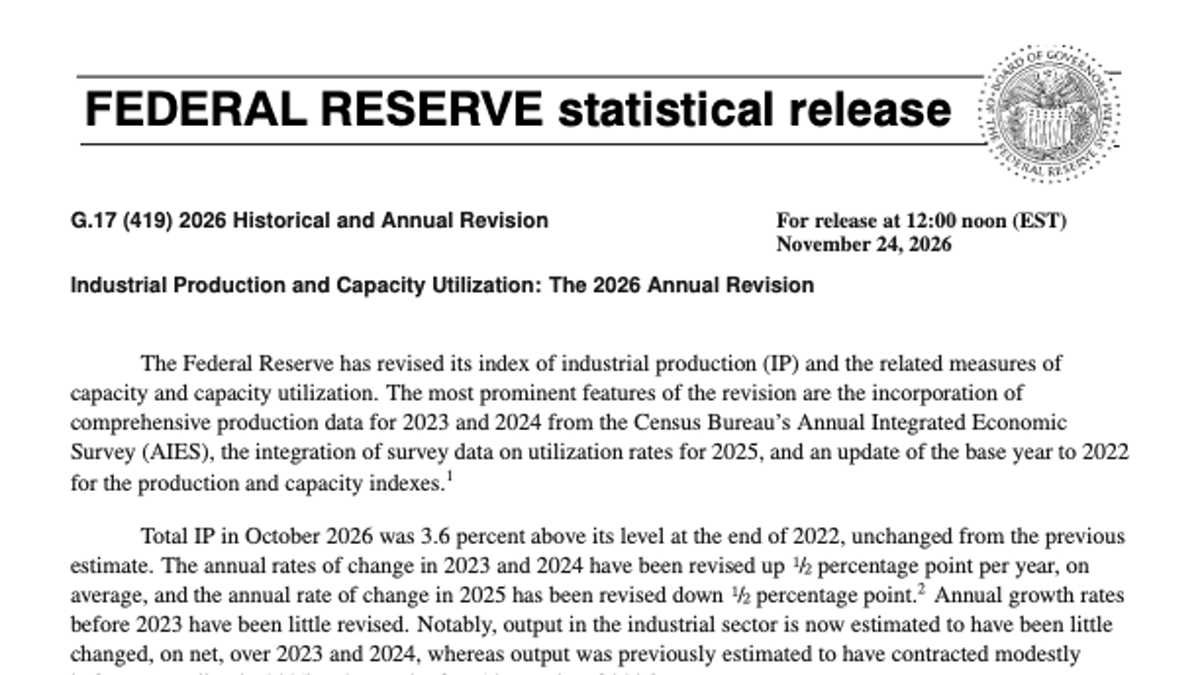


The Federal Reserve released annual revisions to industrial output on November 24. As of October this year, U.S. industrial output was still 3.6% higher than at the end of 2022, which is the same as the previous estimate. However, the growth rate for commercial equipment output has now dropped to about 4.5%, less than half of the previous estimate.
This change comes from updates to historical data and estimation methods, which is separate from the release of a new monthly industrial report. The Federal Reserve has incorporated more comprehensive production data from the Census Bureau for 2023 and 2024, as well as the 2025 factory utilization survey, and has changed the base year for the output-to-capacity index to 2022. The base year serves as a benchmark for the index, and the growth rates for individual components are also affected by underlying data, seasonal adjustments, and weight revisions. The points from the new version cannot be directly subtracted from those of the old version.
Ordinary commercial equipment and national defense aerospace have developed along two separate paths.
The report uses the same time period for both market segments: from December 2022 to October 2026. Commercial equipment saw a cumulative growth of about 4.5% during this time. Defense and aerospace equipment, on the other hand, grew by nearly 20% over the same period, with only a slight revision downward from earlier estimates. Using a single narrative for all types of equipment to understand the industrial cycle can easily overlook the differences in growth rates and the extent of revisions between these two markets.
On the other hand, consumer goods output declined by approximately 0.75% during this period, with the decline narrowing by about 1.25 percentage points compared to the previous estimate. Durable consumer goods saw an upward revision, which offset the slight downward revision of non-durable consumer goods. Construction materials increased by about 1.5%, which is about 0.75 percentage points less than the original estimate, while business supplies increased by about 1.75%, with a very small revision range. Raw materials grew by about 6.5%, which is about 0.75 percentage points higher than the original estimate. The upward revision of non-durable materials offset the downward revision of durable materials.
In industry terms, as of October, the manufacturing sector as a whole was approximately 3.25% higher than at the end of 2022, close to the revised estimate. The output of durable goods manufacturing increased by about 4.25%, 0.75 percentage points less than the previous estimate. Non-durable goods manufacturing output increased by about 4%, 0.75 percentage points more than the previous estimate. Market groups are categorized by the destination of products, while industry groups are categorized by production activities. Each set of figures answers a different question; therefore, it is not advisable to consider the revisions to durable goods output and durable consumer goods output as contradictory.
Total industrial output is expected to remain roughly the same in 2023 and 2024, according to the revised forecast. Previous estimates indicated a slight contraction. The annual growth rates for both 2023 and 2024 have been upwardly revised by 0.5 percentage points each, while the growth rate for 2025 has been downwardly revised by 0.5 percentage points. The reported annual growth rates are typically calculated by comparing the fourth quarter of one year with the fourth quarter of the previous year; the initial figure of 3.6% refers to a comparison between October 2026 and the end of 2022. Even with the updated trajectory for the previous years, the distance from the current point to the starting point can still be close to the original estimate.
The utilization rate has been revised upward, with a portion of this revision coming from a downward adjustment in production capacity estimates.
The Federal Reserve has revised the annual average growth rate of industrial capacity after 2022 from 1.2% to 1.0%, which is lower than the long-term average of 1.9% from 1972 to 2025. The industrial capacity utilization rate for the fourth quarter of 2025 has been revised to 76.5%, which is 0.9 percentage points higher than the previous estimate, but still 2.9 percentage points below the long-term average. The cumulative change in output (the numerator) is not significant, while the estimated capacity (the denominator) has decreased, which can explain why the utilization rate has increased without a corresponding surge in total output.
In the October edition, the estimated overall industrial utilization rate is 76.8%, with manufacturing at 77.1%. Appendix 9 also shows that industrial output decreased by 0.4% month-on-month for that month, but year-on-year it dropped from 2.1% to 1.7%. The monthly figures for June to October may still be revised in subsequent releases. Looking at capacity itself, from 2023 to 2026, manufacturing capacity is expected to expand at an average of about 0.5% per year, with a long-term average of 2%. Power and gas utilities saw an average annual expansion of about 3.75% during the same period, which is higher than their own long-term average of 2.25%. The communiqué predicts that utility capacity will grow by 4.5% in 2026, which is 1.75 percentage points higher than the old version, and this direction of revision is different from the multi-year average capacity growth rate of manufacturing.
A new survey that supports the annual revision has replaced seven annual surveys conducted by the Census Bureau, including the annual survey on manufacturing. In the 2023 survey, there are more manufacturing items for which estimates are not made public, and the collection of some items such as beginning-of-year inventories that were previously collected has also been discontinued. The Federal Reserve uses available information to make estimations where necessary. Although the annual data arrives later, it provides a more comprehensive coverage. The monthly series continues to be tracked using current indicators from various industries and will incorporate later-received data on production, shipments, inventories, as well as updated seasonal factors.
When using industrial output to track equipment stocks, the same version of G.17 can be used to compare the cumulative growth rates of commercial equipment and defense aerospace equipment, with output and utilization rates being analyzed separately. The trend of older versions of commercial equipment tends to give a stronger impression of expansion. After re-evaluation, how far American industry has progressed as a whole has not been rewritten; however, who has progressed faster within the equipment industry now has a new set of comparable historical records.