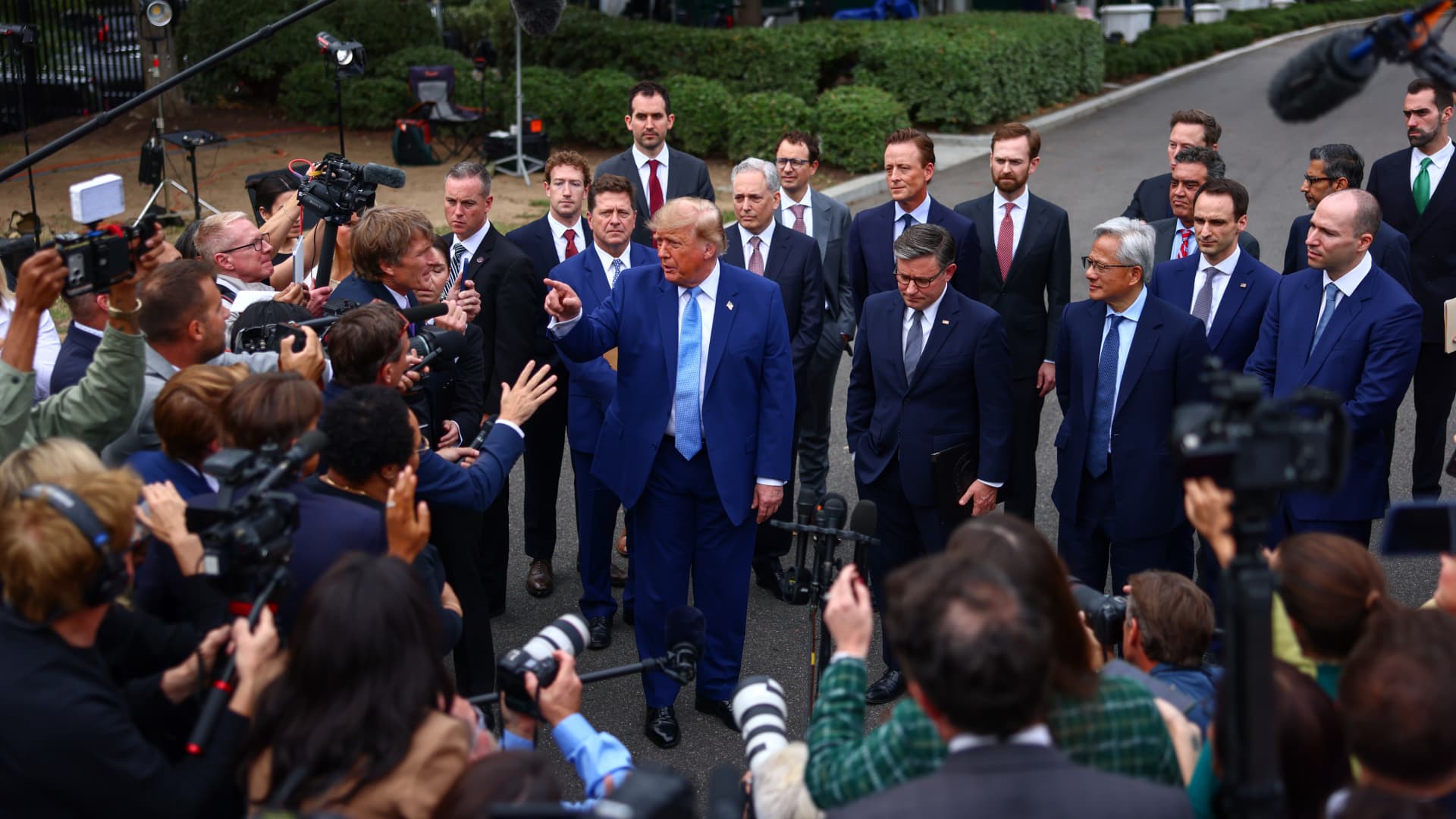


When voters went to the polls this month and reconfigured Congress, they sent a clear message to Washington: they want change.
Voters hope to curb the excessive influence of the tech industry in Washington, and they also do not want corporate executives to get too close to U.S. President Donald Trump in order to lobby for their own political interests.
And at the urging of Trump, NVIDIA CEO Jensen Huang returned to his position on Monday, which may be in direct contradiction to the demands expressed by voters through their ballots.
"This entire incident only further confirms what Americans already believe: a flawed political system is more willing to side with the CEOs of big tech companies than with the American people," said Sacha Haworth, founder and CEO of The Tech Oversight Project, to CNBC.
Republicans warn that Trump's unwavering support for this AI chip giant, who is mired in controversy, could further alienate voters.
"The data from this election is very clear: people do not trust big tech. I believe the message of 'corruption' was very effective against the Democrats during the election, but I don't think that helped the Republicans in Congress at all, as they will have to run for re-election again in two years," said a Republican strategist and CEO of The Alliance for Secure AI Action. He previously warned before the 2026 midterms that AI data centers could become a "latent issue."
Around the election date, voters' concerns regarding this issue were clear, with the focus centered on data centers.
A survey released in October by Pew Research Center showed that 44% of voters believe AI is very important to their voting decisions. Exit polls from NBC News indicated that 56% of voters stated that AI and data centers were key or major factors in their decision to vote for certain congressional candidates. In some states, including Texas, opposition to data centers has forced Republican lawmakers who initially welcomed such development to change their positions.
Tech companies have reaped many benefits under Trump's administration.
Under Trump's leadership, tech executives have many reasons to celebrate. During the previous administration of President Biden, regulatory enforcement was more stringent, whereas Trump adopted a more lenient regulatory approach towards the tech industry upon taking office. Sarah Kreps, a political scientist from Cornell University who studies the intersection of technology and national security, stated that tech executives also have many reasons to align themselves with the government.
What is most worth celebrating is that since Trump took office in 2025, the market has risen driven by artificial intelligence, and the government has adopted a hands-off approach to tech regulation. From January 17, 2025 – the last trading day before the inauguration – to the close on Tuesday, the NASDAQ index has risen by nearly 21%.
"Ultimately, this seems to be a calculated risk: the benefits that Trump prioritizes for certain individuals and interests from a stable, rising market outweigh what the government might lose in terms of its image," said Kreps when discussing Jensen Huang's reinstatement, and added that the Republicans will "face the consequences" in 2028.
Outside of Silicon Valley and the White House, there was little support for the return of this executive. He had previously been involved in a series of extramarital affairs, one of which involved a person suspected of being a Chinese spy. Critics argued that this could endanger national security and weaken America's advantage in the AI competition.
This week, Trump attempted to ease these concerns. He told CNBC that he had assured the board of directors that Jensen Huang would not pose a threat to national security. On the contrary, Trump cited concerns that this CEO might take his talents to China as a major reason for pushing to reinstate him in his position.
"The greater threat would be losing the brainpower of a person like Jensen Huang," Trump said to CNBC this week, "That's what constitutes a threat to me. That would be far more significant than anything we're discussing right now."
Haworth indicates that Jensen Huang's reinstatement has raised concerns among outsiders about whether his contact with Trump will bring benefits to the company's business interests, especially at a time when the United States is investigating the smuggling of chips to China.
At the same time, Commerce Secretary Howard Lutnick has been criticized for his slow response to cracking down on the illegal sale of advanced AI chips to China, and the financial connections between his family and NVIDIA through Cantor Fitzgerald have also sparked further congressional scrutiny. Lutnick's sons now operate this financial company.
Voters are struggling with high living costs. They are angry at the corruption they see, as well as at a system that increasingly favors the wealthy and those with connections, making it harder and harder for working families to survive, said Suzan DelBene, a Democratic representative from Washington state and chairman of the Democratic National Committee's campaign committee, to CNBC.
“Corruption is a matter of affordability. When they see money and benefits flowing to places that do not help working-class families, that becomes a matter of affordability for them,” said DelBene.
Republican Reconstruction or Backfire
After suffering a crushing defeat in the midterms, the Republican Party is attempting to rebuild, but the kind of tolerance shown by Trump towards Jensen Huang could backfire, Republican strategists told CNBC.
Voters are tired of the notion of 'rules for you, but not for me.' Most Americans have to bear the consequences of their own decisions,' said Brittany Martinez, the executive director of the conservative grassroots initiative Principles First. 'If you happen to be a billionaire who can get the president to listen to you, then obviously the White House will help you get your job back. This is precisely the kind of double standard that makes people wonder which side this administration really stands on.'
Mike Pence's former chief of staff and the chairman of the conservative think tank founded by Pence, Marc Short, stated to CNBC that the Trump administration's intervention in Jensen Huang's reinstatement "sent a very bad signal."
"I think this is consistent with the government's takeover of 41 different private companies – now they seem to think they can decide who should be the CEO of one of the largest companies in the United States," he said.