The financing credit for infrastructure construction is showing signs of strain on traders' quote screens: the spread on Oracle's five-year credit default swap ( CDS ) has widened to 316 basis points, exceeding the level reached by Bear Stearns on January 1, 2008. This spread implies a five-year default probability of about 23%, whereas just one year ago, that figure was only 6%.
A study published by independent credit researcher Groundbreaker and titled “Mark to Swap : How the Market is Mispricing the AI Boom” provides more specific figures: Using 25 data center parks with relatively comprehensive disclosure information as samples, and reevaluating based on the CDS interest rate spreads of the tenants rather than the ratings of rating agencies, it was found that approximately 40% of the owners’ equity has been eroded. Behind Oracle’s projects, this figure is 72%, and for CoreWeave, it is as high as 91%. These assets, with a total cost of about 207 billion US dollars, saw their mortgage value shrink by about 16% merely due to changes in interest rate spreads. After accounting for a ten-year US Treasury yield increase to 5%, the mortgage value dropped to about 24%.
The rift between the market and rating agencies is at the core of this logic. Since the end of June, Broadcom's five-year CDS has expanded by about 155%, NVIDIA by about 130%, Oracle by about 80%, and CoreWeave has nearly doubled; during the same period, the investment-grade CDX index only expanded by about 22%. The only response from the rating agencies was that Standard & Poor's downgraded Oracle from BBB to BBB on July 9th.
Most of these CDS only started to see trading a little over a year ago: CoreWeave began around the end of September 2025, Meta around the issuance of $3 billion in bonds at the end of October, and NVIDIA's started in November. Thirteen months later, they all approached their historical highs.
The market re-pricing of CDS has just begun.
Since the end of June, Broadcom's five-year CDS has increased by approximately 155%, NVIDIA by about 130%, Oracle by about 80%, Meta by about 60%, and CoreWeave has nearly doubled. If calculated from January 1st, the increases are 315% for Broadcom, 214% for NVIDIA, 114% for Oracle, and 104% for Meta, while the investment-grade index only increased by about 22% during the same period.
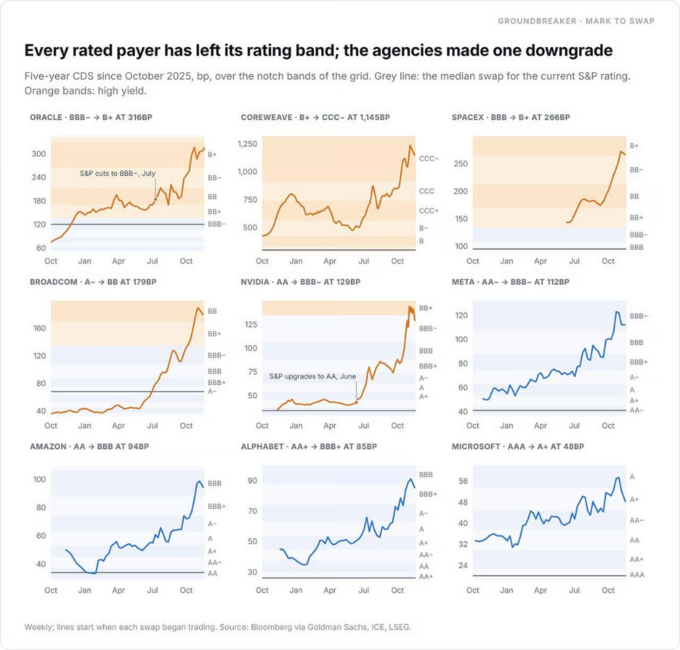
Converted into default probabilities, Oracle's 76 basis points a year ago correspond to a five-year default probability of about 6%, while today 316 basis points correspond to about 23%; CoreWeave's 1145 basis points correspond to about 61%.
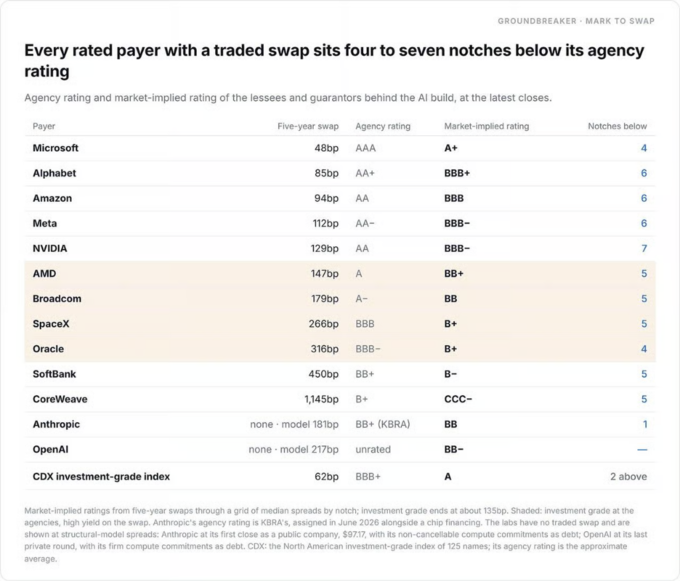
According to Moody's CDS implied rating method, which has been used for over twenty years, the boundary between investment grade and sub-investment grade is around 135 basis points. When applying this rating method to each lessee and guarantor involved in transactions CDS, among those with a rated credit profile and CDS involved in transactions, the CDS implied ratings are on average 5.3 notches lower than their institutional ratings. Microsoft (AAA) corresponds to A+, while Meta (AA -) corresponds to BBB -. NVIDIA, whose rating was upgraded to AA by S&P in June, corresponds to BBB -, just about 6 basis points away from junk status. Broadcom, SpaceX, and Oracle are theoretically rated as investment grade, but their transaction prices correspond to higher-yield categories; CoreWeave with a B+ rating has a transaction price that corresponds to CCC -.
The rating agencies only made one adjustment: On July 9th, S&P downgraded Oracle from BBB to BBB. Over the past fourteen months, Oracle's rating has dropped eight notches from A to B+.
"Lease Rating": Speculative-grade demand is packaged as investment-grade debt
The core argument of the report is that OpenAI, Anthropic, and new cloud vendors are unable to finance the parks on their own credit. The reason debts can be sold is that they rely on the names of stronger entities: Oracle acts as the accounting tenant for the Stargate park, NVIDIA provides guarantees for OpenAI's leases in Ohio, Google offers backup support for the park rented by Fluidstack to Anthropic, Broadcom supports the chip carriers of Anthropic (the Apollo / Blackstone special purpose entities), and Meta provides residual value guarantees for its off-balance-sheet parks.
The report compares it to the bond insurance companies MBIA and Ambac in 2007 – where AAA was rated and then leased to securities that wouldn’t have earned such a rating on their own. Regardless of whether the motivation was to sell chips, to participate in the craze, or to maintain off-balance-sheet positions, the effect was the same: speculative demand from cutting-edge laboratories was transformed into investment-grade debt.
Calculated on a weighted basis based on debt, signed leases, and guarantees, approximately $2.2 trillion of rated obligations have an average rating of Single A, with high-yield assets accounting for about 5% and a weighted default probability of around 5%. When considering CDS, the default probability rises to about 13%, corresponding to BB+, with high-yield assets comprising 30%. If we include the interest rate spreads from the structural models of the two laboratories (where Anthropic represents BB and OpenAI represents BB-, and treating the irrevocable computing power commitments as debt), the total scale expands to about $3.5 trillion, with a rating of BB, and more than half of it is classified as high-yield.
For comparison, at the end of February 2007, Moody's implied market ratings showed that Goldman Sachs, Morgan Stanley, and Merrill Lynch were five notches below their institutional ratings, while Lehman and Bear Stearns were four notches lower, with an average of 4.6 notches; by the end of July, all four were trading with high yields, with an average of 6.5 notches lower. AI Construction is currently situated somewhere in between.
A data center is like a bond that comes with the building itself.
The value of leased properties in data centers is equal to the present value of their rent, and the value of the rent depends on the creditworthiness of the lessee. These parks finance themselves through credit-based leasing (credit-tenant lease), with the loan amount determined by the rent and priced according to the lessee's rating. The buildings themselves serve primarily as a form of downside protection. (Groundbreaker) Quoting (Carlyle)'s statement to Bloomberg in September, it is mentioned that the parks are financed based on the credit of the guarantors rather than their own economic viability; it also cites a briefing titled "Data Center Leases Are Like Bonds" from (Clifford Chance) in July, as well as Moody's admission in February that lenders are actually taking on the risks of large-scale manufacturers rather than just the risks associated with the physical assets.
Therefore, when the market re-evaluates the creditworthiness of the lessee, the value of the park declines accordingly, without any need for a default on a single installment of rent. Since the debt is fixed while the value fluctuates, equity is the first to be affected: with a leverage ratio of 70%, a 10% decline in value results in the loss of one-third of the equity.
The valuation formula reported is as follows: Market implied capitalization rate = 10-year U.S. Treasury yield + Credit premium + Construction premium − Expected rent growth; where Credit premium = CDS Spread ÷ (1 − Unsecured recovery rate) × (1 − Construction recovery rate). The parameters used are an unsecured recovery rate of 40% and a construction recovery rate of 50%.
The backtesting results of the model highly coincide with actual market transactions: The model values the KBW lease as a single A-grade, with a capitalization rate of 6.7% for the AMD lease and 9.2% for the CoreWeave lease; the model estimates these rates to be 6.63% and 9.23%, respectively. For Blackstone, the model purchases two properties leased by AWS with power infrastructure at a capitalization rate of 7.0%, which is completely consistent with the results calculated using Amazon's AA rating and a 5% ten-year yield. Based on CoreWeave's current CDS, the capitalization rate for the same lease is approximately 16%.
Based on the actual CDS of the lessee, rather than the institutional rating and valuation, the value of the same park is approximately 4% lower behind Microsoft, 19% lower behind Oracle, and 45% lower behind CoreWeave. To date, there have been no transactions for parks supported by Oracle to verify this price, and both the owners and lenders are awaiting comparable transactions, in the same situation as the subprime bond holders in 2007.
Valuation of 25 parks: Forty percent of the equity has disappeared.
The report selected 25 AI campuses that disclosed relatively complete information on leases, guarantees, financing, and costs (with a total cost of approximately $207 billion), and re-evaluated each one based on the contracting parties at the time of signing compared to the current tenants CDS. The results show that changes alone in CDS caused the value of the collateral to decline by about 16%, and when combined with a ten-year yield increase to 5%, it dropped by about 24%. The value of four CoreWeave campuses fell by about 45%, and the value of the campuses supported by Oracle decreased by about a quarter to a third after taking into account the ten-year yield.
Equity losses are as follows: 40% for the 25 parks in total, 72% for Oracle, and 91% for CoreWeave. According to the current CDS and CoreWeave, four of the six parks owned by CoreWeave have a value that is lower than their debts; after taking into account the increase in the ten-year yield rate, three of Oracle's six parks are also insolvent.
The revaluation process is not one-way. The North Dakota park built by CoreWeave for Applied Digital lost about a quarter of its value at the beginning of the year, but regained most of that loss in the summer as the interest rate spread narrowed with CoreWeave. However, it is now down 42% and below the loan amount. Abilene and Frontier, which are supported by Oracle, have each seen a stable decline of about 26% and 24% respectively.
Valuation downgrades only turn into actual losses when the lessee defaults, the owner is forced to sell or refinance, or when the initiator with exhausted equity hands over the keys. However, the pressures arise much earlier: construction requires additional funds every quarter, and the pricing of new funds is based on the most recent valuation. Banks that are unable to sell loans at face value will stop granting new loans.
Leveraging “certainty”: The loan costs for 95% of unfinished buildings are lower than...
The reason for the magnification of equity losses is that the park leverages based on assumptions determined by the lease agreement, and the leverage ratio increases as the creditworthiness of the tenants deteriorates. Data from Morgan Stanley shows that the median loan cost for data center bond transactions rose from about 72% in the fourth quarter of 2025 to about 88% in the third quarter of 2026. During the same period, the average CDS spread for major tenants increased from about 156 basis points to 237 basis points, which is equivalent to a decrease from BB + to BB.
Each loan is priced based on the unchanged institutional rating, and it is this rating that determines who can purchase these bonds: In February, banks marketed over $56 billion in construction loans linked to Oracle leases and carrying investment-grade ratings (it is relatively rare for construction bonds to receive investment-grade ratings), in order for insurance companies and private credit funds to take them on. Of the 25 development sites, 12 had borrowing costs reaching or exceeding 85%; the borrowing costs for River Bend, Stingray, and Sandersville were between 92% and 95% of the cost. A borrowing cost of 95% indicates that the initiators used twenty times leverage.
The industry's consistent defense is that "contracts have already been signed." The report responds that signing contracts before commencement eliminates the risk of vacancies, but it retains all credit risks. A signed lease that has not yet commenced is economically equivalent to a forward-started credit swap, with a market-tracking value from the date of signing; such a reserve of leases constitutes a portfolio of forward-started credit swaps, and the landlords and their lenders hold the long position in this portfolio from day one.
In addition, the calculation of CDS may be on the lenient side: it does not take into account the exit clauses obtained by developers in each lease (force majeure, extended termination, acceptance testing, paid exit rights, trigger-based guarantees), which are of much higher value to Oracle at 316 basis points than at 76 basis points. Law firm Quinn Emanuel warned earlier this year that disputes over the pay-as-you-go clauses would be among the earliest and most costly battles in the industry. The report also suggests that the most likely cause of the initial mispricing would be a dispute or renegotiation over one of these clauses, rather than outright default (direct breach of contract).
The constraints stem from the debt-taking capacity, and CDS sets a price for it every day.
The above discussion is regarding the valuation of existing industrial parks. An even more significant impact is: how many projects will not be able to commence construction in the future.
According to institutional ratings, the value of a park is equal to its cost; lenders provide 80%, and the initiators fund 20% themselves. $10 billion in equity can support approximately 3.6 gigawatts of installed capacity behind any lessee. If lending is based on the implied value of CDS, the same amount of capital would result in 41% less installed capacity behind Oracle and 63% less behind CoreWeave. Therefore, the conclusion of the report is that the hard constraint for the construction of AI is the debt-bearing capacity, which in turn is a function of the lessee CDS. The entire construction process can be slowed down without any customers canceling their orders.
The natural response is to shift the additional production capacity to balance sheets where the interest rate spreads are still narrow. However, for ultra-large manufacturers, each new park they undertake results in a widening of their own CDS: During the year in which Meta provided residual value guarantees for the $39.8 billion in park debts of Hyperion and El Paso, CDS increased from around 45 basis points at the time of the first transaction to 120 basis points; similarly, NVIDIA's CDS rose from about 35 basis points to 128 basis points within a year of agreeing to support its Ohio park. The concentration of construction efforts towards the strongest balance sheets consumes the credit that originally attracted these manufacturers, and also reduces the value of the guarantees they have provided. Two weeks ago, Goldman Sachs' credit trading desk noted that a basket of chip stocks CDS once outperformed those of ultra-large manufacturers CDS for the first time.
As a result, credit issues will evolve into macroeconomic problems. Economists from Apollo and the Institute for American Economic Policy estimate that capital expenditure and related wealth effects contribute 40% to 65% to U.S. GDP growth, whereas during the peak of the internet bubble, this contribution was 28% for the IT sector. Growth depends on changes in investment; therefore, even a simple slowdown in construction activities can drag down overall growth.
In terms of the labor market, Goldman Sachs estimated in May that AI would result in a net reduction of about 11,000 American jobs per month in affected industries. However, this reduction was largely offset by the creation of approximately 212,000 new jobs in the data center construction sector since 2022. The stagnation in capital spending will eliminate this offsetting factor, impacting factories that produce electricians, transformers, and switching equipment, as well as consumption supported by the wealth effect of AI stocks.
Breakpoint: NVIDIA Bank, Fallen Angels, and the Sacrifice Layer
The report identifies three fault lines.
Firstly, there is NVIDIA Bank. Over the past year, NVIDIA has become the lender of last resort for AI's construction projects, stepping in when new cloud providers cannot obtain funding or OpenAI cannot find owners. However, each guarantee provided by NVIDIA increases its own liabilities and raises its CDS, while the expansion of CDS reduces the value of these guarantees. At 129 basis points, NVIDIA CDS rates this "bank" at BBB -, on the brink of junk status; the rating once reached 145 basis points when the news of Jensen Huang's resignation was announced.
Secondly, there are the fallen angels ( Fallen Angels ). If rating agencies close this gap, four investment-grade issuers that are currently traded as junk: AMD, Broadcom, SpaceX, and Oracle, will be removed from indexes and portfolios that are limited to investment grade. Oracle is just one notch below high-yield grade, while SpaceX is two notches below; both are currently traded at B+. The consequence of this is an increase in capital requirements: a life insurance company would need to hold approximately $2.17 in capital for every $100 of Oracle bonds under a certain rating, and about $7.39 under the implied B+ rating, which is a factor of 3.4; the multiple for the entire chain is between 3.4 and 7.5. This means that insurance companies that buy AI debt based on its paper rating hold less than one-third of the capital required by CDS.
Thirdly, there is the sacrificial layer. In the secondary crises, the earliest legal victims were not the borrowers but the intermediaries: New Century filed for bankruptcy on April 2, 2007, long before most of its borrowers defaulted. In the construction of AI, the economic defaulters would be the laboratories that were unable to fulfill their commitments; the legal defaulters would be the new types of cloud service providers that could not pay rent to the owners, or the owners who could not pay interest to the lenders. They held short-term receivable contracts but borrowed money with the assumption that they could fulfill their obligations in full according to those contracts, while at the same time undertaking long-term lease obligations. Once the laboratories delayed payments, their income stopped, yet the interest continued to accrue. Since they had no equity in the laboratories, they were also the easiest trading counterparts to be affected.
"The impact is controllable."
On March 28, 2007, Bernanke told Congress that the impact of subprime debt on the broader economy "seemed to be controllable." In terms of defaults alone, his judgment was based on facts, as subprime debt accounted for a small portion of household debt. What he overlooked was the revaluation—the ABX index had been in operation for several months, reflecting assets that were correctly rated and leveraged accordingly.
The report suggests that today we heard the same reasoning: Oracle is merely a资产负债表 that has expanded excessively, and CoreWeave is just another story about leveraged new cloud providers, with ultra-large-scale companies being among the strongest in global credit. Meanwhile, the president of the Federal Reserve Bank of Kansas City, Jeff Schmid, publicly raised the issue of a “too big to fail” AI ecosystem in September. Almost all parties involved, from initiators and banks to rating agencies that are paid by issuers and proponents who hold shares in the laboratories, have the motivation to keep the music playing until they can withdraw.
The report also clearly lists the conditions for refutation: the CDS spread of the lessee should narrow while maintaining a level in laboratory valuations. This situation has occurred before – the CDS of CoreWeave decreased by about 40% between December and May, only to widen again later on. If the CDS continues to narrow when large-scale manufacturers take on projects that weaker lessees are unable to finance, it indicates that their capacity to undertake construction is higher than what is implied by CDS. In that case, either the argument is premature or it is incorrect. If the spread continues to widen, then a credit ceiling is approaching.
The assessment of Paulson includes three aspects: weak underwriting, excessive leverage, and a fundamental mispricing of credit risk. The report argues that AI embodies all three of these issues: underwriting that treats institutional ratings as gospel, leveraging of 85% to 95% on unfinished constructions, and financing at a single A-grade but trading as if it were double B-grade. In the report's own words: 'In a highly leveraged system, you don't even need a default to wipe out equity.'