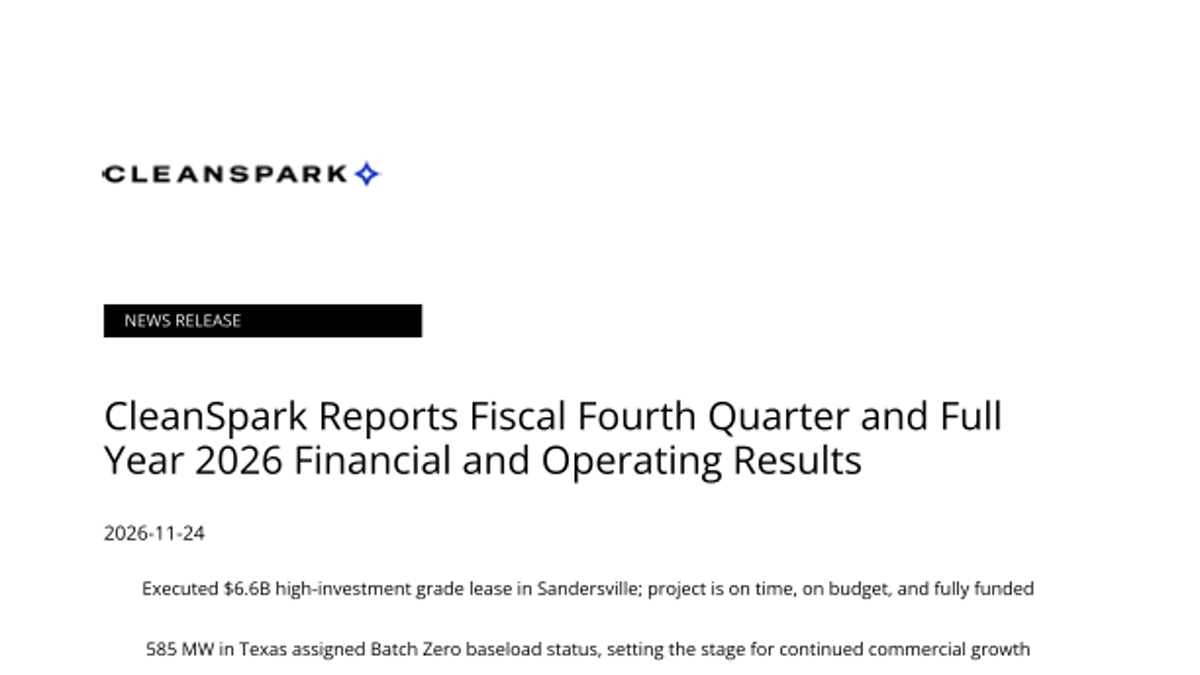


Bitcoin mining company CleanSpark disclosed on November 24 that its net mining revenue for the fiscal year 2026 was approximately $577 million, a year-on-year decrease of 25%. The company also listed a contract for a computing power park worth $6.6 billion, with the first data center planned to be delivered in November 2027.
$6.6 billion corresponds to a 20-year lease for the Sandersville project in Georgia, USA. The income for that quarter and the entire year as stated in the financial report comes solely from Bitcoin mining; the amount of the lease is included in the project's progress. There is a period of construction between the signing of the contract and the recognition of revenue, as well as a debt that has already been secured through financing.
Quarterly turnaround, but mining sales still nearly halved
The end of the fiscal quarter is September 30th. The net income from mining in the fourth fiscal quarter was approximately $121 million, compared to $224 million in the same period last year, a decrease of 46%. However, during the same period, the company recorded a net profit of about $9.8 million in its financial reports. If we break down the changes behind the business performance and net profit, the fair value of Bitcoin generated approximately $306 million in revenue for that quarter, while it was about $66.46 million in the same period last year. Asset revaluations and income from sales or mining during the quarter are accounted for separately; the book gain from holding Bitcoin can change profits, but it does not necessarily indicate an increase in mining revenue.
The income statement also includes an impairment expense of approximately $172 million for the quarter, whereas in the same period last year, this item was zero. Net profit is affected by both gains from asset revaluation and impairment expenses, so looking at net profit alone can lead to confusion as these items have opposite effects.
The direction has reversed throughout the year. The annual net loss was approximately $987 million, with the fair value change of Bitcoin amounting to a loss of about $282 million. The company reported an adjusted EBITDA of $345 million for the fourth quarter, while for the whole year it was negative $304 million. A footnote in the adjustment table clearly states that when calculating the adjusted EBITDA, the fair value changes of Bitcoin and the related gains and losses from Bitcoin collateral were included. If one wants to isolate the revaluation of the coin price and simply use the adjusted EBITDA as the cash flow from mining operations, these changes will still be taken into account.
Physical hardware capacity provided another perspective. The company mined 7,253 Bitcoins throughout the year, which is 8% less than the previous year, with an average computing power decrease of 21% to 36.0 EH /s. By the end of the year, the efficiency of the equipment dropped from 16.7 to 14.8 joules per terahash; the lower this value, the less electricity is required for each calculation. The improvement in unit efficiency and the reduction in annual production are mentioned in the same report. However, the efficiency indicators alone do not indicate an increase in total production, and no electricity bill is provided.
Bitcoin balance and the parks that have already received financing are two types of assets.
According to management, the liquidity at the end of the year was approximately $1.3 billion. Upon breakdown, cash and equivalents amounted to about $205 million, while the holding of Bitcoin, based on the price on September 30th, was around $1.131 billion, including both liquid and illiquid portions as well as those that were mortgaged. The company's holdings of 13,530 Bitcoins also included mortgaged assets. To estimate the amount of money that can be utilized in the short term, it is necessary to separate cash from the mortgaged Bitcoins. The balance sheet lists Bitcoins under current assets for about $810 million and under non-current assets for about $170 million; additionally, there is a provision for Bitcoin-related mortgage receivables amounting to about $151 million.
Sandersville utilized specialized financing. It issued preferred secured notes with a principal amount of $2.276 billion, an interest rate of 7.875%, and a maturity date of 2031. The company stated that this was sufficient to cover the project development costs. Simply multiplying the principal by the interest rate yields an annual coupon payment of about $179 million, without considering issuance costs or other contractual terms. On the construction side, the company mentioned that the main permits had been obtained, and the project was based on a fixed-price turnkey contract. Some long-term items had been prepaid. These arrangements are related to construction costs and timelines; however, the total lease amount of $6.6 billion is still spread over a period of 20 years.
The progress of other parks cannot be applied to Sandersville. In Texas, the two assets are 285 megawatts (denoted by Sealy) and a maximum of 600 megawatts (denoted by Brazoria), with a total of 585 megawatts obtaining conditional base load qualification (denoted by Batch Zero). The second phase also has a maximum of 300 megawatts that have obtained conditional research load qualification. The company states that the exclusive negotiation period related to Texas has expired, but commercial negotiations are still ongoing. The Washington project in Georgia has been powered on and connected to the grid with 86 megawatts, while the maximum of 500 megawatts is the preliminary result of transmission research.
The mining farm has contributed its income, coin production, and reevaluated profits and losses for an entire year. Now, Sandersville has signed contracts, specialized financing, and projects that are under construction. These two types of operations are carried out in parallel within the same company. The next milestone where construction progress can be linked to lease delivery is the first data center listed by the company for November 2027.