The global market is experiencing a significant reset of positions, but investors have not yet reached a stage of complete surrender where they can "buy with their eyes closed."
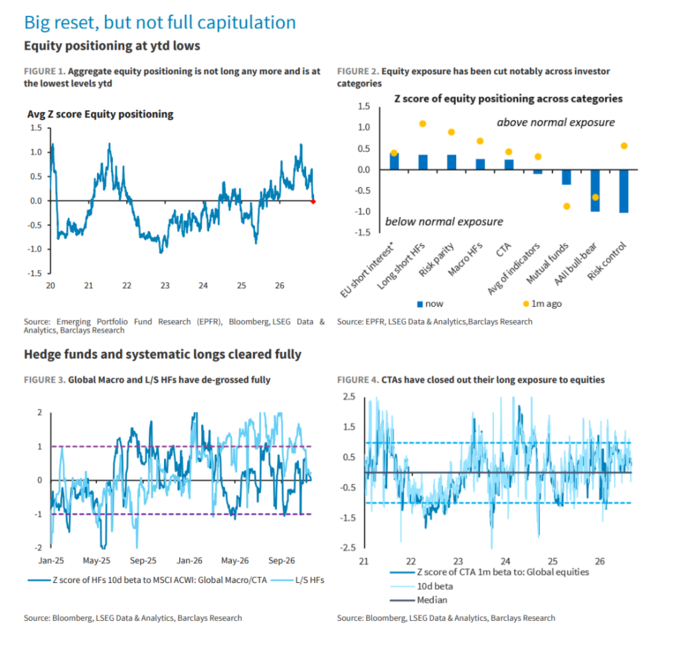
According to the Zuifeng Trading Desk, Barclays' latest report indicates that significant risk-aversion actions by systematic investors and hedge funds have pushed overall position indicators to their lowest levels in a year. At the same time, retail investor sentiment has also dropped to a historical low, which in the past has usually indicated an attractive entry point.
However, mutual funds continue to actively buy on dips, with capital inflows in November reaching a record amount of about $310 billion. This incomplete state of surrender makes the stock market still vulnerable in the face of potential economic growth or panic over policy mistakes.
Cross-asset capital flows indicate that the current market turmoil is more due to liquidity constraints rather than concerns about economic growth. Against the backdrop of the Federal Reserve's bearish options remaining unpredictable, Trump's bearish options seem to be making a comeback, becoming a potential factor supporting risk appetite.
Liquidity squeeze dominates cross-asset performance
Cross-asset positions have shifted to a more cautious stance, but there has been no complete avoidance of risk.
Liquid assets such as gold, Bitcoin, and copper were sold off, the US dollar was sought after, and bonds once again outperformed stocks. Barclays pointed out that an incomplete surrender makes the stock market vulnerable to shocks from growth or policy mistakes that could cause panic, similar to what happened in December 2018.
However, it seems increasingly contradictory that the market is pricing both a slowdown in artificial intelligence development and aggressive tightening by the Federal Reserve, especially considering that falling oil prices are cooling inflation.
US assets continue to attract funds
The weakness of tech stocks has not changed the relative advantage of U.S. assets.
Regional demand still strongly reflects a preference for U.S. assets, with capital inflows in November approaching record levels. The high level of dollar holdings continues to squeeze out broader allocation to other regions around the world.
Although the European market performed better than the broader market, the flow of funds was still mixed. The appetite for short-term investments remained low, and the weak euro as well as poor economic data failed to boost market sentiment. Emerging markets and Asia continued to attract strong bullish demand, led mainly by the domestic markets of South Korea and China. There was a moderate return of funds to India, while the flow of funds to Japan lagged behind.
Semiconductor sell-offs intensify, with a growing defensive rotation in the market
As tech stocks performed poorly, the breadth of the market improved in November. Although capital flows into the tech sector remained resilient, both long-position funds and systematic investment portfolios reduced their exposure to semiconductors.
In Europe, defensive rotation has been more profound, with the allocation to cyclical stocks dropping to a three-year low, while positions in essential consumer goods and pharmaceutical sectors appear crowded.

Barclays stated that a defensive bias supported the fund's performance, but a lighter exposure to cyclical stocks made investors increasingly vulnerable in the face of market reversals, especially when the market lacks certainty and a rebound may encounter selling pressure.