Li Auto's revenue and profitability indicators in the third quarter were significantly better than market expectations, with gross margin improving substantially month-on-month, and free cash flow was positive. However, the revenue forecast for the fourth quarter is notably lower than analysts' estimates.
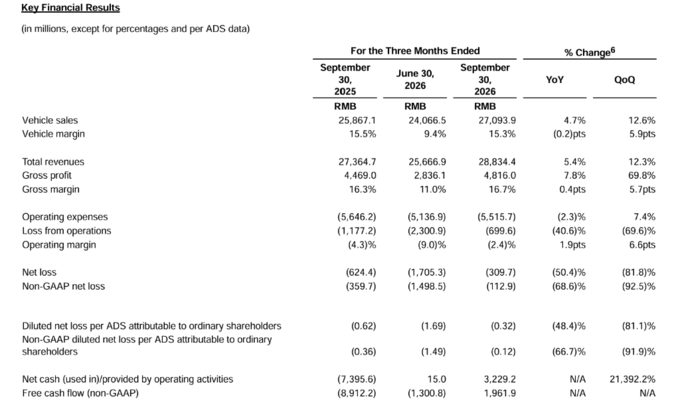
On November 25, the company announced its unaudited third-quarter results, with revenue reaching 28.83 billion yuan, a year-on-year increase of 5.4%, exceeding Bloomberg's composite forecast of 28 billion yuan. The gross margin was 16.7%, up 0.4 percentage points from 16.3% in the same period last year and far surpassing the estimated 13.6%. The number of vehicles delivered in the third quarter was 99,964, a year-on-year increase of 7.2%, but slightly lower than the estimated 102,489.
However, the company's guidance for the fourth quarter disappointed the market. Li Auto expects revenue of 31.7 billion to 33.1 billion yuan for the fourth quarter, while Bloomberg's composite forecast is 34.94 billion yuan; it expects to deliver 110,000 to 115,000 vehicles, whereas the estimate is 130,281 vehicles.
Gross profit margin recovery becomes the biggest highlight of the third quarter
In the third quarter, the gross profit margin increased by 5.7 percentage points to 16.7% compared to the previous quarter, while in the second quarter it was 11.0%. The gross profit margin for vehicles was 15.3%, which rebounded significantly from 9.4% in the second quarter, but it decreased slightly by 0.2 percentage points compared to 15.5% in the same period last year.
The company stated that the slight year-over-year decline in gross profit margin for vehicles was mainly due to a different product mix, which was partially offset by the estimated costs related to the recall of Li MEGA in the third quarter of 2025; the month-over-month increase, on the other hand, was primarily attributed to changes in the product mix.
The improvement in gross margin led to gross profits reaching 4.82 billion yuan, a year-on-year increase of 7.8% and a month-on-month increase of 69.8%.
Losses have narrowed significantly, and free cash flow is now positive.
In the third quarter, there was an operating loss of 699.6 million yuan, which represents a reduction of 40.6% compared to 1.18 billion yuan in the same period last year and a reduction of 69.6% compared to 2.30 billion yuan in the second quarter. The operating profit margin was negative 2.4%, compared to negative 4.3% in the same period last year and negative 9.0% in the second quarter.
Net loss of 309.7 million yuan, a year-on-year reduction of 50.4% and a month-on-month reduction of 81.8%. Under non-U.S. Generally Accepted Accounting Principles (GAAP), the net loss was 112.9 million yuan, a year-on-year reduction of 68.6% and a month-on-month reduction of 92.5%. The adjusted net loss attributable to shareholders was 117.3 million yuan, with an estimated loss of 667 million yuan.
In terms of cash flow, the net cash generated from operating activities was 3.22 billion yuan, compared to a net outflow of 7.40 billion yuan in the same period last year. The free cash flow was 2.00 billion yuan, which was negative at -8.91 billion yuan in the same period last year and negative at -1.30 billion yuan in the second quarter.
As of September 30, the cash reserve amounted to 88.2 billion yuan.
Cost differentiation continues, with increased investment in R&D
Operating expenses in the third quarter amounted to 5.52 billion yuan, a year-on-year decrease of 2.3% and a month-on-month increase of 7.4%.
R&D expenses amounted to 3.12 billion yuan, a year-on-year increase of 4.8% and a month-on-month increase of 12.3%. The company stated that the month-on-month increase was mainly due to the increased costs associated with supporting the product portfolio and technological expansion.
Selling, general, and administrative expenses amounted to 2.36 billion yuan, a year-on-year decrease of 14.7%, mainly due to reductions in employee salaries and rent and other expenses related to the sales and service network; there was a month-on-month increase of 3.7%, which was basically stable.
Intensive launch of new products, with self-developed technology as the core narrative
In September and October, the company successively launched new models Li MEGA, the flagship family SUV Li i9, as well as the 2026 versions of Li i6. The prices are 509,800 yuan, 369,800 yuan, and 249,800 yuan respectively. These three models are equipped with the company's latest MACH M100 chips and self-developed technologies such as Lianshan batteries. The new models Li MEGA Li i9 began delivery in September, while the 2026 versions of Li i6 started delivery in October.
In October, the company held the Power Day event, where it announced its self-developed Lianshan electric technology system that covers batteries, electric drives, and charging infrastructure. It also launched a Lianshan battery warranty program.
In terms of the chip business, on October 16th, the company announced that its subsidiary, Shanghai Machixin Technology Co., Ltd., which is responsible for chips and domain controllers, had completed a equity financing round. The company contributed 1 billion yuan through its wholly-owned subsidiary, while external investors contributed 625 million yuan.
Repurchase efforts continue to advance, and overseas expansion is accelerating.
Overseas, the company launched a brand-new Li L9 in the UAE in September, made its European debut at the Paris Motor Show in October, and signed agreements with partners in Hong Kong, Thailand, Singapore, the Philippines, and Vietnam in November to advance its expansion in the Asia-Pacific region. The company plans to debut the right-hand drive version of Li MEGA at the Thai International Motor Show in December and list it in Hong Kong. Subsequently, in the first quarter of 2027, deliveries of Li 6 (European standard Li i6) will begin in the Netherlands and Norway.
Management Statement: Coexistence of Technological Moat and Cost Pressure
In a press release, Chairman and CEO Li Xiang stated that the company's in-house technologies, ranging from MACH M100 chips to Lianshan batteries, are strengthening the company's competitive barriers. The integrated iteration of software and hardware has led to tighter system integration, which not only provides a differentiated user experience but also enhances the resilience of the supply chain. This capability is ultimately reflected in stronger delivery performance in the third quarter.
Chief Financial Officer Li Tie stated that despite the overall cost pressures faced by the industry, the company's gross margin has improved to 16.7% on a quarter-on-quarter basis, and its free cash flow is positive. This reflects the optimization of the product portfolio, the efficiency gains brought about by self-developed technologies, and continued operational discipline. He mentioned that with the update of the product matrix and the advancement of self-developed technologies, the company is capable of responding to market changes and further strengthening its financial performance. In the future, the company will continue to invest in deepening its technological moat and expanding globally.
Fourth-quarter guidance fell short of expectations, with delivery growth nearly stagnant.
The company expects to deliver 110,000 to 115,000 units in the fourth quarter, representing a year-on-year increase of 0.7% to 5.3%; revenue is expected to be between 31.7 billion and 33.1 billion yuan, with a year-on-year increase of 10.1% to 15.1%.
According to Bloomberg's composite forecasts, the market initially expected 130,281 vehicles to be delivered in the fourth quarter and revenue of 34.94 billion yuan. However, the company's guidance upper limit is still significantly lower than expectations, which means that the year-on-year growth rate of deliveries in the fourth quarter may be close to zero. For comparison, in the fourth quarter of 2025, the company delivered 109,194 vehicles. In October, the company delivered 29,025 vehicles.
As of October 31, the company has 481 retail stores in 160 cities across China, operates 527 service centers and authorized body repair and painting centers in 217 cities, and has put 4,206 super charging stations and 23,163 charging piles into operation.
As of September 30, the company has 485 retail stores in 160 cities across the country, operates 532 service centers and authorized body repair and painting centers in 217 cities, and has put 4,188 super charging stations and 23,077 charging piles into operation.
For investors, the improvement in profit margins and cash flow in the third quarter has been verified. The key variables are whether new vehicle models can be effectively converted into deliveries from the fourth quarter to early 2027, and whether the investment in proprietary technology can continue to support gross margins under the pressures of industry prices and costs.