

BisonFi was developed by Jump Crypto and has maintained its position as the trading volume leader over Solana compared to Prop AMM for 32 consecutive weeks.
Prop AMM is the abbreviation for proprietary, automated, market, and makers. It was initially created to solve a fundamental problem in on-chain market making. Traditional market makers need to constantly update their buy and sell orders to avoid trading with participants who have better information. However, placing, canceling, and updating orders on the chain incurs transaction fees, making the cost of traditional order book market making quite high.
In the early days of AMM, such as Uniswap, the use of liquidity pools and mathematical pricing formulas eliminated the need for frequent order updates. However, such passive liquidity pools often expose liquidity providers to arbitrageurs when external market prices change.
Prop AMM addresses this issue through predictive pricing models and frequent on-chain price updates. Instead of replacing multiple orders, they can update small amounts of pricing information and use smart contract logic to generate quotes based on market conditions, volatility, and transaction data. This approach allows them to provide competitive liquidity while reducing the transaction costs associated with traditional order book market-making.
However, Prop AMM still faces some challenges, including the inclusion of transactions that rely on verifiers, ongoing update fees, the need for licensed aggregator integrations, limited transparency, and a closed-source implementation.
Raydium CMO Explaining why AMM is still important
At the recently concluded Solana Breakpoint in SolanaFloor, Raydium, the Chief Marketing Officer, Ben Ungvari, explained why traditional AMM continues to attract trading activities. Ungvari believes that Prop AMM has significant advantages for certain markets, especially when it comes to exchanges with stablecoins such as $SOL. However, traditional AMM remains competitive when traders deal with updated assets that lack liquidity.
He explained that long-tail assets, including emerging memecoin, NFT, and some RWA products, tend to benefit from traditional AMM because their liquidity pools offer better pricing. Ungvari also mentions the economics of high-volume transactions. Prop AMM can handle billions of dollars in SOL transactions with stablecoins at extremely low fees, which creates a challenging environment for competitive liquidity providers.
Nevertheless, he believes that as Solana attracts new assets and vertical fields of trading, traditional AMM will still retain an important role.
Prop AMM still dominates trading of $SOL with stablecoins
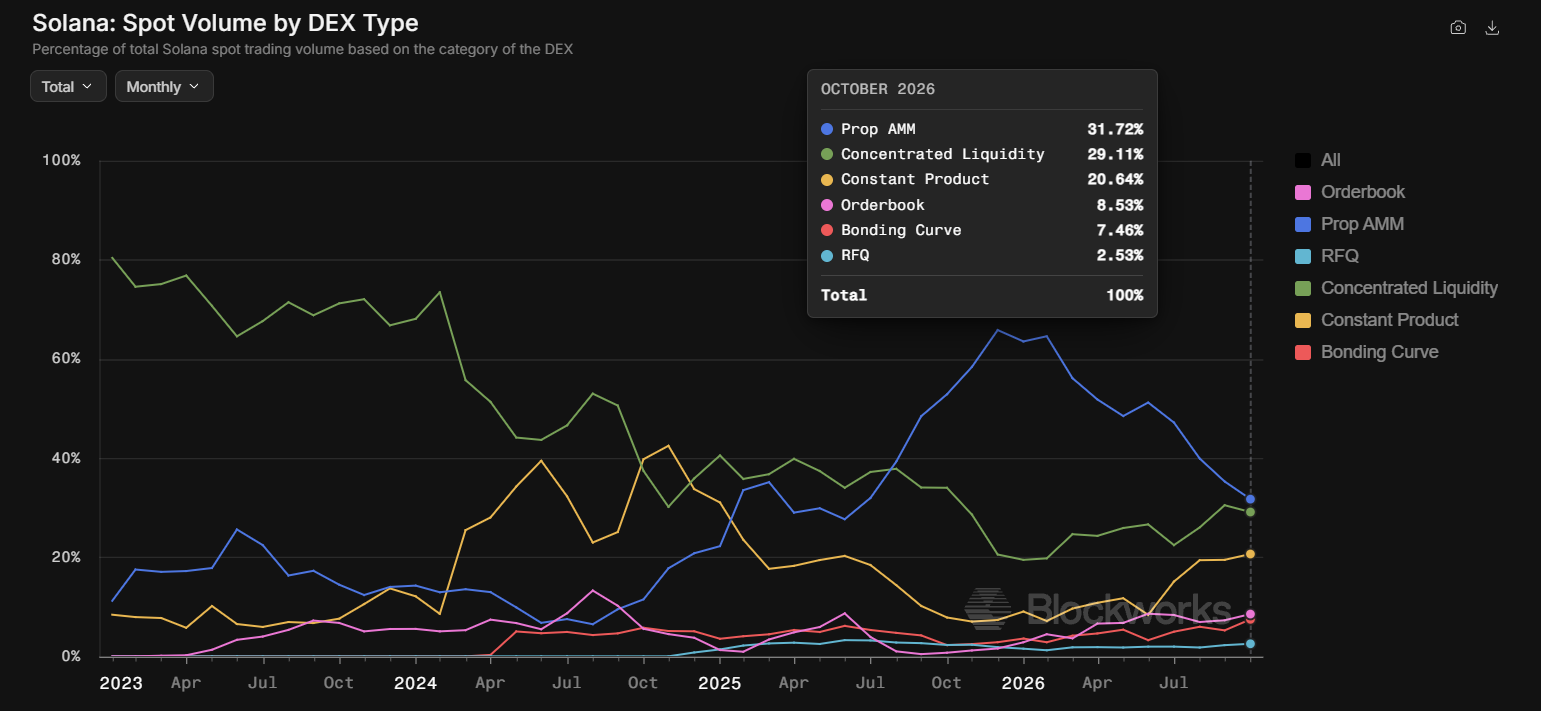
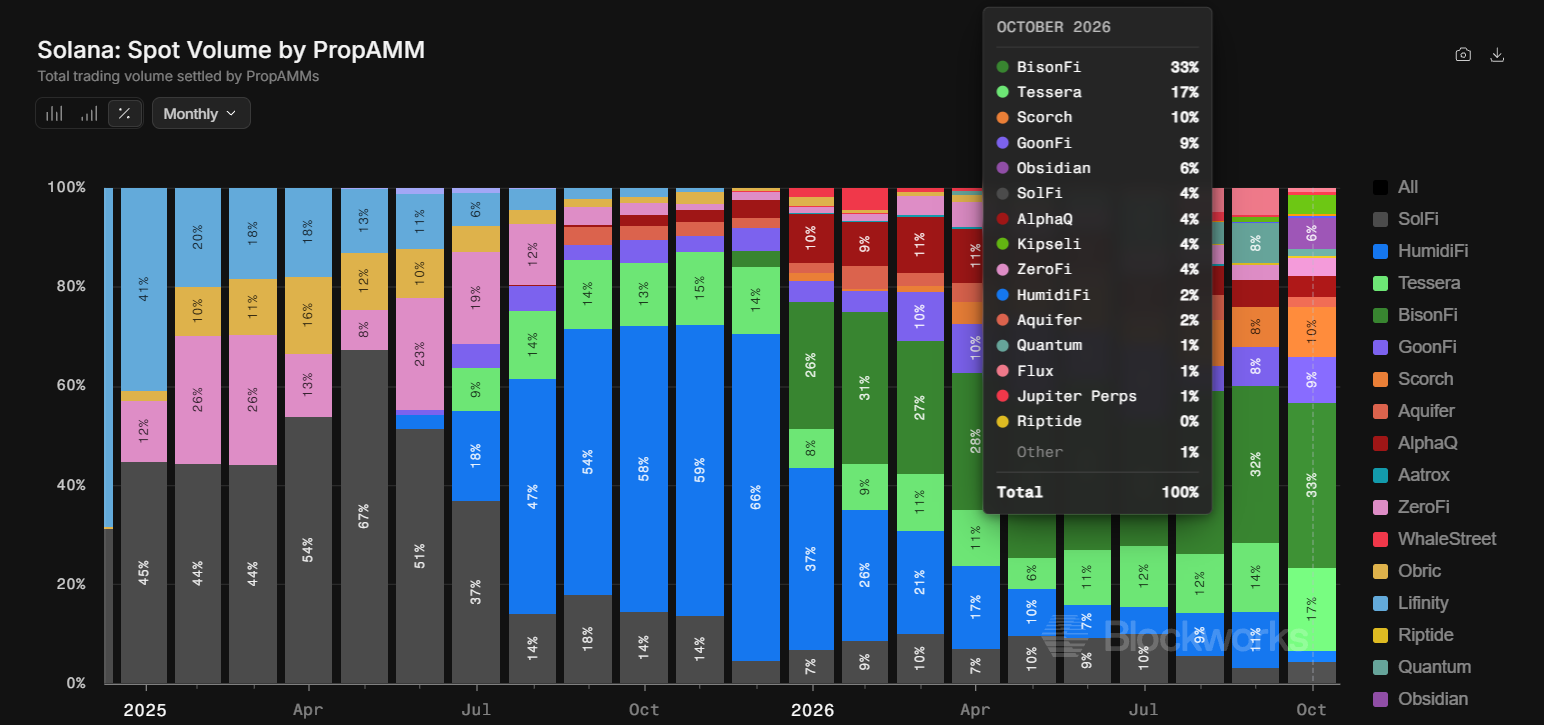
The importance of this distinction lies in the fact that the DEX market serves two different trading environments. Prop AMM dominates assets with high liquidity and mature external prices, including trades with $SOL and stablecoins. Traditional AMM remains an important infrastructure for long-tail assets, which require liquidity pools to facilitate initial price discovery.
Aggregators such as Jupiter help determine in which venue a transaction will be executed by comparing quotes available at different venues and routing the transaction to the one with the more competitive price.
Are traditional AMM and Prop AMM becoming complementary to each other?
Changes in market share may reflect the evolution of asset trading methods, rather than the complete failure of a particular liquidity model. New tokens typically start trading through launchpad and traditional AMM pools, which provide initial price discovery for their markets. As successful assets gradually mature, attract external pricing, and gain access to more trading venues, their trading volumes may shift to Prop AMM.
Tokenized stocks reflect this distinction. Since such assets already have a reference price, they can bypass most of the initial price discovery processes involved in traditional pools. Traditional pools provide the infrastructure for price discovery for emerging assets, while once the assets form a mature market, tokenization handles a large portion of the subsequent transactions.
For further reading
- As Solana struggles to hold above $70, the withdrawal of $5.39 billion by Bitcoin has further deepened.
- Pump.fun launches block0 fees to prevent snipers and bundlers
- All the information about Solana that you need to know now