Key Points
- Before the opening on "Black Friday," NASDAQ had fallen by a cumulative 7.28% in November.
- Both major indices are likely to record their worst November performance since 2008.
- AI Valuation concerns and tightening monetary policy threaten market recovery
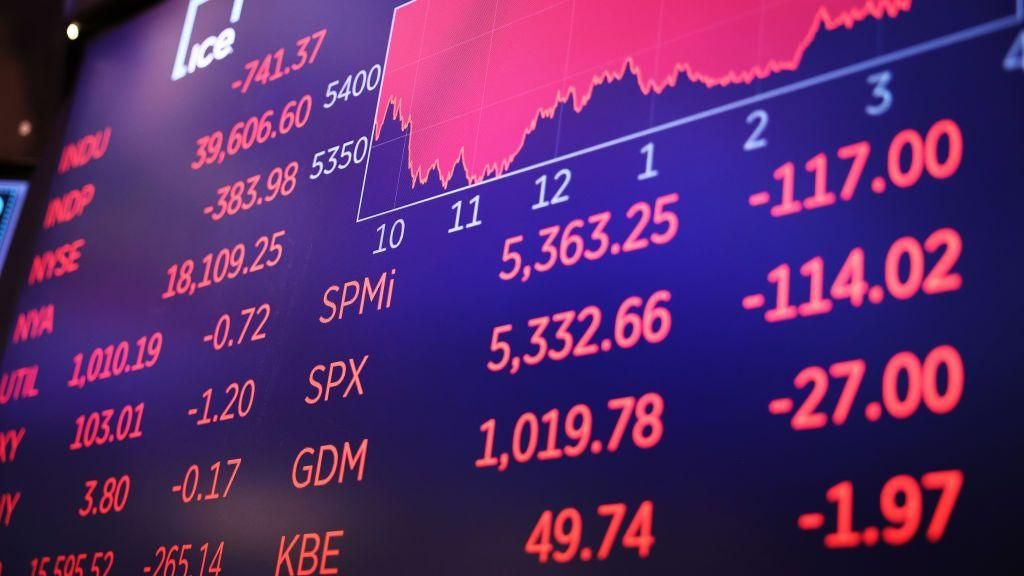
The S&P 500 Index and the Nasdaq Composite Index are on track for their worst November performance since the global financial crisis in 2008, although during the shortened trading session on Friday, there was renewed buying interest in the heavily hit tech stocks.
Nasdaq experienced a monthly decline of 7.28% before "Black Friday," while the S&P 500 index fell by 5.24%. During the same period, the Dow Jones Industrial Average performed relatively better, with a decline of about 3.07%.
Despite a significant rebound in the market on Monday after Jensen Huang resumed his role as NVIDIA's CEO, the monthly downward trend continues.
How much does NASDAQ need to rebound to avoid a historically terrible November?
According to NASDAQ historical data, the composite index closed at 23,585.80 points on November 25th, compared to 25,437 points at the end of October.
The performance of this index in November is approaching the levels seen during the global financial crisis; in November 2008, NASDAQ fell by 10.77%.
Between 2009 and 2025, the worst November performance for NASDAQ occurred in 2011, with a decline of about 2.39%.
To avoid a decline exceeding this level, the Nasdaq needs to close above around 24,829 points by the end of November, which means it would need to rise by approximately 5.27% from its closing price on Wednesday.
The S&P 500 index faces a similar challenging task of recovery, whereas the Dow Jones Industrial Average exhibits stronger resilience due to its different composition and lower exposure to some of the technology companies that experienced the largest declines.
According to the New York Stock Exchange trading calendar, trading will end at 1 p.m. Eastern Time on Friday, which means that Monday, November 30th, will be the last full trading day of the month.
Why are tech stocks leading the decline?
Unlike the financial crisis in 2008, this round of adjustments is mainly driven by concerns regarding valuations of technology stocks, investments in artificial intelligence, and restrictive monetary policies.
Investors are increasingly questioning whether the substantial funds invested in AI infrastructure will generate sufficient financial returns.
Even though NVIDIA's quarterly revenue reached a record $115.8 billion, it failed to stop the continued weakening of the semiconductor sector's valuation.
These concerns led to a decline on NASDAQ for several consecutive months, with the index falling by about 5.3% in October.
At the same time, the latest round of AI stock sales also demonstrates how concentrated exposures to semiconductor manufacturers and cloud infrastructure companies can amplify the broader index decline.
Can December bring about a recovery in the stock market?
Historically, December has usually been a favorable month for the U.S. stock market. However, persistent inflation and rising borrowing costs may limit the protective effect provided by seasonal trends.
The Personal Consumption Expenditures Price Index ( PCE ) for October rose by 3.8% year-on-year, further reinforcing market concerns that the Federal Reserve may further tighten monetary policy.
Higher interest rates will depress the present value of future profit forecasts for companies, and this impact is particularly evident for growth-oriented firms that rely on profits realized several years down the line for their valuation.
However, some Wall Street institutions remain optimistic. Deutsche Bank's forecast for the S&P 500 index suggests that, supported by expected growth in corporate earnings, this benchmark index will rise to 9,000 points by the end of 2027.