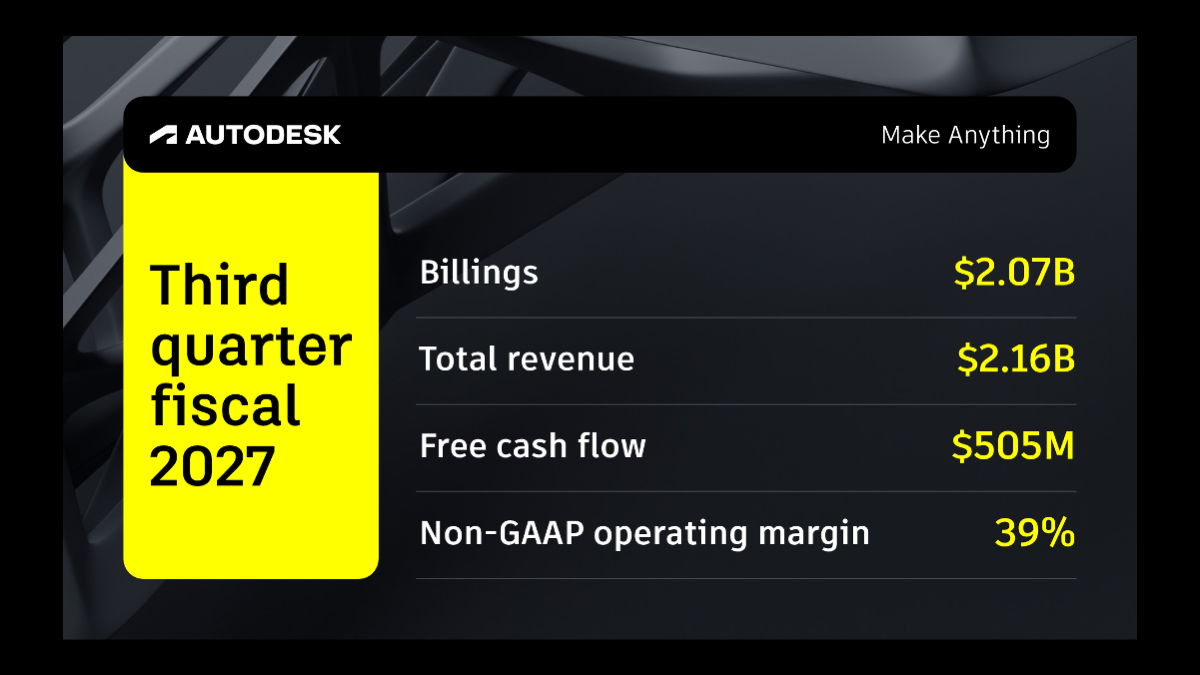


Autodesk reported revenue of $2.16 billion in the third quarter, a year-on-year increase of 17%. During the same period, deferred revenue that has not yet been invoiced under contracts decreased by 4%. For a software vendor that aims to bring AI into engineering drawings and construction sites, changes to the current contract terms were first reflected in the financial report.
This financial report was released on November 24th in the United States, with the reporting period ending on October 31st. At a fixed exchange rate, revenue increased by 14%. The bill amount for that quarter was $2.07 billion, a year-on-year increase of 12%, and the increase at a fixed exchange rate was 13%. Revenue, bill amounts, and amounts that have been signed but not yet fulfilled are recorded at different stages, and even the impact of exchange rates on them may vary.
The time saved by engineering consulting companies must go through quality inspection.
Autodesk cited a limited-scale test in their financial report analysis. A global engineering consulting firm told Autodesk that after adopting the workflow organized with AI, the time required to generate drawings was reduced by over 90%. They also estimated that, including the full production review and quality assurance processes, the net savings could still reach at least 50%. The former figure comes from the test, while the latter is an estimate after incorporating more steps.
The difference between these two approaches lies in the review and delivery processes. During the trial, the generation of drawings was faster, which indicates that the drawing production step can be shortened. However, in actual project delivery, the review and quality inspection still need to be included in the same workload schedule. Autodesk did not disclose the contract amount for this case, the scale of testing, or the actual savings from the formal project, nor was the revenue from AI product listed separately in the financial reports. To assess the potential for payment based on this case, the direct comparable factor is the total workload from the completion of drawing production to the completion of the review process.
Existing customer deployments provide another perspective for observation. Autodesk states that DPR Construction uses Forma Build and Rhumbix to connect construction preparation with on-site execution. A regional water supply company in the UK has expanded the scope of use for Forma, linking capital project delivery with water asset operations. On the manufacturing side, a company specializing in engineering and product development has chosen Fusion to extend its application from simulation to AI for auxiliary design. Since the cases involve different business processes, financial reports do not disclose the fees for each individual service.
The only item in accounting that can be separately identified by amount is MaintainX. According to Autodesk, the acquired company contributed nearly $33 million in revenue in its first quarter after the merger, and its business covers the maintenance and operation of existing assets. This figure measures the realized income from the acquisition, while engineering drawing tests measure the efficiency of the workflow. By separating these two aspects when reading financial reports, one can determine which step of the business expansion is responsible for the increase in revenue.
Invoiced and un-invoiced contract balances are represented by two separate lines.
By product family, revenue from construction, engineering, and construction services amounted to $1.097 billion, a year-on-year increase of 19%, accounting for approximately half of the total revenue. AutoCAD and AutoCAD LT generated $525 million in revenue, with a growth of 11%, while manufacturing-related revenue was $403 million, showing a growth of 13%. This quarter, the company reorganized its product family reporting, incorporating media entertainment and operational solutions into a new 'Other Products' category, and restated the previous related figures according to the current classification method.
The amount remaining to be fulfilled under the signed contracts, that is, the remaining performance obligations, amounted to $7.592 billion at the end of the quarter, representing a growth of 3%. Of this, deferred revenue was $4.231 billion, up 10%, while un-invoiced deferred revenue was $3.361 billion, showing a decrease of 4%. It is expected that the remaining performance obligations for the current period to be recognized in the near future will amount to $5.302 billion, with a growth of 10%. Within the same table, the balance of recent contracts is increasing more rapidly than the total balance.
The company stated that reducing multi-year contract discounts will help to improve the actual transaction prices in the long term, while in the short term, it will slow down the growth of un-invoiced deferred revenue and remaining performance obligations. It is also gradually phasing out the multi-year renewal arrangements that converted from original maintenance plans to subscriptions. In the next quarter's review, un-invoiced deferred revenue and the remaining performance obligations for that period can be considered side by side. The former represents the portion that has not been invoiced since the contract was signed, while the latter provides a more accurate scope of revenue recognition. Looking at just one figure can easily lead to confusion between the contract period and the deliveries for that quarter.
There is another item in the income statement that requires separate accounting. According to U.S. accounting standards, the operating margin is 26%, which is unchanged from the same period last year, and the diluted earnings per share are $2.68. Approximately $105 million in tax benefits for this quarter came from approved adjustments to the treatment of certain R&D costs incurred outside of the United States. The company stated that this affects income tax under accounting standards, but has no impact on operating results, free cash flow, or adjusted earnings per share. The operating cash flow for the quarter was $518 million, and after deducting $13 million in capital expenditures, the free cash flow was $505 million.
The company has raised the midpoints of its full-year revenue and bill amount guidance, setting the revenue range at $8.36 billion to $8.375 billion, while the full-year free cash flow guidance remains at $2.725 billion to $2.75 billion. The guidance includes MaintainX, with the fiscal year ending on January 31, 2027. The productivity changes brought about by AI testing are currently only visible in customer cases, but there are already verifiable financial records for contract duration, merger and acquisition contributions, and cash flows.