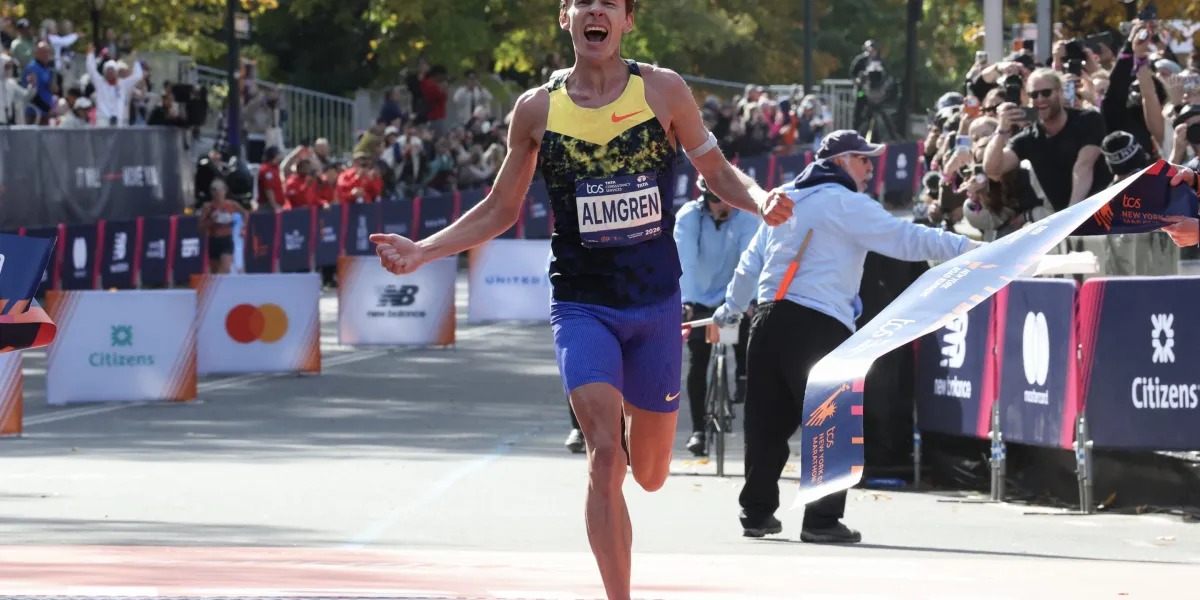


Swedish track and field star Anders reas Almgren ( Andreas Almgren ) won the men's championship at the 2026 New York City Marathon, which he participated in for the first time earlier this month, wearing the Nike Apex racing shoes that will be launched in January. This provides an excellent opportunity for this troubled sports apparel giant to enhance its credibility among serious runners.
Nike has placed Almgren in a central position in its promotional efforts; last week, he even discussed the advantages of this Nike shoe during the company's Investor Day event. Nike also paid for the insert page published by The New York Times on the day following the marathon, which listed the names and results of most of the participants. Last week, Nike renewed its sponsorship agreement with the Chicago Marathon, extending it until 2036; the Chicago Marathon is the only major marathon event for which Nike serves as the primary equipment sponsor. Nike also renewed its sponsorship of the Portland Marathon and announced last month that it had reached an agreement with the San Antonio Marathon.
Overall, these measures indicate that Nike is attempting to repair the damaged relationship with the running community, a relationship that has also hindered its slow recovery. It is very likely that Nike will apply this strategy to other areas of sports that have been criticized for neglect, such as training, football, basketball, and outdoor activities.
Chief Executive Officer Elliot Hill ( Elliott Hill ) told Wall Street analysts last week: "We are re-establishing deep relationships with the running community through offline activities and working with running experts. Our running business is the first example that proves the effectiveness of our model."
Nike's running business had already gone through several tough years before Hill was hired as CEO in 2024 in an attempt to stop the decline of this sports footwear giant. Nike shifted its focus from large wholesalers to direct sales through its own stores and website, but in doing so, it lost a significant amount of influence over independent running stores, which are key channels for reaching more serious runners. This decision proved to be costly: according to data from Euromonitor, between 2016 and 2025, Nike's market share in the $90 billion US sports footwear market dropped from 40% to 30%. This misstep coincided with the rise of the running boom, and Nike largely missed out on this trend; the company focused on limited-edition and lifestyle sports shoes rather than innovative running footwear, allowing competitors such as Hoka and On to take market share.
Hill said, "We are reminded that to lead a movement, one must be part of it. We must start from the athletes and the problems we need to solve."
Nike's running business has now seen growth for nine consecutive quarters, with double-digit growth in the last six of those quarters. (Nike does not disclose the sales figures for this business separately.) Nike President Amy Montagne ( Amy Montagne ) told investor analysts last week that the recovery of this business has been strong enough, and its brand ranking has risen from fifth to third in the past 12 months.
Montagne said, "We must serve every runner, whether they are elite runners chasing records or those who are training for their first 5-kilometer run in life."
The New York Times insert after the marathon also reflected this inclusive tone; it included a tribute to the race course and runners from Nike, and concluded with the sentence: “I can cross the finish line anywhere.” This stands in sharp contrast to an advertisement Nike placed before the Boston Marathon in April, which seemed to mock slower runners and gave off a sense of being detached from reality, even a bit harsh.
Hill and Montagne told investors last week that they hope to use the running business as a model to update the company's approach in other sports categories, but the market wasn't convinced. On the company's investor day, Nike's stock price fell by 6%, while the S&P 500 index dropped by 1%. Nike executives stated that the company's revenue is expected to resume growth in fiscal year 2029, with an anticipated annual increase of $5 billion by the end of fiscal year 2031. (Based on the previous fiscal year as of May, Nike's revenue was $46.4 billion, which represents a 2% decrease from the previous year after adjusting for exchange rate fluctuations.) Since Hill took on the role of CEO two years ago, Nike's stock price has fallen by 60%.
The changes at Nike are not limited to the marketing aspect. Hill stated that the design of running shoes and clothing now places greater emphasis on maximum cushioning, new materials, as well as stronger support and stability.
These updates may be more in line with what investors want to hear. Robert DeBour, Managing Director and Consumer Retail Analyst at BTIG, wrote in a research report: "Product innovation remains one of the most important catalysts for Nike's recovery."