

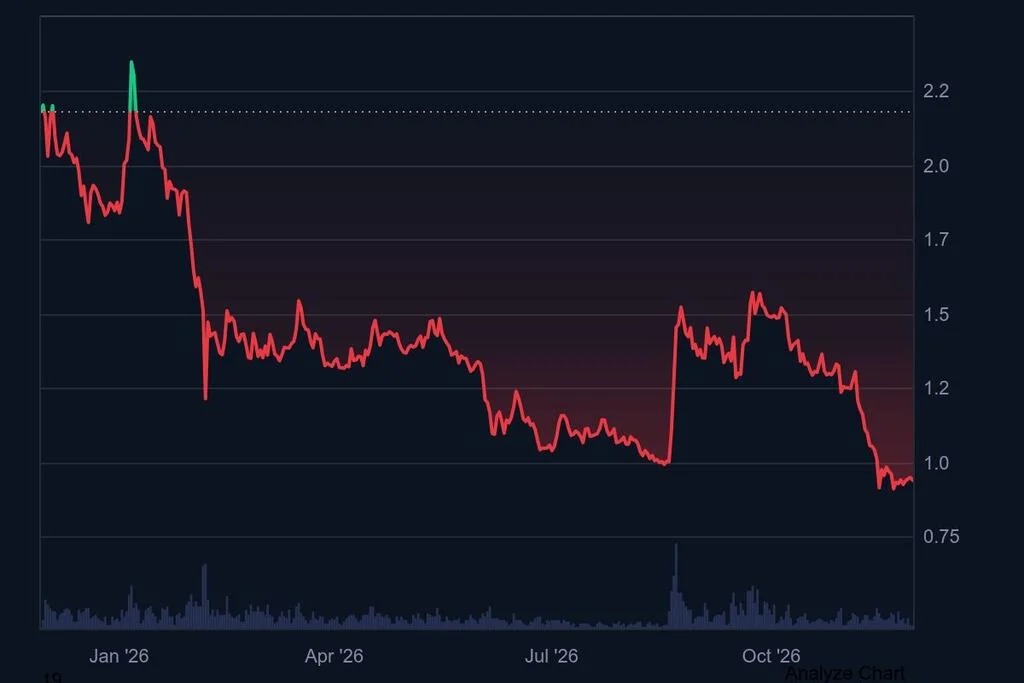
XRP is entering the last month of 2026, a year that has seen one of the steepest monthly corrections in recent times. The token fell to around $0.86 in November, reaching its lowest level since November 2024, before rebounding to around $0.95.
Although this rebound has provided some comfort to holders, it has not yet formed a sustainable bullish trend. On November 28th, XRP was still below $1, with a trading price of around $0.94, failing to maintain the earlier rebound gains.
The $1 level has become an important psychological and technical milestone. Regaining this level would indicate a significant improvement in market sentiment, however, briefly reaching this price does not necessarily mean that the trend has truly reversed.
To stabilize XRP at $1 by the end of 2026, buyers need to prove their ability to hold this level during subsequent pullbacks. Ideally, this should be accompanied by more robust spot market activity and sustained demand.
XRP Price faces a critical resistance level
The callback in November caused XRP to break below several important technical indicators, including the 50-day, 100-day, and 200-day exponential moving averages.
According to the technical structure in the original market data, these moving averages are located around $1.13, $1.20, and $1.30 respectively.
The first challenge to face is to regain the level of $1 and establish it as a support level. If it can remain above $1, the short-term outlook will improve. However, to achieve a more significant reversal, XRP still needs to break through the range of $1.09 to $1.13.
After the lows in November, momentum indicators have improved. A bullish crossover of MACD occurred, and the Relative Strength Index has also rebounded from a deeply oversold area.
However, these two indicators still indicate that the market is merely attempting to stabilize, rather than having entered a confirmed upward trend. The price structure of XRP still reflects the impact of a broader range of corrections.
Institutional demand or factors that could contribute to a rebound for XRP
Institutional demand remains another important factor in the year-end outlook for XRP. US spot XRP exchange-traded funds experienced a large-scale outflow of funds in November, and by late November, the monthly net outflow was reported to be close to 30 million US dollars.
Selling pressure coincided with the time when XRP fell below $1, triggering concerns about a decline in institutional interest in the market.
These inflows are encouraging, but they are not yet sufficient to constitute a sustained trend. Investors need to observe whether institutional buying will continue into December and whether it will be able to offset the selling pressure from other aspects of the market.
Derivative activities also need to be interpreted with caution. The figures cited from the original market data show that there are 1.95 billion outstanding contracts for XRP futures.
The vast derivatives market helps to provide liquidity, but merely having a high number of open contracts does not indicate whether traders are betting on a rebound or a further decline.
Therefore, as XRP approaches the $1 resistance level, the balance between spot demand and leveraged positions will still be of great importance.
Large-scale trader activities have also raised doubts about the strength of the rebound for XRP. Wallets holding between 10 million and 100 million XRP reduced their holdings by a total of 2.9% in November, dropping to approximately 13.25 billion XRP.
If this distribution continues, it may limit the token's ability to rebound, especially in a situation where retail demand remains weak.
Whale activity does not necessarily determine the direction of the market, but it can help to determine whether large holders are increasing their positions during a pullback or reducing their risk exposure.
For XRP to experience a stronger rebound, ideally, the market should show signs of re-accumulation, and at the same time, the cash flow of ETF should improve, as well as the volume of spot trading.
As cryptocurrency traders enter the last few weeks of 2026, the possibility of a Christmas market trend has also begun to attract attention.
Historically, the end of December has sometimes brought stronger performance to financial markets. However, seasonal patterns are not reliable, and the cryptocurrency market may not follow the same trends as the stock market.
The outlook for XRP largely depends on whether the broader digital asset market can recover from the sell-off in November.
Bitcoin has faced significant pressure this month, with declining prices and the outflow of ETF funds jointly dragging down the sentiment of the entire cryptocurrency sector.
When Bitcoin experiences a significant decline, investors tend to reduce their exposure to other cryptocurrencies, especially those that have already suffered substantial losses.
If Bitcoin continues to rebound, the situation could be the opposite, prompting investors to reconsider their positions in XRP and other large-cap altcoins.
However, the so-called Christmas market trend not only requires a brief rebound in Bitcoin prices. The market also needs to show that selling pressure is weakening, institutional capital outflows are slowing down, and liquidity is flowing back into riskier assets.