The retail buying that once supported each round of U.S. stock market corrections is quietly withdrawing.
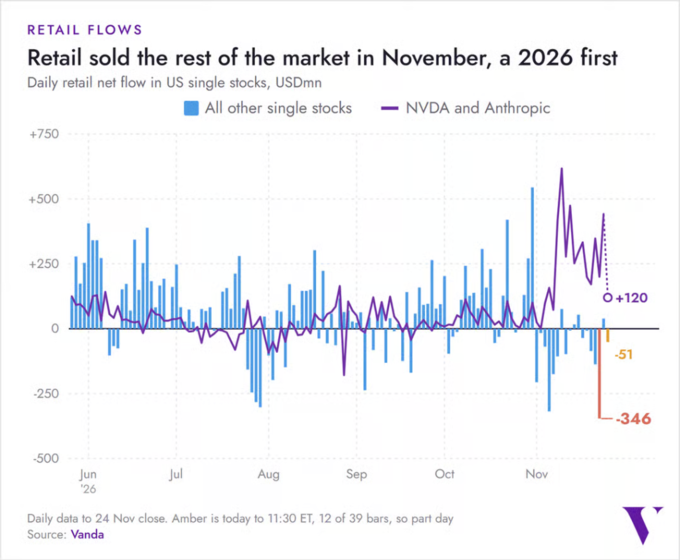
The latest report from Viraj Patel indicates that, after excluding NVIDIA and Anthropic, November saw the worst month for retail investors in terms of net inflows into other stocks since the outbreak of the pandemic, with net sales reaching $1.4 billion. Meanwhile, NVIDIA and Anthropic absorbed approximately $4.4 billion in retail funds during the same period – the enthusiasm for buying at low prices has not disappeared, but it is highly concentrated in these two companies. The conclusion from Patel is straightforward: "Retail investors in 2026 are a completely different breed; they are no longer willing to act as the last buyers during stock market corrections."
The timing of this shift is particularly striking. On Monday, NASDAQ soared by nearly 7%, but retail investors sold a net $346 million in stocks other than the two mentioned above, marking the largest single-day net sale since March 2020. Retail investors chose to take profits during the rebound rather than buying on dips.
Goldman Sachs' Mark Wilson pointed out in its "Weekly Review" that professional investors have completed large-scale position reductions over the past few weeks, and their position settings have become relatively clean, but they have not yet reached a point of complete surrender. The combination of these two factors has weakened the market's traditional buffer mechanisms simultaneously.
Breadth collapse: Retail investors shifting from "buying anything" to "selling anything"
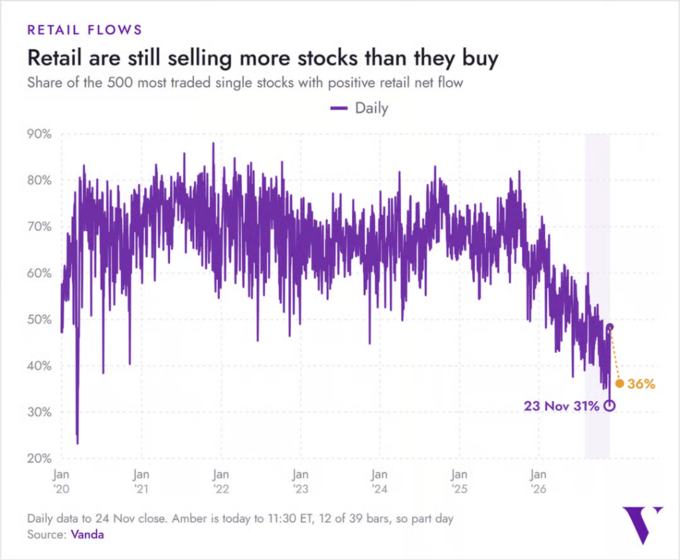
The indicator tracked by Patel is the proportion of net purchases by retail investors in the 500 most active U.S. stocks. He pointed out that retail investors used to be "almost all-in" FOMO type investors, but this proportion has been continuously declining from around 70% in the third quarter of 2025 to 42% this quarter, and has remained below 50% for 37 consecutive trading days.
On Monday (November 23), this ratio dropped to a post-pandemic low of 31% – that is, retail investors only made net purchases in about 30% of the stocks, with the remainder being net sales. After a slight rebound to 48% on Tuesday, it fell back to 36% again on Wednesday morning.
Looking at the monthly data, November was the first month of this year when retail investors made an overall net sale in the “rest of the markets.” Excluding NVIDIA and Anthropic, there was a net sale of $1.4 billion; however, these two stocks attracted approximately $4.4 billion in retail investor funds during the same period.
Selling as soon as the market opens: Habitual selling replaces reflexive bottom-fishing.
Intraday data is also worth paying attention to. Patel points out that retail investors have "become accustomed to selling at the opening of trading": for eight consecutive trading days, retail investors have been net sellers in the first ten minutes of trading. By the close of midday on Wednesday, the net outflow of funds from stocks (excluding NVIDIA and Anthropic) was approximately 51 million US dollars, of which 32 million US dollars occurred in the first ten minutes of trading.
What is more telling is the rhythm of trading during the session: within the ten-minute period when the S&P 500 fell, retail investors sold a net amount of about 23 million US dollars; during the period when the index rose, they only bought a net amount of about 4 million US dollars. This is in stark contrast to the reflex of "buying on dips" that has been observed since 2020.
Patel wrote that the weakness on that day 'was partly driven by retail investors giving up, which may have been synchronized with systematic and institutional investors.'
It is worth noting that the aforementioned sales mainly came from the individual stock level. During the same period, despite a roughly 20% pullback in the Nasdaq, leveraged funds ETF still made purchases amounting to about $20 billion, while equity funds ETF exceeded $200 billion in their buying volume. Goldman Sachs' Lee Coppersmith specifically distinguished between "retail investors" and "retail traders" in its report: the former continued to enter the market through fund channels, while the latter were quietly withdrawing.
Professional investors: Positions have been liquidated, but they haven't completely surrendered yet.
Goldman Sachs’ Mark Wilson provided an institutional-side perspective. He noted that Goldman Sachs’ hedge fund VIP basket (the most crowded long position portfolio) has lagged behind the S&P by about 14 percentage points over the past six months, which is comparable to December 2008 (-13 percentage points) and close to the post-pandemic trough in May 2022 (-15 percentage points). Previously, an article from Wall Street Journal wrote that Goldman Sachs’ Tony Pasquariello had indicated to clients that the past eight weeks represented “one of the largest liquidations” it has seen.
From a valuation perspective, Wilson points out that the forward P/E ratio of the MSCI market has compressed by about 20%, which is among the most extreme valuations contractions in the past 40 years. Unlike in the past, analysts still predict healthy double-digit earnings growth per share for next year.
However, does this mean a complete surrender? The answer from Wilson is “not yet.” Goldman Sachs’ cross-asset strategist Christian Mueller – Glissmann’s risk appetite indicator ( RAI ) fell to around -1 over the weekend, and Wilson described it as “close to a real surrender,” but it still has not reached the historical range of -1.5 to -2, which is considered a strong buying signal.
Meanwhile, according to LSEG Lipper, within the week up to this Wednesday, US equity funds saw outflows of $30.6 billion, representing the largest single-week outflow since early September. The funds that previously supported the belief that "retail investors are still involved" have also begun to show signs of weakening.
Wilson has a constructive view of the market situation: After experiencing valuation compression, position clearing, and emotional reset, he believes this has laid a "cleaner foundation" for re-pricing in 2027. However, he also acknowledges that current volatility still leads many people to choose to continue reducing their risk exposure rather than increasing their positions.
The data from Patel points to a more direct issue: clean position setting requires buyers to come through with their commitments. In the past five years or so, there was always a group of buyers who would inevitably enter the market during pullbacks. However, nowadays, they are selling at the opening of each session, selling whenever prices fall, and also selling when prices rise – except for two stocks.