The long-term growth prospects of the humanoid robotics industry are colliding with the current valuations of leading companies.
On November 27th, Yushu Technology's stock price rose by 19.9% to 798.70 yuan, with a total market value of approximately 323 billion yuan. Just one trading day prior, Goldman Sachs covered Yushu Technology for the first time, assigning a "sell" rating with a target price of 347.1 yuan, which implied a potential decline of about 48% compared to the day's closing price of 666 yuan. As Yushu's stock price subsequently hit the daily limit up, the gap between Goldman Sachs' target price and the market price further widened.

Goldman Sachs is not bearish on the humanoid robot industry. On the contrary, the bank expects global shipments of humanoid robots to increase from 75,000 units in 2026 to 6.5 million units in 2035, with a market size reaching $138 billion. The real question is: which companies will ultimately benefit from this industry growth? Will Yushu be able to maintain its market share and sustain high profit margins amidst increasing competition in the industry?
Jacqueline Du, the head of industrial technology research at Goldman Sachs China, pointed out in the report that current valuations seem to have already taken into account expectations such as Yushu ranking among the top three globally by 2035, achieving over 15% of global sales share, and maintaining at least 25% operating profit margin in the long term. However, the company has not yet proven its ability to maintain market share in productivity-oriented use cases, nor has it demonstrated that its long-term profit margins are resilient.
In other words, the market has already begun to price Yushu based on a globally leading robotics company with sustained high profitability, but these long-term competitive advantages still need to be verified.
From "the iPhone in the robotics laboratory" to factory competition, Yushu faces new challenges
Goldman Sachs acknowledges that Yushu indeed possesses a strong competitive advantage.
In 2025, Yushu will account for 36% of the global shipments of humanoid robots, with its share of quadruped robot shipments reaching 63%. Low-cost self-developed actuators, leading motion control capabilities, and a wide influence among developers and universities collectively constitute the company's early advantages.
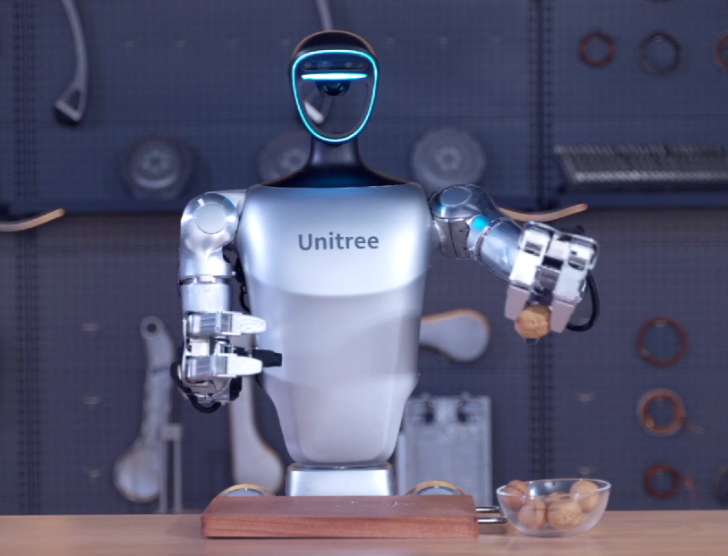
The Goldman Sachs team in Hong Kong even referred to Yushu as "the iPhone in the robotics laboratory" ( iPhone for robot labs ). Its G1 robots have become an important testing platform for embodied intelligence research, and Apple's latest HALO system was also tested on G1. For scientific research institutions that need to rapidly carry out robot development, algorithm verification, and data collection, Yushu provides a relatively mature and cost-competitive hardware platform.
But Goldman Sachs believes that being the most popular robot in the laboratory does not equate to winning in the factory.
YuShu's early market advantages mainly came from scenarios such as scientific research, education, stage presentations, and data collection. As humanoid robots transition from being used for technical demonstrations to practical productivity applications, customer needs are changing. Goldman Sachs predicts that the global share of robot shipments in scientific research and education scenarios will decline from 26% in 2026 to 2% by 2035, while the share in industrial applications is expected to rise from 26% to 39%.
This means that in the future, the focus of competition among robot manufacturers will no longer be solely on motion control, hardware costs, and product display effects, but also on reliability in complex industrial environments, task execution capabilities, and the efficiency of large-scale deployment. Whether Yushu can replicate its leading advantages from laboratory settings to factory environments remains to be seen.
Based on this assessment, Goldman Sachs expects that YuShu's global humanoid robot market share will decline from 36% in 2025 to a probabilistically weighted 6% by 2035. This forecast includes two scenarios: Goldman Sachs assigns a 40% probability that YuShu will be able to rank among the top three globally and achieve a market share of about 15%; another 60% probability corresponds to a further decline in its market position.
In addition to leading hardware, AI's capabilities determine the long-term competitive barriers.
In addition to market share, Goldman Sachs also raised another question about Yushu's technical competitiveness: Can the hardware advantages be transformed into complete robotic intelligence capabilities?
In Goldman Sachs' assessment of 20 global humanoid robotics companies, the evaluation criteria included AI "brains," motion control, data, hardware, commercialization, and manufacturing capabilities. Yushu was categorized in the third tier, with its main advantages lying in motion control, low-cost hardware, and brand influence.
This does not mean that Yushu lacks technical competitiveness; rather, there is still a gap between it and some leading companies in terms of the AI model and data advantages.
Goldman Sachs is particularly concerned about the potential impact of the externalization of AI capabilities. If more and more robot manufacturers are able to access similar cutting-edge AI models, the underlying intelligent capabilities may no longer be a unique competitive advantage for individual manufacturers. External AI models can help accelerate the commercialization of robots, but they may also reduce the differentiation between different hardware manufacturers, focusing competition further on cost and product iteration speed.
Goldman Sachs pointed out in the report that external AI may both drive commercialization and reduce the degree of differentiation among manufacturers, thereby intensifying competition and posing a risk of declining profit margins.
Yu Shu is also increasing its investment in the capabilities of AI. According to the fundraising arrangements disclosed in its prospectus, the company plans to invest 2 billion yuan of the raised funds in the AI basic model project, which accounts for approximately 48% of the total 4.2 billion yuan raised. Of this amount, the investment will be mainly focused on building the "brain" of the robot and the "cerebellum" for motion control.
For Yushu, the future not only requires proving its ability to manufacture robots with outstanding performance and competitive costs, but also demonstrating its capability to establish autonomous and sustainable advantages in intelligent technology.
Selling prices continue to decline, Goldman Sachs expects profit margins to come under pressure
Even if Yushu is able to continue to increase its shipment volumes, price competition may limit its profitability.
Goldman Sachs expects that the average selling price of YuShu humanoid robots will drop from 133,000 yuan in 2026 to 101,000 yuan in 2030, and further to 90,000 yuan by 2035, with an average annual decline of about 4%.
As the number of industry participants increases and product supply continues to expand, downward pressure on prices may become more apparent. Goldman Sachs expects that scaled production and vertical integration can help Yushu reduce costs, but the cost reduction may not be sufficient to fully offset the impact of declining product prices.
It is estimated that Yushu's gross margin will decline from 60% in 2025 to 40% in 2035, while its operating profit margin may drop from 23% in 2026 to 15% by 2035.
Changes in the sales structure may also bring additional pressure. Goldman Sachs expects that between 2026 and 2035, Yushu's average gross margin for its overseas business will be around 57%, which is higher than the 39% of the domestic market. If more sales in the future shift to the domestic market, changes in the product structure could also have a negative impact on the overall gross margin.
Goldman Sachs also tracked the rental prices of Yushu G1 robots. The report data shows that the daily rent on G1 approached 15,000 yuan during the Spring Festival in 2025, and then dropped to around 3,000 yuan. The corresponding payback period for investment also extended from about two months to about 12 months.
A decline in rental prices alone does not prove a weakening of demand across the entire industry, but it does indicate that increases in supply and changes in commercial returns in some use cases deserve attention. For robot manufacturers, what ultimately determines the sustainability of commercialization is not just the volume of shipments, but also the price customers are willing to pay and whether the investment in equipment can yield reasonable returns.
Behind Goldman Sachs' target price: Yushu needs to achieve both high market share and high profit margins
The target price of 347.1 yuan set by Goldman Sachs is not based on the assumption that Yushu will not grow in the future.
In fact, it is expected that Yushu's revenue will increase from 2.8 billion yuan in 2026 to 47.8 billion yuan in 2035, with a compound annual growth rate of 37%; net profit is expected to rise from 700 million yuan to 7.8 billion yuan.
Goldman Sachs uses a price-earnings ratio of 50 times the expected earnings for 2035 to value the company, and then discounts it to 2027 at a cost of equity of 12%. This calculation corresponds to a price-to-sales ratio of about 31 times for Yushu in 2027, which is significantly lower than the valuation level of about 60 times before the substantial increase in the stock price.
What truly determined Goldman Sachs' decision to "sell" was the combination of market share and profit margin.
In Goldman Sachs' valuation sensitivity analysis, for Yushu to receive significant valuation support, it needs to meet two conditions simultaneously: maintain a global market share of over 15% by 2035, and achieve or exceed an operating profit margin of 25%. This means that the company not only needs to become a leading robotics manufacturer globally but also needs to sustain a high level of profitability amidst intensifying competition.
However, in Goldman Sachs' baseline scenario, Yushu's global market share in 2035 is only 6%, with an operating profit margin of 15%. Even if the market share remains at 6% and the operating profit margin approaches 25%, the calculated results still indicate that the stock price is somewhat overvalued.
Therefore, the disagreement between Goldman Sachs and the market is not about whether the robotics industry has a future, but whether Yushu can achieve both a high market share and high profit margins. The former determines how large a share of the market a company can obtain, while the latter determines how much profit the company will ultimately be able to retain.
There is a huge disagreement on Wall Street's target prices, but there is still consensus on industry growth.
Goldman Sachs is not the only institution to provide a clear valuation assessment for Yushu, but there are significant differences among different institutions.
JPMorgan Chase once assigned Yushu a ‘reduce holdings’ rating at the beginning of October, with a target price of 300 yuan; subsequently, it raised the rating to ‘increase holdings’, with the target price significantly increased to 995 yuan. Its optimistic judgment is related to Yushu’s founder Wang Xingxing’s expectation of breaking through the physical AI barrier from a maximum of ten years to one to two years ahead of time.
Nomura assigned a “buy” rating on the first day of Yushu’s listing, with a target price of 370 yuan. In contrast, Goldman Sachs’ target price of 347.1 yuan seems much more cautious.
These differences reflect the inconsistent assessments by institutions regarding YuShu’s future market share, technological progress, and profitability. However, for the humanoid robotics industry as a whole, Wall Street’s long-term growth expectations continue to be raised.
Goldman Sachs recently estimates that the global humanoid robot market will reach $138 billion by 2035; Morgan Stanley has also repeatedly raised its forecasts for the shipment volume of humanoid robots in China, predicting that the Chinese market will see shipments of 446,000 units by 2030.
There may not be much dispute over the direction of industry growth, but the real disagreements lie in: who will be able to take a leading position in this growth, and how much of that growth will ultimately translate into profits.
For Yushu, the early hardware advantages and brand influence have helped it establish a market position. However, what lies ahead is more challenging commercial competition: transitioning from scientific research scenarios to industrial applications, moving from its strengths in motion control to breakthroughs in AI capabilities, and maintaining profit margins in the face of price competition.