

Rocket launches, vegan values, Doge coin – what do they have in common? Nowadays, each of them has its own exchange-traded fund (ETF). They are just a part of the record-breaking approximately 1,180 ETFs that have been launched in the United States this year; this number has already surpassed the total for the entire year of 2025.
The surge in ETF is far from what occurred when the first US ETF SPY was launched in 1993. Initially, SPY allowed investors to hold the entire S&P 500 index in a way that was cheaper and more tax-efficient than mutual funds. Today, according to data from the Investment Company Association of America, the number of US ETF has exceeded 5,200, managing assets worth $16.3 trillion.
Izak Ben-David, a finance professor at The Ohio State University who studies ETF, compares this market to the yogurt shelves in a supermarket. He says, “Why do you need so many different types of yogurt?” He adds that plain yogurt hardly makes any money, so companies turn to varying the ingredients to attract more niche consumer groups and charge higher prices as a result.
Broad-based index funds are like plain yogurt: they are inexpensive, and there is almost no difference between them across different issuers. In order to stand out, issuers offer funds based on themes that investors are currently passionate about, and in exchange, they charge higher fees. The question is whether investors truly get additional value as a result.
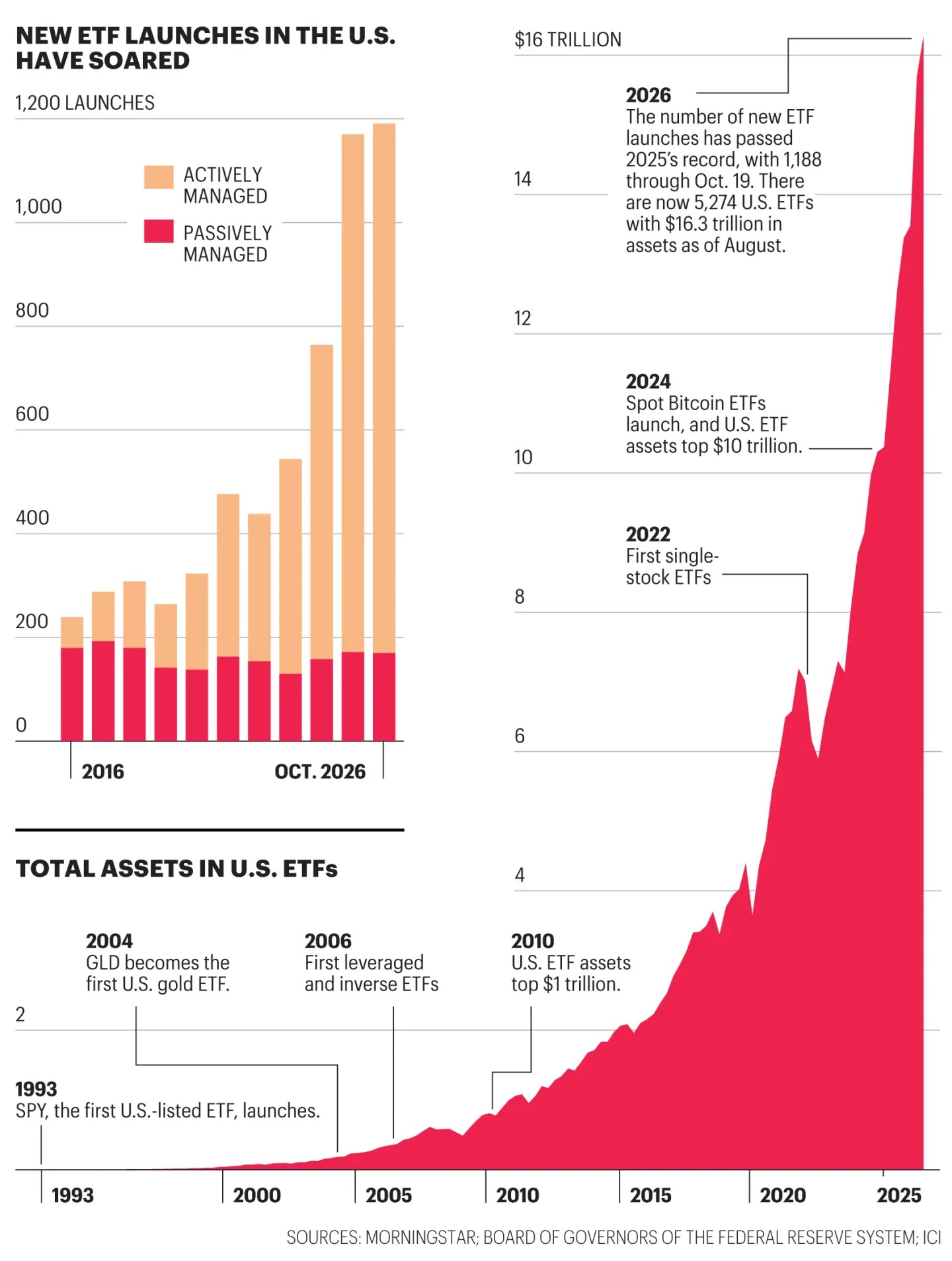
ETF There has been a major explosion in products, partly due to a rule introduced by the U.S. Securities and Exchange Commission (SEC) in 2019 that simplified the approval process for most new funds. At the same time, artificial intelligence has also reduced many of the remaining obstacles to launching new funds. Jeff Wenig, the chief investment strategist at Corgi Invest, said that the company entered the ETF sector just last December and now offers more than 220 ETF products, including those focused on popular consumer goods such as coffee and energy drinks, as well as products that specifically invest in hot industries like space and semiconductors. Aniket Ural of CFRA Research said, "There is a bit of a land-grabbing element to it," and added that the funds that succeed first in a particular category tend to end up dominating that category.
Of course, the majority of funds invested by ETF investors still flow towards the simplest and lowest-priced funds. This includes Vanguard S&P 500 ETF ( VOO ), which has an management fee of only 0.03% and became the first fund to reach a assets under management of one trillion dollars in June of this year.
Some investors are keen to pursue more “alternative” products, and this impulse is understandable, as a few funds have indeed delivered impressive returns. Among them is Breakwave Tanker Shipping ETF ( BWET ), which bet on the future trend of crude oil shipping costs and is expected to achieve a year-to-date return of 3411% as of mid-November. Other funds that have performed outstandingly include ZCSH, which tracks cryptocurrencies Zcash, as well as AIS focused on artificial intelligence; as of mid-November, these two funds had year-to-date increases of approximately 239% and 33%, respectively. In contrast, VOO only rose by about 9% during the same period.
However, Ben-David warns that although buying the right ETF at the right time can bring a significant boost to a portfolio, such funds tend to be disappointing in the long run. His research found that as of 2019, these funds lagged behind the market by more than 30% over a five-year period. Issuers often launch funds around themes that have already seen significant gains, so investors tend to buy in near the peak: “It’s like buying insurance only after the flood has passed.”
Ural stated that in addition to active funds, there are two other types of products that are driving the ETF craze. This year, about 30% of the newly launched products are leveraged or inverse funds, many of which make amplified bets on individual stocks. Another type of product that is growing rapidly utilizes options to shape returns; for example, buffer funds, which limit investors' returns in exchange for a certain level of downside protection.
Many of these funds will not exist for a long time. Data from CFRA shows that just this year alone, 259 ETF funds have closed, and they averaged only 1.3 years of trading. Just a few years ago, the average duration of closed ETF funds was still 2.5 to 3 years. Ural said, "This industry already has a mindset of rapid trial and error and quick failure, similar to that of Silicon Valley."
This article was published in the December 2026/January 2027 issue of “Fortune”, under the title “There’s almost everything ETF now, but that doesn’t mean they’re suitable for your investment portfolio.”