Key Points
- Google is seeking to obtain more computing power from SpaceX.
- Its current monthly fee for the existing protocol is $920 million.
- Despite the weakness in tech stocks, demand for infrastructure continues to persist.
While Wall Street is questioning whether artificial intelligence companies can justify their massive investments in infrastructure, Google still seems interested in securing more computing power from Elon Musk's SpaceX.
On November 28, Musk stated on X that Google has expressed its desire to rent more computing power from his company. The scale of any potential agreement and the financial terms have not been disclosed.
Google already has a computing power agreement with an annual value of $11 billion.
According to the documents submitted to the U.S. Securities and Exchange Commission (SEC) by SpaceX, on June 5th, the company signed a cloud service agreement with Google, allowing this tech giant to use approximately 110,000 NVIDIA GPU units as well as other computing components.
According to the existing computing power agreement, Google agrees to pay $920 million to SpaceX each month from October 2026 to June 2029.
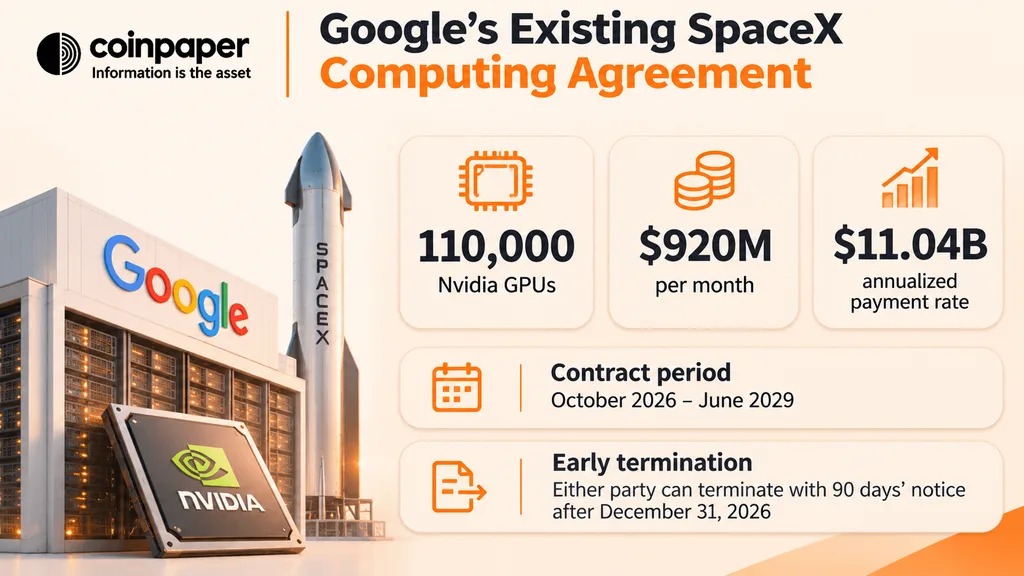
This is equivalent to an annualized payment rate of $11.04 billion. However, both parties can notify each other 90 days in advance to terminate the agreement after December 31, 2026, which means that the total potential value of the contract is not entirely certain.
Google's interest in additional computing power indicates that even its existing infrastructure commitments may not be sufficient to meet future computing demands.
Despite Wall Street's selling off, demand for AI continues.
Elashe's statement came during a particularly difficult month for tech investors. As the last trading day of November saw a shortened trading session, the Nasdaq Composite Index closed down 7.28% for the month of November, while the S&P 500 Index fell 5.24% during the same period.
Wider market corrections have intensified concerns among outsiders about whether AI can obtain sufficient returns from increasingly expensive data centers, advanced processors, and energy infrastructure.
However, a decline in the prices of tech stocks does not necessarily mean a decrease in demand for computing power. Alphabet disclosed in its financial report that its revenue for the third quarter was 127.6 billion US dollars, a year-on-year increase of 25%, and the number of users of its Gemini application reached 1 billion.
Some Wall Street analysts also believe that opportunities are emerging in the selling pressure. Investment bank JPMorgan Chase recently listed several technology stocks that could benefit from a rebound in valuations and the continued adoption of AI.
SpaceX is becoming the infrastructure provider for AI
It's not just Google that relies on the computing power of SpaceX. The company previously reached an agreement with Reflection AI worth up to $6.3 billion and has also established important commercial computing power partnerships with Anthropic.
These arrangements enable SpaceX to generate revenue from an infrastructure that supports both its own artificial intelligence ambitions and the needs of external clients, including Grok.
However, expanding computing power requires a large amount of upfront investment. SpaceX is reportedly still exploring additional GPU financing of about $40 billion to support the expansion of its infrastructure.
Therefore, the financial challenges of this company are similar to those of other AI infrastructure providers: it is necessary to ensure sufficient long-term customer revenue to justify the hardware purchases, financing costs, and operating expenses.
About the Author
Maya Bennett is a financial journalist with experience reporting on cryptocurrencies, stocks, and broader market trends. Her work focuses on Bitcoin, major digital assets, the stock market, monetary policy, as well as economic developments that influence investor sentiment. She is adept at transforming rapidly changing market news into clear and concise reports.