Key Points
- Telegram and Binance issue another security warning to iPhone users
- Outdated iOS versions may expose sensitive wallet credentials.
- Operating system updates can prevent the exploitation of these recorded vulnerabilities.
Telegram Founder Pavel Durov and Zhao Changpeng, co-founder of Binance, have recently issued another security warning to iPhone users, emphasizing a threat that goes beyond the security scope of cryptocurrency wallet applications themselves.
On November 27th, Durov announced that Telegram was sending reminders to users who were running the older version of iOS. The next day, Zhao Changpeng also issued a similar warning within the Binance ecosystem, which involved Trust Wallet, PancakeSwap, and Binance Wallet.
Why Hackers Don't Need to Intrude into Your Wallet
Unlike traditional phishing attacks that trick users into revealing sensitive information, exploitation of operating system vulnerabilities allows malicious web content to invade devices with those vulnerabilities.
In March 2026, Google's Threat Intelligence team documented two exploit frameworks: Coruna and DarkSword. Coruna targets versions 13.0 to 17.2.1 of iOS, while DarkSword targets versions 18.4 to 18.7.
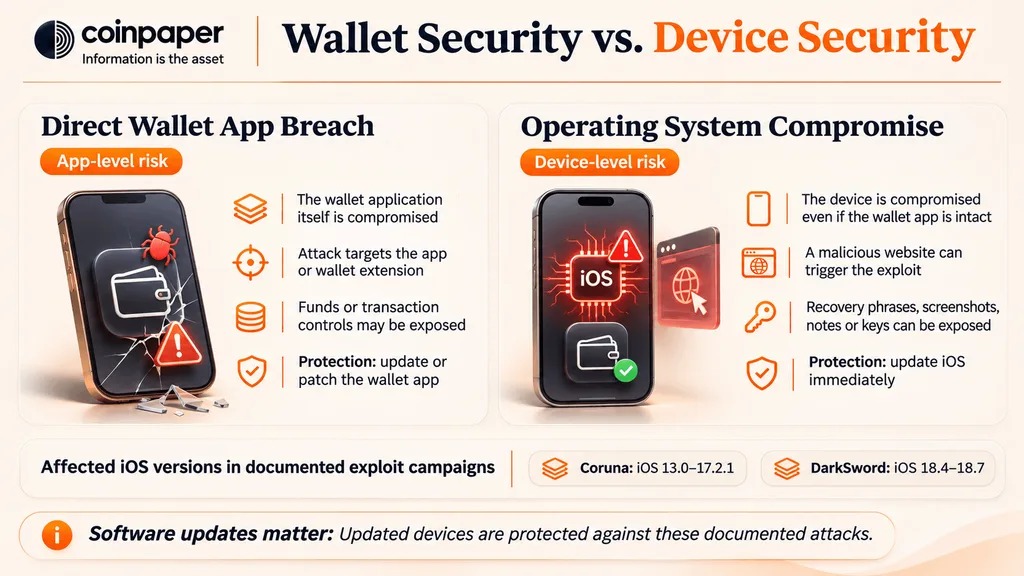
In a security announcement on November 6, Trust Wallet warned that these threats could expose cryptocurrency recovery phrases stored on vulnerable devices, including information saved in screenshots, photos, and memos.
The mnemonic phrase of a wallet allows the holder to regain access to their cryptocurrency assets. If someone obtains this mnemonic phrase, they may be able to control the related assets without having access to the original wallet application.
This is different from the previous Trust Wallet vulnerability, which involved security issues in its browser extension.
Why is it not enough to just update the wallet app?
Cryptocurrency assets exist on the blockchain, not in smartphones. Wallet applications are responsible for managing the credentials required to authorize transactions of these assets.
Although wallet developers can add encryption, biometric authentication, and alerts for suspicious transactions, these protective measures cannot eliminate all the risks that arise after an operating system is compromised.
Even hardware wallets cannot protect against all threats, especially when the recovery credentials are stored separately on a connected device.
Past incidents involving fake wallet prompts have already shown what consequences can arise from revealing recovery phrases. The exploitation of operating system vulnerabilities poses another type of risk, as victims may not be aware that they have already disclosed their credentials.
Which iPhone users are still at risk?
Apple has already fixed the vulnerabilities related to these recorded attacks. The company confirmed in its official security guidelines that devices running with the appropriate updated software are protected and will not be affected by the exploitation of these vulnerabilities.
Anyone who suspects that their recovery phrases have been compromised should consider that their wallet may have been hacked. Updating the operating system will not be able to retrieve the previously stolen wallet credentials.
Adrian Cole
Adrian Cole has been engaged in financial market reporting for over 6 years, with a focus on cryptocurrencies, stocks, and macroeconomic trends. He tracks Bitcoin, major altcoins, the U.S. stock market, interest rates, commodities, as well as data that drives market changes. Over the years, he has written hundreds of market updates and analysis articles, with an emphasis on price trends, investor sentiment, and the connections between traditional finance and digital assets.